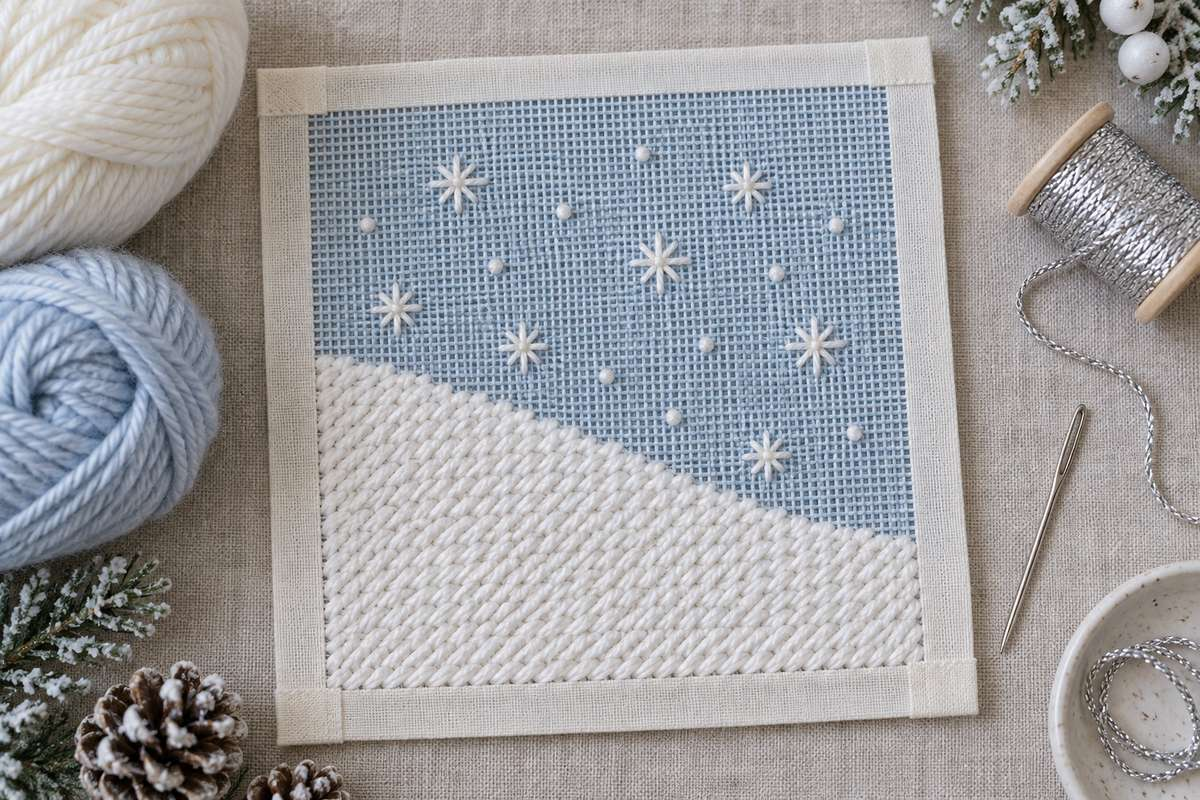
Snow is one of the most satisfying things to stitch on canvas: mostly one color, so the texture has to do the talking. The right stitch makes snow read as fresh powder, deep drifts or falling flakes; the wrong one makes it look like unbleached canvas. The teachers and shops agree on a short list - Nobuko for smooth snowfields, daisy and eyelet stitches for individual flakes - plus a sparkle thread to catch the light. This guide walks the choices, with the stitch and thread pairings the sources actually recommend. Last updated November 3, 2026.
Start here: For a smooth snowy hillside, use Nobuko stitch - it is the snow standby every source names. For individual snowflakes, use the daisy stitch (easy, ends every stitch in the center hole) or a lacy snowflake eyelet. Add shimmer with a fine metallic like Kreinik braid or Nordic Gold worked in the short stitches, and always test the stitch in the margin of your own canvas first.
Before you choose a snow stitch
Floss Field's which-stitch guide asks three questions that settle most snow decisions. First, size: a stitch with a large repeat needs room, so measure the narrowest part of the snow area - if two or three repeats will not fit, the stitch is too big for it and you drop to tent stitch. Second, role: should the snow sit back quietly (a small, low stitch) or join the design as a texture (a larger, more geometric one)? Third, paint: an open stitch lets a shaded painted canvas show through and read as depth, while the same stitch on bare white canvas can look stark. And its standing advice applies double for one-color areas: work a small square of the stitch on scrap or in the margin, in the thread you plan to use, before committing. Our stitch choosing guide covers the general framework.
Smooth, new-fallen snow: Nobuko
Every source's first answer for snow is the same stitch. Floss Field's snow line is one word - Nobuko, which it says reads as smooth, new-fallen snow. Serendipity Needleworks, the teaching site of stitcher Ellen Johnson, explains why: freshly fallen snow has little texture, and Nobuko's pattern of long diagonal stitches broken by small tent stitches implies just enough movement to give gently rolling hills subtle depth without busyness. Janet Perry of Nuts about Needlepoint backs it from practice - she used Nobuko for the snow on a Kirk & Bradley snowman ornament - and KC Needlepoint lists it in its stitch vault tagged simply: a great stitch for snow.
Serendipity's working notes: Nobuko is a true diagonal stitch, meaning each long stitch crosses the same number of vertical and horizontal canvas threads, so it follows a clean diagonal roadmap; it is a smallish stitch that fits ornaments to pillows and doubles as a good background stitch; and you can reverse the slant to change the direction of the drifts. Her thread pairing: Neon Rays for the long stitches and Kreinik Tapestry Braid #12 for the short tent stitches, one strand of each in a #22 needle on 18 mesh, laid smoothly with a laying tool. One stitcher's tip she repeats: Kreinik braid behaves better if you run it between your fingers a few times before threading, and keep cuts short, no longer than about 15 inches. Our Nobuko stitch guide has the step-by-step diagram.
Individual snowflakes: daisy and eyelet
For flakes rather than fields, Serendipity's pick is the daisy stitch: a small starburst where every straight stitch ends in the same center hole, which is what pulls the stitches into a flake shape. It is quick, genuinely easy - she recommends it for beginners and returning stitchers - and small enough to work on almost any canvas size, which makes it the natural choice for the little white dots scattered across holiday canvases. KC Needlepoint's stitch vault adds the lacier alternatives: a snowflake stitch and a snowflake eyelet stitch built from eyelet units, for flakes that read as openwork rather than solid stars. Our eyelet stitches guide covers the pulled-hole family those lacy flakes come from.
Threads that make snow sparkle
Real snow glitters, and the sources reach for fine metallics to get the effect without bulk. Serendipity's snow pairings: Kreinik Tapestry Braid #12 for the short stitches of a Nobuko snowfield - a single-strand braided metallic she calls easier, cheaper and washable against real metal threads - and Nordic Gold or Petite Silk Lamé Braid for daisy-stitch flakes. Nordic Gold is a fine chain-construction metallic, equivalent to about two or three strands of blending filament but stronger and pleasanter to handle, usable straight off the card in lengths under about 18 inches; Rainbow Gallery rates it for canvas up to 24 mesh. Floss Field's general rule matters here: sparkle comes from the thread, so keep the stitch quiet - a busy stitch plus a shiny thread on a large white area competes with your subject. For handling tricks, see stitching with metallic thread.
Snow as a background
Often snow is not the subject but the ground behind it - a snowman, a cabin, a cardinal. Floss Field's background table puts Nobuko on its large-background list alongside basketweave, brick, mosaic and Scotch, and its snow line confirms the same stitch carries both jobs. The discipline that makes it work as a background is the second question from the top of this guide: a small, quiet stitch recedes and lets the subject do the talking. So snow behind a detailed snowman wants plain Nobuko in a matte white wool or cotton, sparkle saved for a few flakes; snow as the whole point of the canvas can take the shimmer. Our background stitches guide and sky and water stitches cover the neighboring choices for winter scenes.
Where sources disagree
Is there really one best snow stitch? KC Needlepoint's vault lists several (Nobuko, snowflake stitch, snowflake eyelet), Janet Perry highlights three great ones, and Floss Field names exactly one - Nobuko. The apparent disagreement dissolves by job: for covering a snow area, everyone lands on Nobuko; the other stitches are for individual flakes and lacy accents. Pick by what your snow is doing, not by a crown.
Matte or metallic for snow? Serendipity happily mixes Neon Rays and Kreinik braid into snowfields, while Floss Field's snow entry assumes the stitch alone reads as snow, no shimmer required. Both work; the deciding factor is the canvas's mood. A folk-art snowman ornament takes sparkle well, a quiet landscape wants matte - and even sparkle fans should keep it to accents, since one or two decorative stitches are plenty for a small piece (Floss Field).
Perfect symmetry or not? Real snowflakes are six-armed but never perfectly symmetrical, as Serendipity notes, so a slightly irregular daisy-stitch flake is truer to nature than a rigid one. Eyelet-based flakes are the exception: their geometry is the charm, so keep those regular.
FAQ
What is the best needlepoint stitch for snow? Nobuko, for snowy areas - the one stitch Floss Field lists for snow, backed by Serendipity Needleworks, Janet Perry and KC Needlepoint. For individual flakes, daisy stitch or a snowflake eyelet (Serendipity; KC Needlepoint).
Which thread makes snow look real? White wool or cotton for the body; a fine metallic for sparkle - Kreinik Tapestry Braid #12 in Nobuko's short stitches, or Nordic Gold / Petite Silk Lamé Braid for flakes (Serendipity).
What stitch should I use for snow on an ornament? Nobuko scales down well - Janet Perry used it on a snowman ornament - and Serendipity calls it smallish enough for ornaments to pillows. Tight corners and curves can drop to tent stitch (Floss Field's size rule).
Can I use Nobuko for things other than snow? Yes - Serendipity suggests it for sand and as a general background stitch, and Floss Field puts it on its sky, water and large-background lists too.
How do I keep white snow stitches from looking flat? Let texture, not color, do the work: a directional stitch like Nobuko (reversing slant for drifting), a lacy eyelet for flakes, and a touch of metallic for light (Serendipity; Floss Field). And test on scrap first - Floss Field's standing rule.
Sources
- Serendipity Needleworks - Winter Threadventure: Snowy Narvik (Nobuko) (teacher Ellen Johnson, February 2019; Nobuko for smooth snow, true diagonal stitches, Neon Rays and Kreinik braid pairing)
- Serendipity Needleworks - Winter Threadventure: Snowflakes in Lillehammer (Daisy Stitch) (teacher Ellen Johnson, February 2019; daisy stitch for individual flakes, Nordic Gold and Petite Silk Lamé Braid)
- KC Needlepoint - The Stitch Vault: Stitches for Snow (a needlepoint shop, 2021; snowflake stitch, snowflake eyelet stitch and Nobuko tagged for snow)
- Nuts about Needlepoint - Three Great Snow Stitches (teacher Janet Perry, June 2022; three snow stitches, Nobuko used on a snowman ornament)
- Floss Field - Which Needlepoint Stitch to Use (a needlework guide site; the three choosing questions, the snow and background stitch lists, test-first habits)