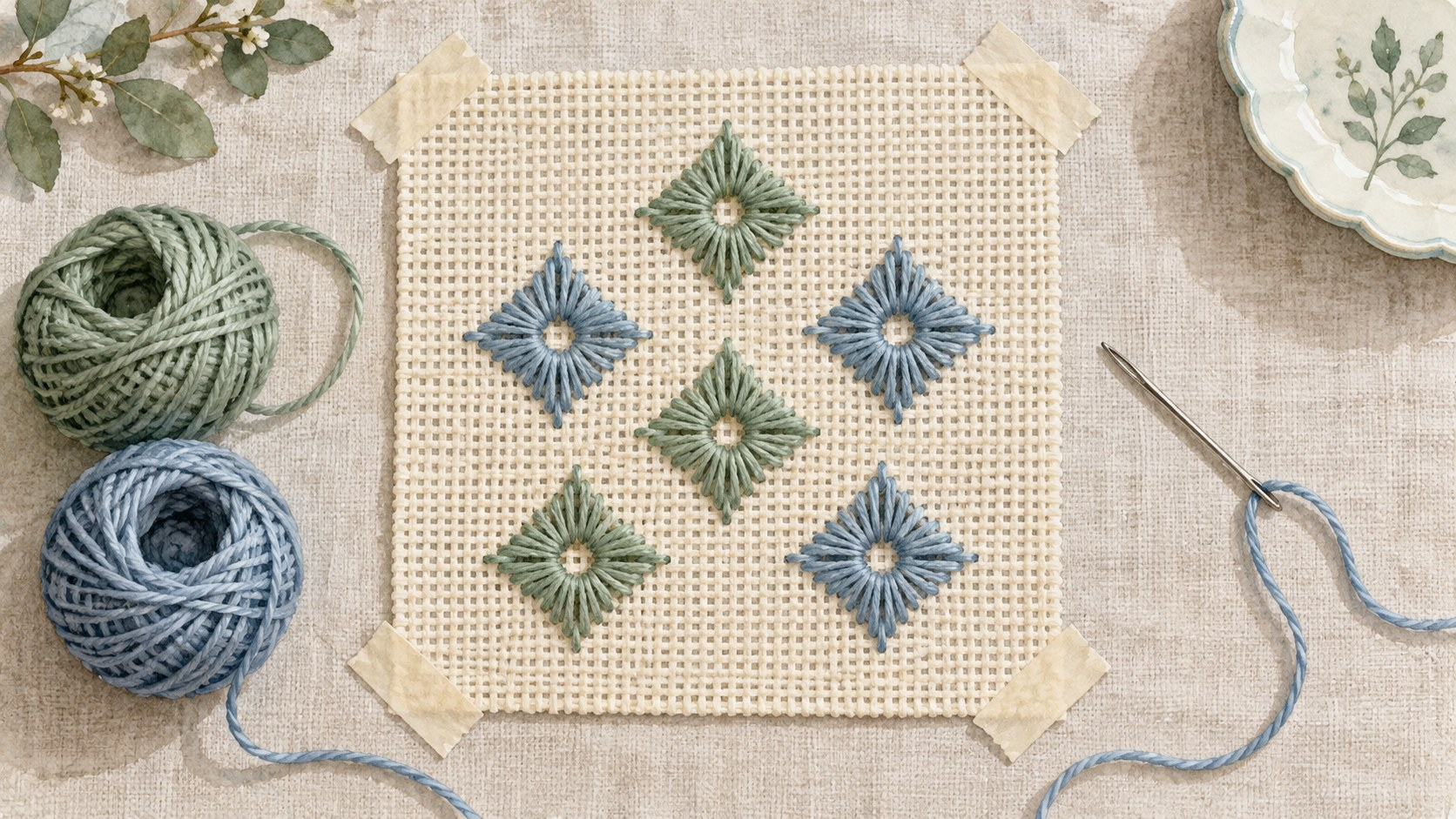
An eyelet stitch sends every stitch of a unit down into one shared center hole. Fan those stitches around a square and you get an Algerian eye; stretch the shape into a diamond and you get a diamond eyelet. Pull the stitches tight and the center opens into a real hole in the canvas, which is where the family gets its name. Eyelets are quick, lacy and surprisingly hard-wearing. Last updated October 23, 2026.
Start here: stitch a single Algerian eye over a 4-thread square in a light perle cotton. Come up at each of the four corners, then the middle of each side, always going down in the center hole. Eight stitches, one shared hole, done. Switch to a thinner thread than usual and a needle one size larger, and the center will open on its own.
What makes a stitch an eyelet
Ellen Johnson at Serendipity Needleworks gives the cleanest definition: eyelet stitches are unique because the individual stitches of a unit share a single hole. That is why eyelet diagrams only show odd numbers - the even numbers would all be crammed into the same tiny space at the center. Everything else about the family follows from that one fact: the shared hole crowds the thread, the crowd of thread can be pulled open into a visible eye, and the stitches always radiate outward like spokes.
The family is bigger than needlepoint. The RSN StitchBank records eyelets in whitework traditions going back centuries: small round eyelets appear in Guimaraes embroidery from Portugal, Madeira work, Ayrshire work and Broderie Anglaise, and the diamond eyelet features strongly in Icelandic embroidery, where it is called augnasaumur, literally "eye stitch," used to cover bed and cushion covers. On canvas, the two shapes you will meet most are the square Algerian eye and the diamond eyelet.
How to work an Algerian eye
The Algerian eye also answers to star eyelet, square daisy or star stitch (Serendipity Needleworks, Floss Field). Floss Field's version covers a square of four canvas threads:
- Corner to center. Come up at one corner of the square and go down in the center hole.
- The other three corners. Work the remaining corners the same way, always going down into the center.
- The four sides. Fill in the stitches between, from the middle of each side into the center. Eight stitches in all, and the unit is complete.
Worked in a row, each eye takes the next four threads, so neighbors share the holes along the side where they meet. Floss Field rates the coverage as lacy with an open center, lists it for stars, borders and lacy clothing and curtains, and notes one teacher calls it very hard-wearing even though the points of the star are long.
How to work a diamond eyelet
Stretch the square into a diamond and the logic stays the same: straight stitches radiate out from a central hole (RSN StitchBank). The RSN works it on a clock face - twelve stitches around the center, always taking the needle down into the same center hole, with a quick pull on each stitch to open the canvas threads. Worked as a filling, the RSN recommends a travel path: work a sequence of half diamonds on the outward journey, then complete the other half of each diamond on the return.
Needlework Tips and Techniques works its diamond eyelet over 16 fabric threads and adds two details worth stealing: start an eyelet one stitch away from a vertical or horizontal stitch, and pull each stitch towards the outside to enlarge the hole in the middle. To fasten off, pull the last stitch towards the center and slip the needle behind nearby stitches a few times.
Practical Embroidery points out a bonus for finishers: the reverse side of a diamond eyelet looks very similar to the front, and starting and finishing tails hide easily under the stitches - just plan the starting point ahead for bands and fillings so no jumping threads show on the back. Our neat-back guide has more on that.
Pulled or unpulled
Here is the choice that defines the look. The RSN StitchBank says the diamond eyelet can be worked as a pulled thread stitch, or without pulling the threads tight on even-weave fabrics such as canvas. Practical Embroidery agrees: pull the stitches on a looser weave and you form a real hole in the center; keep even, ordinary tension on a dense ground and the stitches stay flat and decorative.
On needlepoint canvas the mesh is open enough that a firm pull opens a small eye without distorting the piece, which is the effect most stitchers want. The RSN's whitework eyelet filling - twelve pairs of stitches pulled taut into a circle's center - shows the extreme: a large central hole with twelve small perforations around the edge. Interestingly, the RSN notes that stitch is not technically classed as pulled thread work, because it does not rely on counting the ground threads. On canvas, call it what you like; the physics is the same.
Threads, needles and the shared hole
The shared center hole drives every thread decision, and Serendipity Needleworks' three guidelines are the ones every stitcher should tape to their frame:
- Use a thinner, lighter thread than usual. All those stitches share one hole, and a thick thread crowds them.
- Use a needle one size larger than usual. Ellen recommends a #18 or #20 for 13/14 mesh canvas and a #20 or #22 for 18 mesh. The bigger needle pre-opens the center hole so the later stitches pass through cleanly.
- Nudge the canvas threads apart. A laying tool (or the needle tip) pushed into the center before the last few stitches makes room for them.
Faby Reilly stitches diamond eyelets in a single strand, and her sequin variation places a sequin under the stitches, curved side down so the threads lie flat against it. For fiber choices, Serendipity suggests silk or silk-blend braids for gowns and cotton floss for lacy pieces; our thread types guide compares them. Color matters too: Practical Embroidery notes that white-on-white emphasizes the pulled texture, a contrast color emphasizes the diamond shape, and a variegated thread mixes both in one eyelet.
Where to use eyelets
Both Floss Field and Serendipity Needleworks list borders, lacy clothing, curtains and stars for the Algerian eye; Ellen adds angel wings, ball gowns and wedding dresses, suggesting you match the thread to the painted design. The RSN adds that in Iceland the diamond eyelet covered whole household textiles, and Practical Embroidery uses it for detached motifs, decorative bands and dense fillings. Eyelets also sit naturally beside other fan-and-hole stitches: a Rhodes stitch piles its spokes up into a bump, while an eyelet opens the same geometry into a hole, and the two textures contrast beautifully in one piece. For flower centers and small round accents, see needlepoint stitches for flowers.
Where sources disagree
Work outside-in or center-out. Most diagrams (Floss Field, Needlework Tips and Techniques, Practical Embroidery, the RSN) bring the needle up on the outside edge and take it down in the shared center hole. Faby Reilly works her plain diamond eyelet the other way - up in the center, down at the edge - because it is easier to count the fabric threads that way, though she switches to outside-in for the sequin version because the sequin hole is easier to hit from the front. Both produce the same stitch; pick the direction that lets you place your needle most accurately.
Whether an eyelet is pulled work. Practical Embroidery treats the diamond eyelet as a pulled thread stitch on loose weaves and an unpulled one on dense ground. The RSN StitchBank offers both methods for canvas, yet classifies its whitework eyelet filling as not-quite-pulled-work because it does not depend on counting ground threads. In practice: on needlepoint canvas, pull firmly for an open eye, ease off for a flat star, and do not worry about the label.
What to call them. The Algerian eye alone collects star eyelet, square daisy, Algerian eyelet and star stitch; the diamond eyelet answers to lozenge eye stitch and diamond daisy (RSN, Practical Embroidery, Serendipity). Chart authors pick freely, so match by shape - every stitch into one center hole - not by name.
Tips for neat eyelets
- Consistent pull, not maximum pull. The RSN asks for increased, even tension on every stitch. A hole made by one hard-yanked stitch will relax unevenly.
- Avoid splitting the weave. When you come up through the canvas, the RSN advises steering clear of splitting the ground threads, which keeps the radiating stitches crisp.
- Start one stitch off the grid lines. Needlework Tips and Techniques starts an eyelet one stitch away from a vertical or horizontal stitch so the shape centers cleanly.
- Fill in halves. For bands and fillings, the RSN works half diamonds out and completes them on the return journey - easier and more logical than finishing each unit before moving on.
- Mind the back. Plan your starting point before a band or filling so tails hide under the radiating stitches (Practical Embroidery).
FAQ
What is the difference between an Algerian eye and a diamond eyelet?
Shape. Both send every stitch into one shared center hole, but the Algerian eye radiates around a square (usually 8 stitches over 4 threads) while the diamond eyelet radiates around a taller diamond (often 12 stitches). Practical Embroidery calls the method very similar and the visual difference significant.
How do I get a visible hole in the middle?
Three things combine: a thinner thread than usual so the hole is not stuffed shut, a needle one size larger to pre-open the canvas, and a firm, even pull on every stitch (Serendipity Needleworks, RSN). On needlepoint canvas the mesh opens readily, so you rarely need to yank.
What thread should I use for eyelet stitches?
A lighter weight than you would normally use on that canvas. Faby Reilly uses a single strand; Serendipity suggests silk braids for gowns and cotton floss for lacy pieces. White thread on white canvas gives a subtle pulled texture; a contrast color shows off the shape.
Is an eyelet stitch the same as a Rhodes stitch?
They are cousins, not twins. Both fan straight stitches around a shape, but a Rhodes stitch never shares holes - each stitch has its own pair of holes and the layers pile up into a raised bump. An eyelet sends every stitch into one center hole and opens it. One builds a pyramid, the other punches a window.
Can I use eyelets as a filling stitch?
Yes. The RSN works diamond eyelets as fillings by stitching half diamonds out and completing them on the return, and Floss Field notes Algerian eyes in a row share their side holes. Both make a lacy, open-textured ground rather than full coverage.
Sources
- Floss Field - Algerian eye stitch (8-stitch square method, shared side holes in rows, uses and coverage)
- Royal School of Needlework StitchBank - Diamond eyelet (clock-face method, half-diamond filling path, pulled and unpulled versions, Icelandic augnasaumur history)
- Royal School of Needlework StitchBank - Eyelet stitch (whitework filling of twelve pulled pairs, tension-formed holes, radio punch work)
- Royal School of Needlework StitchBank - Small eyelet (round eyelets pushed, not cut; Guimaraes, Madeira and Broderie Anglaise traditions)
- Needlework Tips and Techniques - Diamond eyelet stitch (16-thread diamond, starting one stitch off the grid, fastening off into the center)
- Serendipity Needleworks - All About The Algerian Eye Stitch (shared-hole definition, thinner thread and larger needle guidelines, garment and wing uses)
- Faby Reilly Designs - Diamond Eyelet stitch (center-out working direction, one strand only, sequin variation)
- Practical Embroidery - Diamond Eyelet Stitch (diamond vs Algerian comparison, pulled vs unpulled grounds, color effects, tidy reverses)