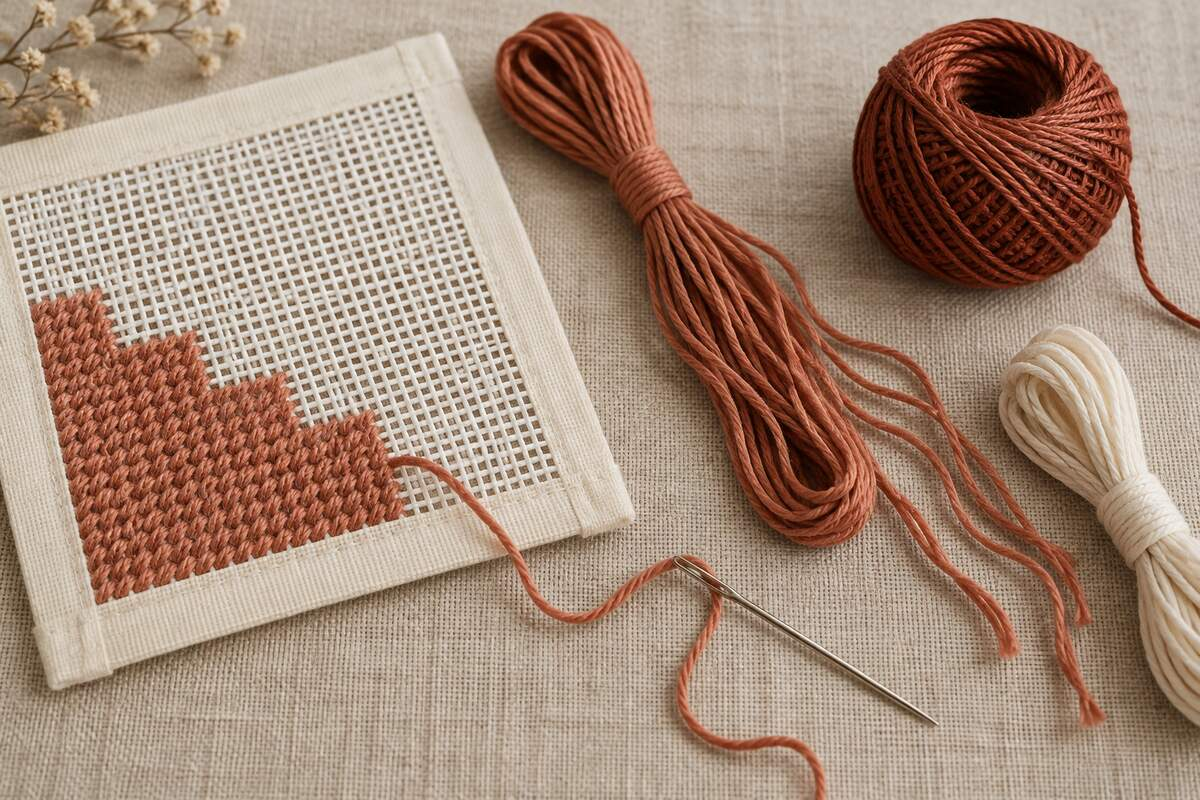
Cotton is the workhorse alternative to wool in needlepoint: cheaper per skein, available in hundreds of finely graded colors, and tough enough for pieces that get handled. But "cotton thread" covers three very different products - divisible six-strand floss, twisted perle cotton, and soft matte cotton - and each covers a different canvas mesh and gives a different surface. This guide sorts out the three, with the strand counts and mesh matches that shops and makers actually publish. Last updated November 2, 2026.
Start here: If you want maximum control, choose six-strand floss and add or remove strands until the canvas is covered. If you want defined stitches with a slight sheen and no strand-counting, choose perle cotton - size 3 for 13 to 14 mesh, size 5 for 18 mesh. If you want a soft, flat, full-coverage look on 12 to 14 mesh, choose a matte cotton. Whatever you pick, stitch a dozen test stitches in the margin before committing.
Cotton in needlepoint
Janet Perry of Nuts about Needlepoint grounds the fiber first: cotton is carded and spun fiber from the cotton plant's seed pods, and two label terms tell you most of what matters about quality. Mercerized cotton has been treated to change its structure, making it softer and better able to take dye - higher quality cotton threads are almost always mercerized, even when the label does not say so. Staple is the length of the individual fibers, and longer is better, smoother and more expensive.
Staple is why two skeins that look identical can stitch very differently. Perry explains that inexpensive floss brands use shorter-staple cotton, which feels rougher and does not pass as easily through the needle's eye or the canvas; sticking with the major manufacturers and well-known hand-dye companies gets you long-staple cotton, since the hand-dyers buy their base thread in bulk from those same major makers. For how cotton sits alongside wool and silk overall, see needlepoint thread types: wool, cotton and silk.
The three cotton threads
Every cotton thread on the needlepoint wall is one of three builds. Six-strand embroidery floss is divisible: six two-ply strands you can separate and recombine in any number. Perle cotton (also spelled pearl) is a non-divisible twisted thread with a slight sheen, sold in numbered sizes. Matte cottons, like DMC's Retors Mat, are non-divisible strands with a soft, non-shiny finish. The Spruce Crafts notes that cotton is the most popular floss fiber, and that the same six-strand format also exists in silk, rayon, linen and hemp blends - but cotton is the inexpensive, hard-wearing default for needlepoint.
Six-strand embroidery floss
Floss is the flexible option. The Spruce Crafts describes it as a loosely twisted thread of six strands, sold in 9-yard skeins in hundreds of finely graded colors; you can use all six strands at once or separate them into smaller groups to match the canvas mesh. Anne Scott Needlepoint, a retailer, makes the practical case: the color range is enormous, so if you are matching a school, camp or logo color, floss usually has an answer, and it is inexpensive and easy to find. Her shop uses all six strands on 18 mesh for full coverage, adjusting down on finer canvas, and recommends it for small details, lettering and shading.
The trade-off is management. Needlepoint.Com, a retailer, points out that some stitchers dislike handling the separate plies, which are harder to get to lie flat on the canvas, and that cotton feels more rigid to stitch with than wool or silk because it has less stretch. Anne Scott's fix for the twisting: let the needle dangle occasionally so the strands untwist. The Spruce Crafts adds the length rule - a good working length is about 20 inches, because longer strands fuzz, fray and can break as you stitch.
Perle (pearl) cotton
Valdani Threads, a maker, defines perle cotton as a non-divisible, twisted thread made from long-staple cotton - smooth, strong, and resistant to separating or fraying, with a consistent, slightly raised texture. It is sized by number, and the numbering runs backward from intuition: the smaller the number, the thicker the thread. Valdani sells sizes 5, 8 and 12, with 5 the thickest in its range; DMC also makes the thicker size 3 that needlepoint shops rely on. Because it cannot be divided, you choose a size rather than a strand count.
On canvas, perle's twist and sheen are the point. Unwind Studio, a retailer, describes DMC Perle #3 as mercerized with a subtle sheen that produces more defined stitches, best for 13 to 14 mesh. Anne Scott Needlepoint recommends perle when you want that defined, slightly textured surface without any strand management. Valdani positions perle for projects where a defined, slightly raised texture is wanted, and notes its sturdiness also suits heavy use.
Matte cottons
Unwind Studio's guide to DMC Soft Matte Cotton (Retors Mat No. 4) describes the third build: a non-divisible, matte-finish thread made from long-staple cotton that is gassed and combed but not mercerized, so it stays soft and slightly fuzzy rather than shiny. It comes in 285 colors, lies flat and fills the canvas well, and is budget-friendly; the studio recommends it for 10 double mesh and 12 to 14 mesh canvas, and for pieces where you want a soft, natural, full-coverage finish. The same logic applies to other matte cottons and cotton-wool blends shops carry: they behave like a single strand of soft cotton, chosen by thickness rather than by separating plies.
Matching cotton to your mesh
Floss Field's needlepoint thread guide states the rule that drives every chart: the thread should cover the canvas and pass through the holes without force - mesh sets the hole size, so mesh sets the thread weight, with thicker threads for lower mesh counts and finer threads for higher ones. Its published coverage chart, built from makers', teachers' and shops' charts, gives these starting points for cotton:
- Six-strand floss: 8 to 10 strands on 10 mesh, 7 or 8 on 13 mesh, 6 or 7 on 14 mesh, and 4 to 6 strands on 18 mesh.
- Perle cotton: size 3 (two strands on 10 to 12 mesh, one strand on 13 to 14) and size 5, one strand, on 18 mesh.
- Matte cotton such as Retors Mat: one strand on 10 double mesh and 12 to 14 mesh, per Unwind Studio.
Floss Field is explicit that these are starting points: the underlying charts do not all agree, so some cells are ranges, and every stitcher's tension is different, so you add or remove a strand until the canvas is covered. It also warns that upright stitches such as bargello and brick cover less well than slanted ones and may need an extra strand or a thicker thread. Its own advice when in doubt: stitch a dozen tent stitches in a corner of the margin and look. For more on strand counts by mesh, see needlepoint thread by mesh count and the needlepoint mesh size chart. Its needle chart pairs 18 mesh with a size 22 tapestry needle; see how to choose a needlepoint needle.
Stitching with cotton
The sources converge on a handful of working habits. Keep floss lengths to about 20 inches (The Spruce Crafts). Let the needle dangle now and then so stranded threads untwist (Anne Scott Needlepoint). Test before you stitch past six strands: The Spruce Crafts says to check that the threaded needle still pulls smoothly through the canvas, removing strands one at a time until it does. Buy quality: cheap short-staple floss feels rough, frays faster and drags (Nuts about Needlepoint, echoed by The Spruce Crafts' caution about low-quality floss). And know cotton's limits as a category - Needlepoint.Com notes that cotton threads come without sparkle, so if a canvas calls for shine you blend in a metallic or choose another fiber, and that its kitters will sometimes mix cotton floss, perle and overdyed cotton on one canvas depending on mesh and color match. For working with overdyed cottons once you have them, see how to use variegated thread in needlepoint.
Cotton is sturdy, but running out mid-piece is still the classic mistake, and dye lots matter for cotton as much as for wool - keep what to do when you run out of thread bookmarked before a big cotton background. A small test piece is the cheapest teacher: the needlepoint stitch sampler approach works just as well for auditioning cotton threads as for auditioning stitches.
Where sources disagree
How many floss strands on 18 mesh? Anne Scott Needlepoint uses all six strands for full coverage and treats fewer as the exception for very fine canvas. The published charts Floss Field collected mostly say four to six - two shops' charts say four, a third says four to six, and one belt maker uses all six. The spread is real; tension and how flat the plies lie explain most of it, which is why every chart ends with the same advice: test and adjust.
Does floss belong on coarse canvas at all? One shop's chart in Floss Field's collection uses 8 to 10 strands of floss on 10 mesh, while one maker's chart does not recommend floss on canvas that coarse at all - a perle cotton or wool does the job with less strand-wrangling. If you do use floss on 10 to 12 mesh, expect to manage a very full needle.
Sheen or matte? Unwind Studio presents the choice squarely: perle's mercerized sheen gives more defined stitches, while non-mercerized matte cotton lies flatter and reads softer, and each suits a different finished look. Neither source calls one "better" - the disagreement is really about which surface your project wants, and shops happily sell both for the same meshes.
FAQ
Is cotton a good thread for beginners?
Yes, with a caveat. Anne Scott Needlepoint calls floss great for beginners because it is inexpensive, everywhere, and the color range removes matching anxiety. The caveat is strand management: Needlepoint.Com notes some stitchers find the separate plies harder to keep flat. A first project on 18 mesh with all six strands, or on 13 mesh with perle #3, keeps the variables to a minimum.
Should I use cotton or wool for a pillow?
Cotton is sturdy and does not pill, per Needlepoint.Com, and Valdani notes perle's sturdiness suits heavy-use projects. Wool remains the traditional choice for maximum wear and has more stretch and forgiveness in the needle. For a pillow that will be used hard, either works; the deciding factor is usually the surface you want - wool springy and matte, cotton flatter and slightly crisper.
Can I mix floss, perle and matte cotton in one piece?
Yes. Needlepoint.Com says its own kitting sometimes combines cotton floss, perle cotton and overdyed cotton on a single canvas, depending on the mesh and the color match. The textures differ on purpose - use the difference where the design calls for it.
Why does my cheap floss keep fraying?
Two likely causes from the sources: lengths over about 20 inches (The Spruce Crafts) and low-quality short-staple cotton, which Nuts about Needlepoint says feels rougher and moves poorly through canvas. Shorten your strands; if it still shreds, switch to a major-brand or hand-dyed floss, which use long-staple base thread.
What does the perle size number mean?
It is a thickness label that runs backward: smaller number, thicker thread. Size 3 is the thick one needlepoint shops use on 13 to 14 mesh, size 5 suits 18 mesh, and sizes 8 and 12 are finer still, per Valdani and the Floss Field chart.
Sources
- Nuts about Needlepoint - Cotton Threads for Needlepoint (needlepoint blog by Janet Perry)
- The Spruce Crafts - Needlepoint Embroidery Floss and How to Use It (craft reference site)
- Floss Field - Needlepoint thread guide: which thread for which canvas (needlepoint reference site)
- Floss Field - Needlepoint thread and needle chart by canvas mesh (needlepoint reference site)
- Anne Scott Needlepoint - Types of DMC Thread and When to Use Each (retailer)
- Unwind Studio - DMC Soft Matte Cotton (Retors Mat): Complete Guide (retailer)
- Needlepoint.Com - Thread Options (retailer)
- Valdani Threads - Understanding the Differences: Perle Cotton vs. Embroidery Floss (thread maker)