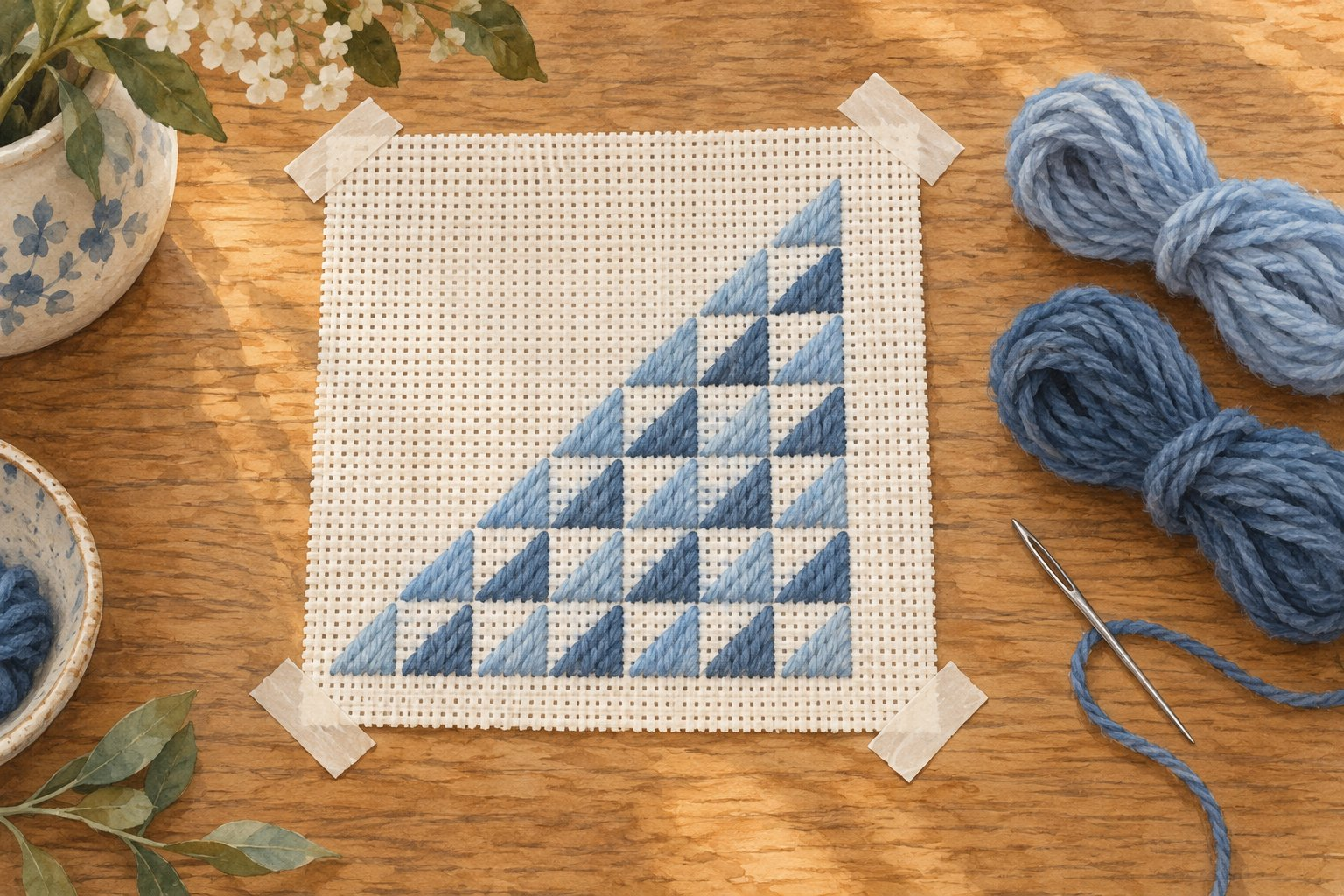
Milanese stitch builds little triangles out of four straight stitches - over one, two, three and four canvas intersections - and packs them into diagonal rows that climb across the canvas like steps. It fills fast, reads as movement, and can look calm or busy depending on the thread and colors you choose. Here is how to work it, where it earns its place, and what nine sources say to watch for. Last updated October 24, 2026.
Start here: make a tent stitch over one intersection. Below it, stitch over two, then three, then four - that is one triangle. Repeat the 1-2-3-4 sequence down a diagonal row, then work the next row in reverse so each small stitch sits beside a long one (RSN StitchBank, Sew Sew Mellow). Get the first row right and, as designer Ziva puts it, the rest just falls into place.
What the Milanese stitch is
The RSN StitchBank describes Milanese as a canvaswork filling stitch made of diagonally offset triangles, worked in diagonal rows, and notes it first appears in print in the early 20th century - Mary Thomas included it in her 1934 Dictionary of Embroidery Stitches. Each triangle is four stitches long: one over one intersection, one over two, one over three, one over four (Sew Sew Mellow, KC Needlepoint). Unwind Studio classifies the result as flat, parallel, diagonal and condensed, related to the Oriental stitch, and quick to work up.
The visual signature is the stair-step edge. Poppy Monk, a needlepoint kit designer, points out that the climbing steps make the stitch read as upward or downward movement - which is why so many teachers reach for it on hills, mountains and buildings.
How to stitch it
The method is consistent across the RSN StitchBank, Sew Sew Mellow, KC Needlepoint and Unwind Studio:
- In the top left of the area, make a tent stitch across one canvas intersection.
- Below it, make a stitch across two intersections, then one across three, then one across four. You now have one triangle.
- Repeat the 1-2-3-4 sequence to build a diagonal row of triangles from top left to bottom right (RSN StitchBank).
- Work the next row in reverse: the triangles flip to face the other way, and the smallest stitch of the new row always sits beside the longest stitch of the row before, so the rows lock together (RSN StitchBank, Sew Sew Mellow). KC Needlepoint notes the triangle direction flips again at the bottom of each diagonal row as you work back.
- At shaped edges you will not fit whole triangles - fill the partial spaces with the longest stitches that fit, the same compensation logic covered in our compensation stitches guide.
Where to use it
Sources agree it belongs in medium to large areas, then split on mood:
- Mountains, hills and buildings. Poppy Monk recommends it anywhere you want climbing steps; Rittenhouse Needlepoint suggests realistic mountains in Pebbly Perle, perle cotton or an overdyed thread, and a reader on their blog used it for distant blue fold mountains in a sampler landscape. Rittenhouse also likes it for Southwestern motifs with an overdyed thread.
- Backgrounds and large fills. The RSN StitchBank lists it as a background filler that fills in quickly, and Unwind Studio recommends it for large areas. Rittenhouse adds a caveat: in a thicker fiber like perle cotton it becomes slightly bulky, which suits a background precisely because it will not distract from the focal point. More background options in our background stitches guide.
- Areas that need movement. KC Needlepoint calls Milanese a very busy stitch and advises saving it for parts of the canvas where you want a lot of movement - the opposite instinct from the background camp, and the difference is mostly thread weight and color contrast (see disagreements below).
- Patterns with structure. Poppy Monk used it for a repeating cobblestone street on one design and for fabric texture on clothing. Ziva built a graduated grey Art Deco box insert with it, shading from black at the edges to light grey in the center for a three-dimensional effect.
- Mirroring. Poppy Monk notes you can flip the stitch direction to mirror an object or show that something has turned.
Threads and canvas
The Needlepointer, a needlepoint shop, rates Milanese as an intermediate stitch that works in silk, wool or cotton on 13, 14 or 18 mesh, calls it dimensional, and notes it works well with shading. The samples across sources show the range: Rittenhouse stitched theirs in perle cotton for a thicker, calmer fill; KC Needlepoint stitched theirs in Neon Rays for shine and movement; Rittenhouse and Poppy Monk both suggest over-dyed threads to add a color dimension (our variegated thread guide covers how those threads behave). Match your strand count to the mesh as usual - see our thread by mesh count chart.
Because every stitch in a row leans the same way, keeping the lie of the thread consistent matters more than usual. A laying tool keeps the longer stitches flat - see our laying tool guide - and even tension keeps the triangles crisp, as covered in our tension guide.
Straight, reverse and two-color variations
Straight Milanese. The RSN StitchBank documents a straight version built from horizontal stitches across two, four, six and eight canvas threads, forming vertical bands instead of diagonal ones. The Art Needlepoint Company teaches it for backgrounds and any part of a canvas that runs upward: triangles stacked in a straight column, narrowest over two threads and widest over eight, which together read as a wavy line. They suggest it for ornaments, clouds, leaves and waves, caution that it can be heavy as a background, and note it can be worked vertically or horizontally - the horizontal version is the one usually called straight Milanese.
Reverse Milanese. KC Needlepoint publishes a reverse version that is the mirror image of the regular stitch - same 1-2-3-4 triangles, same row flip, slanting the other way.
Two-color rows. Poppy Monk's favorite trick: stitch alternate diagonal rows in a second color and the climbing steps disappear into a jacquard pattern of triangles - subtle with close shades, dramatic with contrast. Rittenhouse suggests the simpler version, one color per row, or an over-dyed thread that shifts color on its own.
Where sources disagree
Background or focal movement. KC Needlepoint says Milanese is a very busy stitch to save for movement; Rittenhouse recommends it as a background in perle cotton so it will not fight the focal point; the RSN StitchBank files it as a background filler, full stop. These can be reconciled: in one quiet color and a matte, thicker thread the triangles settle into texture, while shine or color contrast pushes the steps forward. Pick the effect first, then the fiber.
How hard it is. The Needlepointer rates Milanese intermediate; Ziva calls it so easy to learn that once the first row is in, the rest falls into place. The stitch itself is four lengths you already know - the intermediate part is keeping the diagonal flow and the small-beside-long interlock correct across a large area, which is exactly the mistake The Needlepointer warns about.
How wide the straight version goes. The RSN StitchBank builds straight Milanese triangles over two, four, six and eight threads. The Art Needlepoint Company agrees on two to eight but says you need not go all the way to eight - stop shorter, and go wider only when you need a bigger fill.
Common mistakes
- Losing the directional flow. The Needlepointer names inconsistent directional flow as the common Milanese mistake: rows accidentally slanting the wrong way or triangles facing the wrong direction break the step pattern. Count the 1-2-3-4 out loud for the first few rows.
- Small beside small. Rows only interlock when the shortest stitch of one row meets the longest of the next (RSN StitchBank). If your rows show a visible gap or ridge, check that pairing first.
- Using it in tiny areas. Every source that recommends it points to medium or large areas; a motif smaller than a few triangle repeats never establishes the pattern.
- Forgetting the flip. The triangle direction reverses at the end of each diagonal row (KC Needlepoint). Mark the first row with a pin or a row of waste thread if you keep losing your place.
FAQ
What is the Milanese stitch in needlepoint?
A canvaswork filling stitch made of triangles - four stitches over one, two, three and four canvas intersections - packed into diagonal rows that interlock small-beside-long (RSN StitchBank, Sew Sew Mellow). It first appears in print in the early 20th century and is used for backgrounds, mountains and anywhere you want movement.
Is Milanese stitch good for beginners?
The four stitch lengths are simple, and designer Ziva says once the first row is in, the rest falls into place. The Needlepointer still rates it intermediate because keeping the diagonal flow and the row-to-row interlock correct over a large area takes attention. Try a small sample square before committing a whole background to it.
What thread should I use for Milanese stitch?
The Needlepointer lists silk, wool and cotton on 13 to 18 mesh. For a calm background, Rittenhouse suggests perle cotton; for movement and shine, KC Needlepoint used Neon Rays; for extra color interest, Rittenhouse and Poppy Monk both like over-dyed threads.
What is the difference between Milanese and straight Milanese?
Regular Milanese runs in diagonal rows of offset triangles. Straight Milanese stacks the triangles in straight vertical (or horizontal) bands using stitches over two, four, six and eight threads, which reads as a wavy line (RSN StitchBank, Art Needlepoint Company).
Where should I avoid Milanese stitch?
Small motifs, where the repeat never establishes, and - if you use a shiny or high-contrast thread - anywhere you want the eye to rest, since KC Needlepoint calls it a very busy stitch. The Art Needlepoint Company also cautions that straight Milanese can be heavy as a background.
Sources
- RSN StitchBank - Milanese stitch (definition, history, 1-2-3-4 method, small-beside-long interlock, straight Milanese over 2-4-6-8, uses: filling and shading)
- Sew Sew Mellow - Milanese (a needlepoint shop; step-by-step and the row-flip rule)
- KC Needlepoint - Milanese Stitch (a needlepoint shop; busy stitch for movement, Neon Rays sample)
- KC Needlepoint - Milanese Stitch, Reverse (mirror-image variation)
- Unwind Studio - Milanese Stitch Tutorial (a needlepoint designer and shop; stitch classification, large areas, quick to work up)
- Rittenhouse Needlepoint - Stitch of the Week: Milanese (a needlepoint shop; perle cotton background logic, mountains, Southwestern motifs, over-dyed threads, reader mountain example)
- Poppy Monk Needlepoint - Spotlight on the Milanese Stitch (a needlepoint kit designer; climbing steps, direction change, cobblestone repeat, two-color jacquard effect)
- Ziva Needlepoint Designs - Milanese Stitch (designer; Art Deco box design, graduated grey shading, ease of learning)
- The Needlepointer - Milanese Stitch Detail (a needlepoint shop; intermediate rating, thread and mesh picks, directional-flow mistake)
- The Art Needlepoint Company - Stitch Course Lesson 7 (a needlepoint shop; straight Milanese method and uses, heavy as background caution)