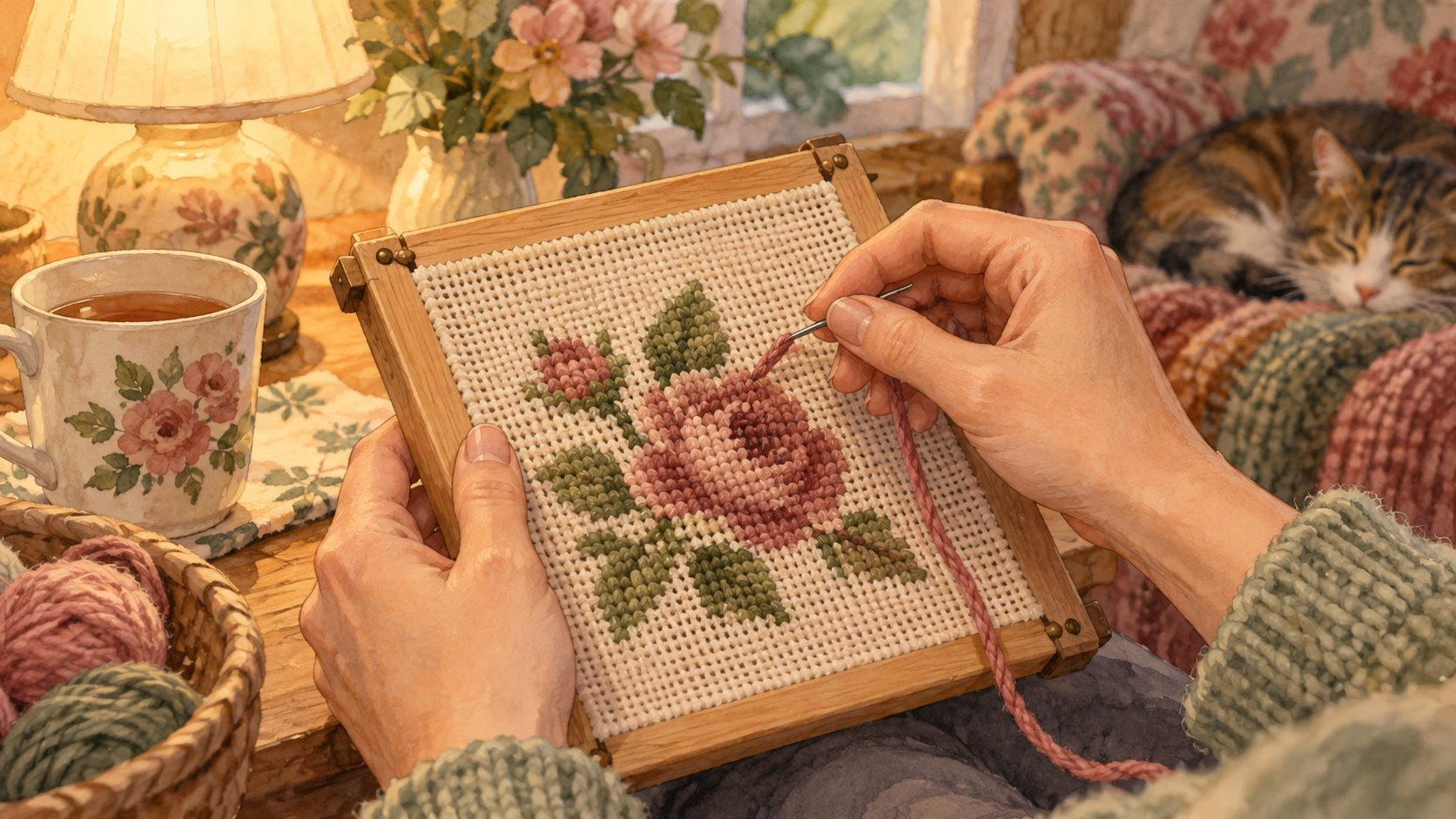
Even tension means every stitch sits snug on the canvas without pulling the mesh out of shape. Needlepoint sources keep coming back to the same short list: pull to the point of resistance and no further, keep your hands and posture consistent, manage thread twist, use a frame, and choose a stitch that does not drag the canvas one way.
Elizabeth Bradley says to pull the needle through until you feel the resistance of the yarn and the stitch is nesting in place, snug but not tight. NeedlepointTeacher says a loose tension looks lumpy and a tight one distorts the canvas. Aim between the two, then repeat the same motion on every stitch.
What good tension feels like
Elizabeth Bradley says its tapestry wool has some elasticity, so you pull until you meet resistance and the stitch nests. Unwind Studio says to pull the whole thread through to the back or front until you feel a bit of resistance, work the stitches firmly, snug but not too tight, and then apply the tension you found evenly across all stitches. Poppy Monk Needlepoint puts the most common mistake plainly: pulling stitches too tight, which it says will distort the canvas and create gaps or ridges. It wants stitches that lie smoothly, resting neatly, not pulled hard.
Mary Katherine Needlepoint Designs adds that tight stitches are more common among new stitchers, but loose ones can also cause problems.
Habits that keep it even
- Pull in one movement. NeedlepointTeacher says to pull the thread in a complete movement, not to pull, stop and finish pulling, and to avoid jerky stitching, which makes an uneven area.
- Use the same angle. Poppy Monk Needlepoint says to pull each stitch with the same motion and pressure, bringing the needle through as close to perpendicular as possible.
- Keep your posture steady. NeedlepointTeacher says changing between sitting straight and slouching can change your stitching, and suggests sitting the same way each time.
- Stop at a natural point. NeedlepointTeacher says to stop when you finish an area or a strand of thread, because stopping in the middle can change your tension.
- Light the work. Elizabeth Bradley says that if you are straining to see, you are more likely to tug too hard or miss a loose stitch.
- Do not yank the last stitch. In its basketweave tips, Poppy Monk Needlepoint says pulling the thread tight at the end tugs the last stitch tighter than its neighbors.
- Fill small gaps carefully. For small areas surrounded by stitching, Elizabeth Bradley describes pushing the needle down, then reaching under the canvas to pull it through and guide it back up, making sure each stitch nests before the next.
Put together, a simple routine from these sources looks like this: set up good light and a steady seat, mount the canvas on a frame if you can, keep thread lengths short, pull each stitch through in one even motion to the same point of resistance, let the needle dangle when the thread twists, and stop at the end of an area or strand. None of the sources gives a number for how hard to pull. They all describe a feel, so test on a corner of the canvas and compare how the stitches sit.
Thread twist and thread size
Poppy Monk Needlepoint says each pull of the needle builds a little twist in the thread, which can travel down it and cause tangles, knots and uneven stitches. Seasoned stitchers, it says, give the needle a slight quarter turn against the twist, and the right amount depends on your own motion and the thread. It also suggests letting the needle and thread dangle now and then so the twist releases, and using shorter lengths because twist builds more slowly. Elizabeth Bradley gives the same dangle tip and says over-wound wool does not sit flat on the canvas.
Thread size matters too. Poppy Monk Needlepoint says thread that is too thick forces stitches to crowd, and thread that is too thin makes tension harder to control. Our thread by mesh count guide covers matching the two, and our guide to separating Persian yarn covers getting the strands to lie flat.
Frame, stitch choice and distortion
Flossfield says a frame keeps the canvas flat and square, so work done on one often needs little or no blocking, and that it keeps tension more even. It adds that stitching in hand bends the canvas with every stitch, and that rows of continental and half cross can pull the canvas out of square. Poppy Monk Needlepoint recommends a frame, plus Frameloks to keep stretcher bars from shifting, and notes that using only one stitch such as basketweave can still pull the canvas in one direction, so a mix of stitches balances it.
| Source | What it says about stitch choice and canvas shape |
|---|---|
| Flossfield | Basketweave is less likely than continental or half cross to warp the canvas |
| Atlantic Blue Canvas | Continental is worked in rows and can put more tension on the canvas, basketweave is diagonal and helps reduce distortion |
| The Spruce Crafts | Basketweave suits large backgrounds where another slanted stitch could distort the canvas |
| Mary Katherine Needlepoint Designs | Use stretcher bars and basketweave for backgrounds, and work continental in the correct direction |
| Unwind Studio | Basketweave causes minimal distortion, and a frame is optional: many people roll the canvas instead |
Our guides on basketweave, continental versus half cross, stretcher bars and blocking cover each of these in detail.
Fixing tension after the fact
NeedlepointTeacher says that for loose stitches you can turn the work over and gently tug the stitches toward the area where you stopped. That suits small areas. For a large area or very loose stitches it says it may be best to rip out and start again, and that nothing will help stitches that are too tight: you will need scissors. Poppy Monk Needlepoint likewise says it is fine to pull out a few stitches and redo them. See how to fix mistakes in needlepoint.
Where sources disagree
- Frame or no frame: Flossfield and Poppy Monk Needlepoint favor a frame. Unwind Studio calls it optional and says many people roll the canvas instead.
- Too tight or too loose: Poppy Monk Needlepoint calls over-tightening the most common mistake. Mary Katherine Needlepoint Designs says tight is more common but loose also causes problems. NeedlepointTeacher says loose looks lumpy and tight distorts.
- Basketweave alone: Several sources recommend basketweave to reduce distortion. Poppy Monk Needlepoint says using only basketweave can still skew the canvas and recommends mixing stitches.
- Fixing tight stitches: NeedlepointTeacher says nothing helps tight stitches except cutting them out. Other sources focus on prevention.
Questions
How tight should needlepoint stitches be?
Snug but not tight. Elizabeth Bradley and Unwind Studio both describe pulling until you feel a bit of resistance.
Why does my canvas warp?
Poppy Monk Needlepoint says repeated stitch tension pulls the mesh out of alignment. Flossfield adds that stitching in hand and rows of continental or half cross can pull it out of square.
Does lighting affect tension?
Elizabeth Bradley says poor light makes you more likely to tug too hard or miss loose stitches.
How do I stop thread twisting?
Poppy Monk Needlepoint suggests a small counter-turn of the needle, letting the thread dangle, and shorter lengths.
Can I fix tight stitches?
NeedlepointTeacher says no, they have to be cut out.
Sources
- Elizabeth Bradley: Tips on Tension
- Mary Katherine Needlepoint Designs: Straight Up
- Poppy Monk Needlepoint: Four Tips to Prevent Needlepoint Canvas Distortion
- Poppy Monk Needlepoint: Stitch Chill, the Guide to Perfect Needlepoint Tension
- Poppy Monk Needlepoint: Five Tips for Smoother Needlepoint Basketweave
- NeedlepointTeacher: Making Correct Tension
- Unwind Studio: Best Needlepoint Tips for Smoother Stitching
- The Spruce Crafts: Basketweave Needlepoint Stitch Tutorial
- Atlantic Blue Canvas: Needlepoint FAQ
- Floss Field: Needlepoint frames and stretcher bars