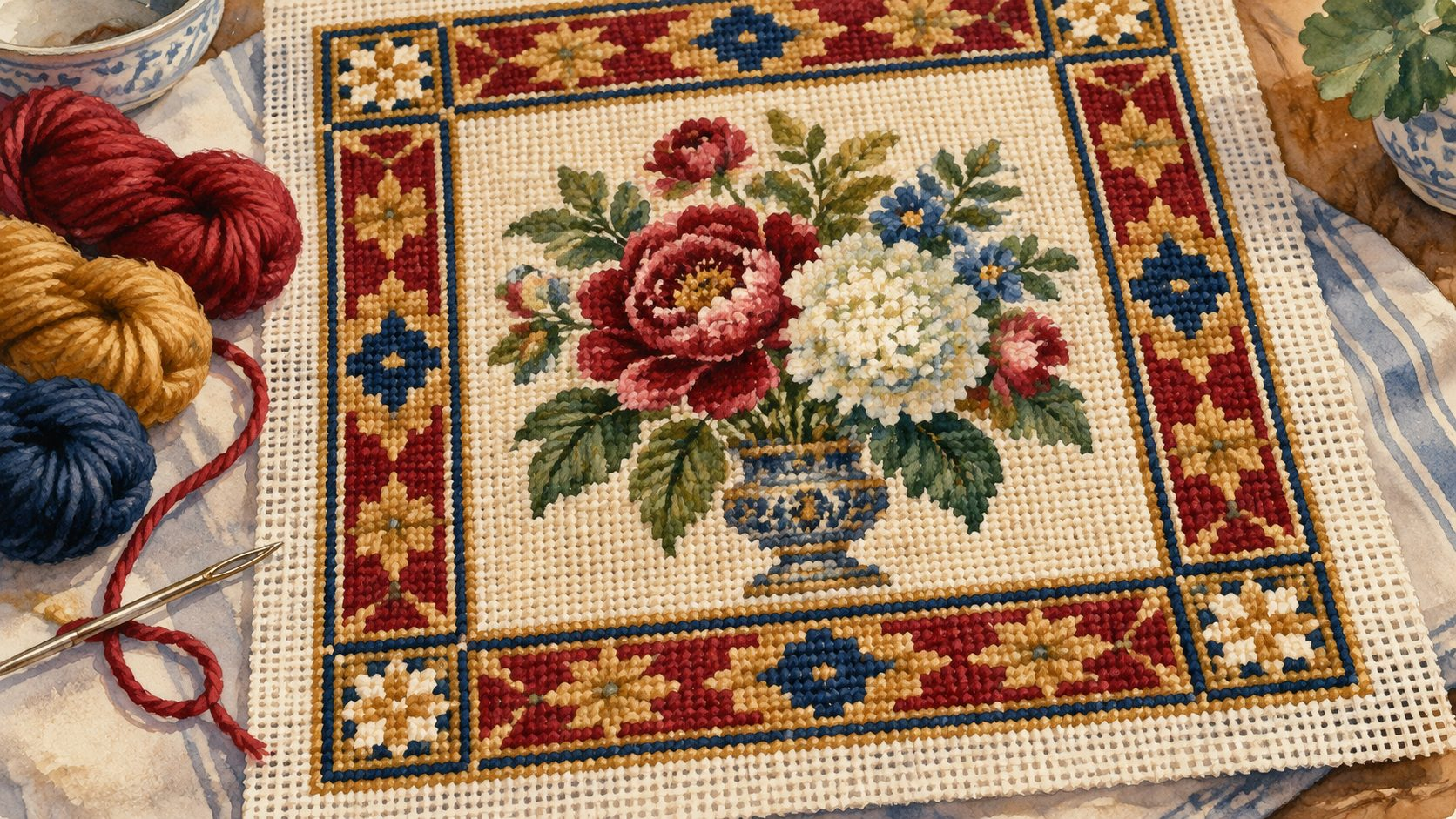
A needlepoint border is the stitched edge that surrounds the main design, and the sources split it into two jobs: a decorative border that is part of the design, and a structural border that finishes the edge cleanly. Either way, every source that covers planning says the same thing: decide on the border before you start stitching, because it changes how much canvas you need and how the piece can be finished.
Leave at least 2 inches of bare canvas on all sides for blocking and finishing (Atlantic Blue Canvas), count the threads along each side and pick a stitch that divides evenly (Rittenhouse Needlepoint), and start with a simple stitch: tent stitch rows, elongated continental, upright cross or double brick all make clean borders. Save the fancy multi-color borders for when the design itself is calm.
What a border does
Atlantic Blue Canvas frames borders the way finishers see them: a border contains the design, creates a visual boundary and gives the eye a place to rest. It splits borders into decorative ones, which add pattern and color as part of the design, and structural ones, which simply finish the edge and give the finisher a stable foundation. Rittenhouse Needlepoint adds that borders are not only for the outside edge: they work inside a canvas too, as dividing lines between sections, and they give a sense of completeness that can make a painted canvas feel more your own.
Planning the border
- Plan before stitching, not after. Atlantic Blue Canvas calls stitching the design first and dealing with the border later the most common mistake, because you may not have room left. Most projects need at least 2 inches of bare canvas on all sides for blocking and finishing, and a stitched border may need more.
- Count the threads. Rittenhouse Needlepoint's advice: count the canvas threads horizontally and vertically, then choose a stitch whose repeat divides evenly into those numbers. When no stitch divides evenly, it suggests a corner medallion, for example four mosaic stitches with alternating slants, to absorb the difference.
- Let the finishing method shape the choice. Atlantic Blue Canvas: framing is forgiving because the mat and frame make their own border (and may hide some of yours); pillows need sturdy edges that survive folding, seaming and stuffing; ornaments usually get minimal borders because space is tight.
- Leave a buffer row. Rittenhouse notes that finishing usually consumes a row or two of stitches at the outside edge, so stitching a couple of rows of basketweave beyond your border keeps the border itself fully visible.
Easy border stitches
- Tent stitch rows. Atlantic Blue Canvas calls tent stitch the stitcher's friend for borders: clean, subtle, and compatible with any finishing method. Rittenhouse points out that tent stitch borders in repeated color patterns can look decorative without any counting-heavy stitch. Our tent stitch comparison covers the variants.
- Elongated continental (the rope border). Rittenhouse's favorite no-count border: continental worked over two, three or more canvas intersections in a cord-type thread such as perle cotton or Kreinik braid, which reads as a rope. It works all the way around a piece or as a divider.
- Upright cross stitch. Poppy Monk likes it for small borders because the packed crosses look textured and lustrous. It warns the stitches sit tight, so thin your thread if you can, and suggests working it in a horizontal line rather than diagonal for a straight border.
- Double brick stitch. Poppy Monk's pick for larger borders: easy to work, and it runs both across and up and down, so one stitch can carry all four sides. It can also be laid horizontally if that suits the design.
- Scotch stitch. Poppy Monk calls it versatile: one option is to leave a gap between each Scotch stitch and fill the gaps with tent stitch. Rittenhouse alternates the direction of Scotch stitches in a shiny thread like Neon Rays so light reflects differently off each block.
- Satin stitch bands. Rittenhouse describes a simple grouped border: a band of satin stitches with a row of continental above and below in a contrasting color.
Decorative borders
- Chain border. Nuts about Needlepoint's three-color chain: two colors form the circular links, a third makes the straight bars between them.
- Amish Bargello border. Also from Nuts about Needlepoint: used only on the straight sides, with a different accent stitch at the corners; a single color creates a quilted effect in the gaps between stitch groups. Our Bargello guide explains the underlying stitch family.
- Oriental border. A wide border built on a line of Milanese stitch down the middle, with the stitch's characteristic wings worked in different threads or colors on each side, in the same order on both sides (Nuts about Needlepoint).
- Lokota stitch. A diagonal border six threads wide: three short stitches over two threads, then three long stitches over four, then the reverse for the other half of the border (Nuts about Needlepoint).
- Or Nue scroll border. Pattern couching: long stitches laid along the border, caught down with small stitches that pass over the laid thread and back into the same hole, building a pattern. Nuts about Needlepoint says it is called Or Nue when the laid thread is metallic, and that it works best as a strong accent rather than a quiet frame.
- Herringbone. Floss Field's method: slanted stitches zigzag along a row and cross near their ends, each new row nesting one canvas thread below the last, every row started from the left. Whimsical Stitch says the sequence is critical: start every row from the same edge (top or bottom), and do not alternate, because the layered look comes from a consistent starting point. It also notes the first stitch of the row is a compensation stitch, and that dragging thread across the back to start the next row adds bulk that can complicate framing. Our compensation stitches guide covers those edge fill-ins.
- More candidates. Rittenhouse's class list for borders: slanted Gobelin, Jacquard, long-armed cross, Rice, leaf and Algerian eye. It singles out Rice stitch worked with a metallic tie-down, with the caveat that the same stitch in different threads can look completely different, so test first.
Turning corners
Corners are where borders fail: stitches change direction, and gaps or bulges appear. Atlantic Blue Canvas says to slow down as you approach a corner, keep the same gentle tension as everywhere else, and, if you are in basketweave, mind whether you are on an up or down row; for tent stitch it suggests switching between continental and half-cross at corners to balance thread distribution. Puckered corners can often be fixed in blocking, per the same source, but prevention is easier.
For mitered corners, Rittenhouse gives the Gobelin method: step the stitch back one thread at a time, turn the canvas 90 degrees, step it back up to full size, and add a fill-in continental stitch in the corner for a complete look. Nuts about Needlepoint extends mitering to diagonal stitches: draw diagonal lines from the inside corner to the outside corner, stitch two opposite sides first ending along the miter lines, then work the remaining sides with the same stitch slanting the other way. It warns that square stitches do not miter because they look the same in both directions, while stitches like Criss-cross Hungarian wrap the corner without mitering. Its reassuring tip: do not worry if rows do not line up at the corners, because the miter line itself hides mismatches.
Color choices
Atlantic Blue Canvas groups border color strategies into three. Matching borders pull colors from the main design for harmony, best when the design is already busy. Contrasting borders, like a dark frame around a light design, make a bold statement suited to geometric or modern pieces. Neutral borders in navy, charcoal, cream or taupe contain a busy design and keep finishing options open, since they work with almost any frame or backing fabric.
Finishing and margins
The border and the finish are one decision. Atlantic Blue Canvas notes that professional finishers can do a lot, but clean, evenly tensioned edges make their job possible: messy borders create problems even skilled finishing cannot fully correct. Rittenhouse's buffer-row advice applies here: finishers typically lose a row or two at the edge, so stitch beyond the border. Before finishing, block the piece; Atlantic Blue Canvas says aggressive blocking smooths many wavy-border tension problems. Our blocking guide, finishing basics guide and framing guide cover those steps.
Quick comparison
| Border | Look | Best for | Sources |
|---|---|---|---|
| Tent stitch rows | Clean, quiet | Any project, any finish | Atlantic Blue Canvas, Rittenhouse |
| Elongated continental | Rope-like | No-count border or divider | Rittenhouse |
| Upright cross | Textured, lustrous | Small borders | Poppy Monk |
| Double brick | Geometric | Larger borders, all four sides | Poppy Monk |
| Scotch | Blocked, light-catching | Versatile, gaps optional | Poppy Monk, Rittenhouse |
| Herringbone | Zigzag layers | Structured decorative edge | Floss Field, Whimsical Stitch |
| Chain, Oriental, Lokota, Or Nue | Bold, multi-color | Statement borders on calm designs | Nuts about Needlepoint |
Working tips
- Test the stitch in the actual thread before committing: Rittenhouse found one Rice stitch sample in metallic looked completely different from another in Kreinik braid and floss.
- Thin your thread for packed stitches like upright cross, per Poppy Monk.
- If the border looks wavy, block aggressively before assuming you need to unpick, per Atlantic Blue Canvas.
- Keep shiny-thread borders consistent in direction so the light plays evenly, per Rittenhouse's alternating Scotch example.
- Start every herringbone row from the same edge, per Floss Field and Whimsical Stitch.
- Match border weight to the design: Poppy Monk uses upright cross on small pieces and double brick on large ones.
Where sources disagree
- Simple or showy: Atlantic Blue Canvas says simple often works best and tent stitch is your friend. Nuts about Needlepoint argues stitchers too often settle for easy choices and offers chain, Oriental and Or Nue borders as distinctive alternatives. Both agree the border should not crowd the design.
- Which stitches miter: Nuts about Needlepoint says square stitches cannot miter and Criss-cross Hungarian does not need to. Rittenhouse miters Gobelin happily. There is no single rule; it depends on the stitch structure.
- Herringbone sequence: Whimsical Stitch insists on one consistent starting edge per row for a clean layered look, while allowing that alternating directions can suit a woven effect like basketry.
- What the stitch is called: Whimsical Stitch admits it first mistook a Pinterest stitch for Gobelin before realizing it was herringbone. Stitch names in needlepoint are loose; follow diagrams, not names.
Questions
What is the easiest needlepoint border?
Rittenhouse's rope border, elongated continental in a cord thread, needs almost no counting. Atlantic Blue Canvas suggests plain tent stitch rows as the cleanest option.
How much canvas should I leave for a border?
Atlantic Blue Canvas says at least 2 inches of bare canvas on all sides for blocking and finishing, more if you plan a stitched border. Rittenhouse adds a couple of basketweave rows beyond the border because finishing eats a row or two.
How do I turn a corner cleanly?
Rittenhouse miters straight stitches by stepping back one thread at a time and turning 90 degrees. Nuts about Needlepoint draws diagonal miter lines at corners and works opposite sides in opposite slants. Keep tension even and do not pull tighter at corners, per Atlantic Blue Canvas.
Should the border match the design?
It depends on the design, per Atlantic Blue Canvas: matching colors for harmony on busy designs, contrast for bold definition, neutral to contain a busy piece and keep finishing flexible.
Do I have to stitch a border at all?
No. Framed pieces rely partly on the mat and frame, per Atlantic Blue Canvas. But a border, even one tent stitch row, gives the edge definition and helps the finisher.
Sources
- Atlantic Blue Canvas: Needlepoint Borders, Tips for Clean Edges
- Poppy Monk: Needlepoint Stitches for Borders
- Rittenhouse Needlepoint: Needlepoint Borders
- Nuts about Needlepoint: 5 Fun Borders
- Nuts about Needlepoint: Miter a Diagonal Stitch Border
- Floss Field: Herringbone Stitch
- Whimsical Stitch: Herringbone, Gobelin, Whatever