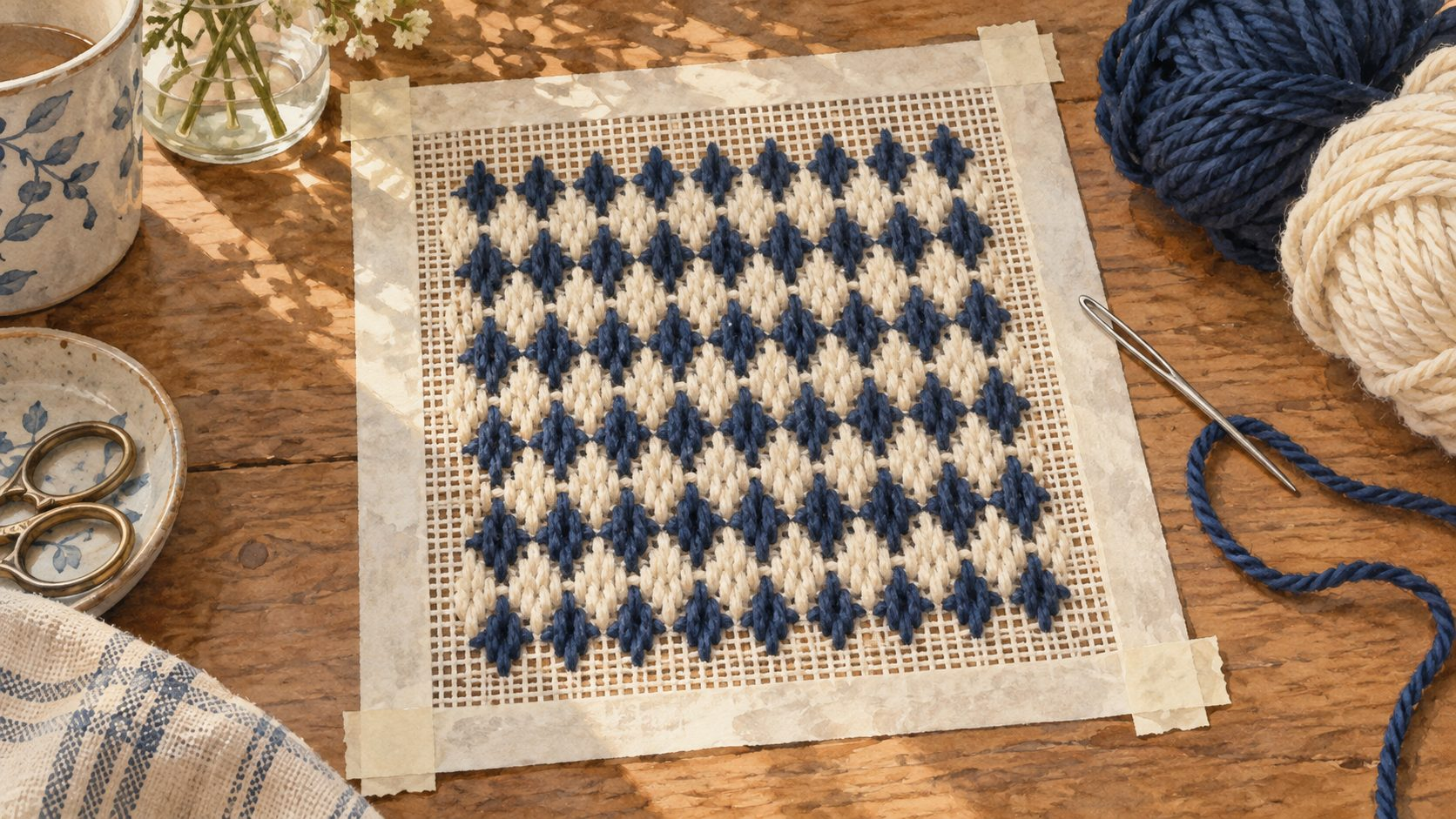
Hungarian stitch is a pattern of small diamonds made from groups of three upright stitches: short, long, short, with a gap before the next group. It is one of the oldest canvas stitches on record. It is also easy to get lost in when you change rows, because the diamonds nest instead of lining up. This guide pulls together eight sources on how to work it, how to use it, and where they disagree.
Work an upright stitch over two threads. Next to it, work one over four threads, starting one hole lower and ending one hole higher. Work another over two, level with the first. Skip one hole and start the next diamond (Floss Field). Count the skipped hole carefully on the first row, because every later row depends on it (Floss Field, Annake's Garden).
What Hungarian stitch is
RSN StitchBank calls it a canvaswork stitch that makes small diamond-shaped blocks from three vertical stitches over two, four and two canvas threads, and says it is very similar to mosaic stitch but worked vertically rather than on the diagonal. Floss Field says it can be worked in one color or with a different color in each row, which brings out the diamonds. Needlepoint For Fun says in one color it looks more like a textured filler with no distinct pattern, and that the pattern needs room to get established.
RSN StitchBank says it dates to the late medieval period, since it was used in German ecclesiastical embroidery, and that the Metropolitan Museum of Art has a seventeenth-century stitched portrait of Charles II that includes it alongside petit point. Annake's Garden calls it a very old stitch from the Renaissance. Needlepoint For Fun describes it as three brick stitches: an over 2, an over 4 and an over 2. Our brick stitch guide and mosaic stitch guide cover the relatives.
| Stitch | How it differs | Source |
|---|---|---|
| Parisian | Alternates long and short stitches without a break | Floss Field |
| Hungarian | Groups of three, short, long, short, with a gap before the next group | Floss Field |
| Mosaic | Similar, but worked on the diagonal | RSN StitchBank |
How to work it
- Work an upright stitch over two threads (Floss Field).
- Next to it, work one over four threads, starting one hole lower and ending one hole higher (Floss Field, Annake's Garden).
- Work another over two, level with the first. That is one diamond (Floss Field).
- Skip one hole and start the next diamond. Annake's Garden says the empty square is vital and the pattern will not work without it.
- On the next row, two threads lower, work each short stitch straight below a short stitch of the row above, sharing the hole at its lower end. Place each long stitch in the skipped space, so the diamonds nest between those above (Floss Field).
RSN StitchBank works the first row right to left and the second left to right, fitting each long stitch into the spaces left in the previous row. Needlepoint For Fun says to work in horizontal rows and warns that because the diamonds do not line up under each other, changing rows can be confusing, and that you might have to relearn the stitch every time you use it. Annake's Garden suggests starting a few squares down the canvas on a practice sample and going back to fill in partial stitches at the top and bottom. Floss Field says that if the diamonds stop nesting, a gap was missed in the row above.
Thread, coverage and tension
Floss Field says upright stitches cover less well than slanted ones, so add strands or use a thicker thread, and use a laying tool when there are several strands in the needle. Needlepoint For Fun says the same: thicken your thread or expect some canvas to show. It also says to compensate as you go, with shorter stitches at the edges, and to watch tension on mono canvas, because pulling too tight to make stitches lie flat will skew the canvas. See our compensation stitches guide, laying tool guide and even tension guide.
Serendipity Needleworks stitched its sample in Sparkle Rays, a flat metallic ribbon thread, and recommends a laying tool and short lengths of no more than 15 inches because it can unravel. That is one designer's thread choice. The Needlepointer lists silk, wool and cotton, on 13, 14 and 18 mesh.
When to use it
Floss Field names backgrounds, small diamond texture and two-color patterns. Turned on its side, with stitches lying across, it is used for rivers, lakes and drifting clouds, and Serendipity Needleworks says worked horizontally it looks like water flowing down a river or lapping a lakeshore. Floss Field relays one teacher who stitches clouds in Hungarian in front of a brick stitch sky, because Hungarian is slightly larger in scale.
Annake's Garden used it in a solid color as the background of a forest picture, because its double diagonals echoed the slopes of Bargello trees and an eagle's wings. Needlepoint For Fun put it on the background of a trellis canvas stitched in basketweave, where one contrasting stitch makes the trellis pop. The Needlepointer says it suits architectural and geometric effects. Needlepoint For Fun calls it best in medium to large areas, and Floss Field says it also fits tight spaces. See our background stitches guide and sky and water stitches guide.
Variations
- Doubled. Annake's Garden says both Parisian and Hungarian can be doubled by making two consecutive stitches each time.
- Color rows. Annake's Garden shows strong contrast, weak contrast and variegated yarn samples. Floss Field says a different color in each row brings out the diamonds.
- Hungarian grounding. Bands of diamonds alternating with zigzag rows of longer upright stitches, as recorded by one stitch reference (Floss Field).
- Pavilion stitch. The same idea on a bigger scale with more steps in each diamond (Floss Field).
- Criss-cross Hungarian. Serendipity Needleworks works it in two steps: Hungarian units slanted instead of upright, with the slant reversed every other row, then cross stitches (or a bead, sequin or French knot) in the spaces. It says it is a medium-size stitch that needs room for 3 rows of at least 3 units, and used it for a Santa bag, tree tops and angel wings.
Where sources disagree
- Difficulty. Serendipity Needleworks calls it one of the simpler stitches and a good first decorative stitch. The Needlepointer labels it intermediate. Needlepoint For Fun says it looks simple but changing rows can confuse you. Our read is that the stitches are easy and the row change is where people slip.
- Area size. Needlepoint For Fun says it works best in medium to large areas. Floss Field and Serendipity Needleworks say it fits tight spaces. Needlepoint For Fun says the diamonds do not show in one color, while Annake's Garden used it in a single color on purpose for texture.
- Origin. RSN StitchBank says late medieval German church embroidery. Annake's Garden says Renaissance. Both describe old stitches, and neither date is exact.
- Stitch order. Unwind Studio's steps start with the short stitch, skip one intersection and describe the stitches as two over two threads and one over four. RSN StitchBank and Floss Field agree on the over 2, over 4, over 2 structure but describe the starting holes differently. Follow one diagram throughout.
- Sellers. Needlepoint For Fun, Unwind Studio, Serendipity Needleworks and The Needlepointer sell products or classes. Read their advice with that in mind.
Questions
How many threads do the stitches go over?
Two, four, and two (RSN StitchBank, Unwind Studio).
What is the difference between Hungarian and Parisian?
Parisian alternates long and short stitches without a break. Hungarian works in groups of three and leaves a gap (Floss Field).
Why do my diamonds not nest?
A gap was missed in the row above. Each long stitch must drop into the gap between two diamonds (Floss Field).
Why does canvas show?
Upright stitches cover less than slanted ones. Use thicker thread or more strands (Floss Field, Needlepoint For Fun).
Can I work it sideways?
Yes. Worked horizontally it suits water and clouds (Floss Field, Serendipity Needleworks).
Sources
- Floss Field, Hungarian stitch
- RSN StitchBank, Hungarian stitch
- Unwind Studio, Hungarian Stitch
- Needlepoint For Fun, Hungarian Needlepoint Stitch
- Serendipity Needleworks, A Needlepoint Stitch For Rivers And Lakes
- Annake's Garden, Back to the Classroom: Hungarian and Parisian Stitches
- Serendipity Needleworks, Criss-Cross Hungarian Stitch
- The Needlepointer, Hungarian stitch detail