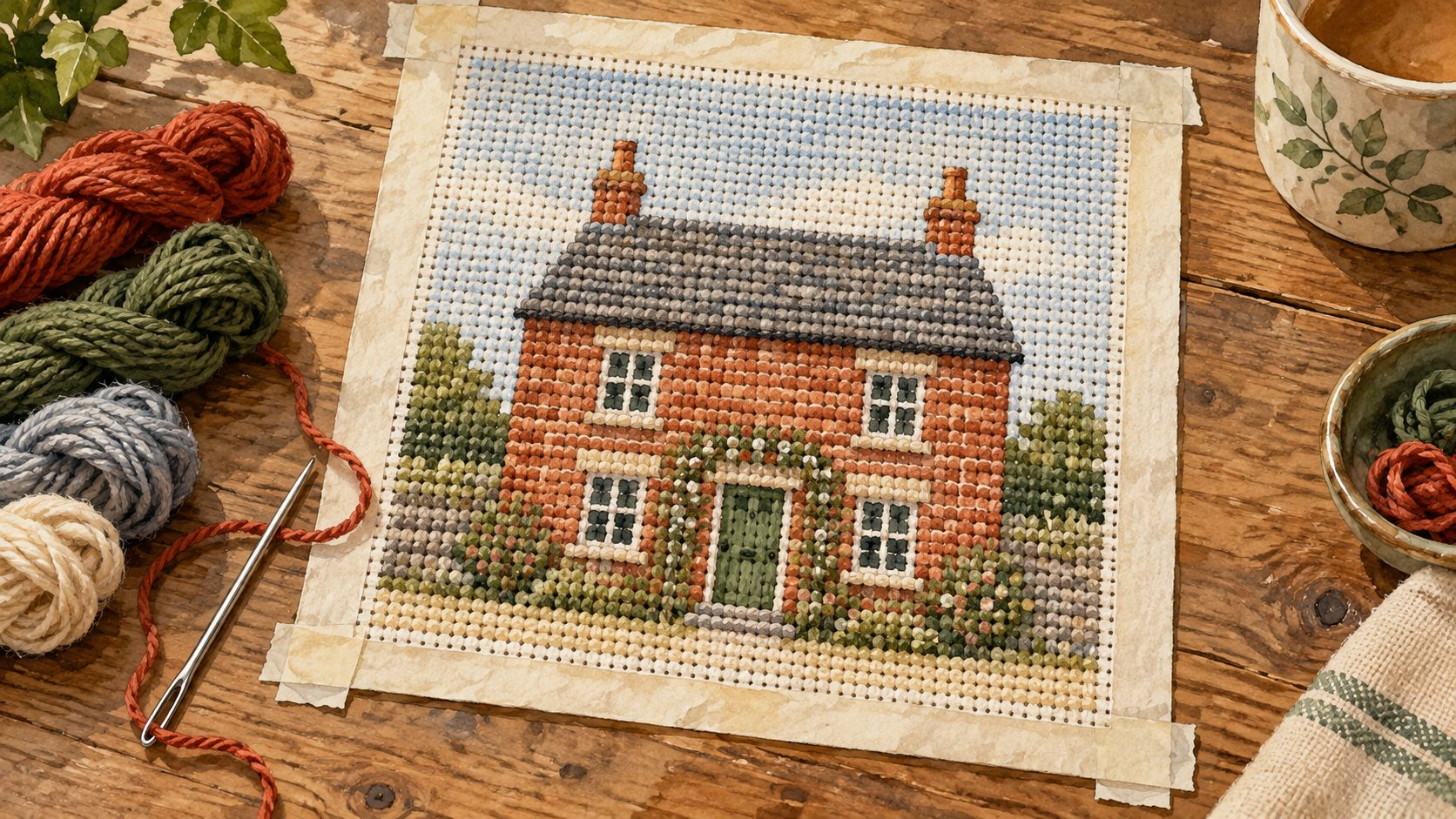
Brick stitch is a row of upright stitches, each over two canvas threads, stepped half a stitch from its neighbor like courses of brick. It covers fast, fits small spaces and is easy to fit against an edge. It is also the stitch most sources reach for when a canvas has a house or a wall. This guide pulls together eight sources on how to work it, how to stitch buildings, and where the advice differs.
Work an upright stitch over two threads. Work the next one a thread lower, so the two overlap by half. Zigzag across the row, then fit each stitch in the next row under the one above, sharing its hole (Floss Field). Use a thread a little thicker than you would for tent stitch, because upright stitches cover less (Floss Field, Stitchmate). For brick walls, turn the stitch on its side (Floss Field, Serendipity Needleworks).
What brick stitch is
Floss Field describes upright stitches over two threads, worked in a zigzag so each is stepped half a stitch from its neighbor. Stitchmate calls it a row of straight stitches over two threads with every other column shifted down by one thread, like the running bond of a brick wall. Unwind Studio lists its structure as flat, parallel and straight.
Floss Field says it is a small, neutral stitch that does not lead the eye in any direction, which is why teachers use it for backgrounds, and that its small scale makes a sky look far away. Beyond sky and buildings it names clothing, hair, hills, clouds and foliage. Unwind Studio names skies, rolling hills, clothing textures and mountains. The Needlepoint Clubhouse names backgrounds, buildings and water.
| Fact | Source |
|---|---|
| Upright stitches over 2 threads, offset by 1 | Floss Field, Stitchmate |
| Giant brick: over 4 threads, offset by 2 | Stitchmate |
| Can be worked vertically or horizontally | The Needlepoint Clubhouse, Serendipity Needleworks |
| Can be made larger by going over more intersections | The Needlepoint Clubhouse |
How to work it
- Make the first stitch: an upright stitch over two threads (Floss Field).
- In the next hole along, work another upright stitch one thread lower, so the two overlap by half (Floss Field).
- Continue across in this up-and-down zigzag (Floss Field).
- On the next row, fit each stitch under the one above it, sharing its hole, so the rows lock together (Floss Field, Stitchmate).
Stitchmate says the first row takes concentration because you place every stitch from scratch, and after that each new stitch tucks under the one above it, so a wrong one is obvious. It also says the back stays tidy because the needle travels only short distances. Serendipity Needleworks says you can instead alternate stitches up and down across the row, and that either way is fine as long as you are consistent. Unwind Studio describes the zigzag as working up two threads, down to the lower right hole, then moving right to the height of the first stitch. Our beginner stitches guide covers the basics this builds on.
Edges and compensation
Floss Field says brick is easy to compensate: where a full stitch will not fit against the edge of a shape, work a shorter upright stitch in its place. Stitchmate says every other column ends half a brick short along the top and bottom edges, leaving a gap one thread tall, and says to fill those with straight stitches over a single thread. It recommends doing this as you go, because compensating stitches added later tend to sit tighter and show as a fringe. Serendipity Needleworks also calls it easy to compensate. For the general method see our compensation stitches guide.
Thread and coverage
Floss Field says upright stitches cover less well than slanted ones, so add strands or use a thicker thread, and use a laying tool when stitching with several strands. Stitchmate gives a rule of thumb of one more ply or strand than for tent stitch on the same canvas, and suggests stitching a one-inch test square and looking at it from a couple of feet away. It also warns that tight tension narrows a straight stitch and lets canvas show. The Needlepoint Clubhouse says vertical stitches always show a little canvas and suggests a thicker thread for fuller coverage.
Serendipity Needleworks stitched its sample with Bravo!, a four-ply divisible cotton from Rainbow Gallery. It recommends 2 plies on Congress cloth, 3 to 4 plies on 18 mesh and 5 to 6 plies on 13 or 14 mesh, stranded and laid with a laying tool. That is one designer's choice for one thread, not a general rule. See our laying tool guide and thread by mesh count guide.
Stitches for buildings
Serendipity Needleworks calls brick the terrific stitch for buildings. It notes that its own example, a red sandstone castle, looks like brick from a distance, and says the stitch looks most like bricks when turned on its side and worked horizontally. Floss Field also says to turn the stitch on its side for brick walls and buildings. Stitchmate lists houses, garden walls, chimneys, fences and, in the horizontal version, a wooden floor.
Other stitches come up for architecture too:
- Corduroy stitch. The Pampered Introvert describes a layered straight stitch that makes vertical or horizontal ribs. Worked horizontally it reads as brick courses, with slight color shifts for aged brick. Worked vertically it reads as clapboard. It also names stone, painted wood, chimneys and foundation stone. It suggests stranded cotton or silk, avoiding very fuzzy fibers, and not pulling too tight or you lose the rib. We did not find a stitch diagram in that post, so check another source for the exact stitch path.
- KC Needlepoint architectural tag. KC Needlepoint files several stitches under architectural stitches. It suggests diagonal enlarged cashmere for water or a house roof, and a Bargello pattern called Bargello Points for roofs, with a more jagged texture than many Bargello patterns. It says vertical reverse cashmere suits buildings and sidewalks, and it also lists triple brick and double brick vertical.
- Houses as a project. Janet Perry of Nuts about Needlepoint planned a free project with four colonial houses, one brick, one stone and two wood, on 18 mesh. She listed a matte dark gray thread for roofs and metallic threads for glass panes. That post is a 2012 announcement, not a stitch tutorial.
Our guides to background stitches, borders and Bargello cover the neighbors of these stitches.
Variations
- Horizontal brick. Horizontal stitches over two vertical threads, each row offset by one. Stitchmate says it reads like a stacked stone wall and suits fields, water and wood grain. Unwind Studio and KC Needlepoint also chart horizontal versions.
- Double brick. Two stitches side by side at each step (Floss Field, Stitchmate). Stitchmate says the bolder texture suits bigger areas on coarser canvas, while KC Needlepoint calls the vertical version versatile, especially for small areas.
- Giant brick. Over four threads with an offset of two. Stitchmate says it covers fastest but leaves longer floats, so keep it for framed pieces.
- Triple brick. KC Needlepoint lists a vertical triple brick stitch and says brick can be worked in many combinations.
Common mistakes
- Losing the offset. Two neighboring columns starting at the same height break the bond (Stitchmate).
- Thread too thin. Canvas shows between the stitches (Floss Field, Stitchmate).
- Stitches lean or look uneven. Floss Field says to pick one working method and keep to it, and relays one teacher who works every other stitch across the row and fills the gaps on the way back so the stitches stand straighter.
- Using it in a tiny area. Stitchmate says brick needs a few full bricks in each direction, and in an area four threads wide it looks like a mistake. Floss Field and Serendipity Needleworks, by contrast, say it fits small spaces. See below.
Where sources disagree
- Small spaces. Floss Field, Serendipity Needleworks and The Needlepoint Clubhouse praise brick for tight spaces. Stitchmate says to skip it for small or fiddly areas. Our read is that it compensates easily but needs a few bricks to show as brick.
- How much thicker the thread should be. Floss Field says a little thicker, Stitchmate says one more ply or strand, and Serendipity Needleworks gives ply counts for one specific thread. Test on scrap.
- Canvas distortion. Stitchmate says brick distorts the canvas very little and needs only light blocking. Floss Field does not rate distortion. Treat the claim as one source's view and still block if the piece needs it.
- Working order. Zigzag across the row (Floss Field, Stitchmate) or alternate up and down (Serendipity Needleworks), or skip a stitch and fill in on the way back (Floss Field's teacher). Floss Field and Serendipity Needleworks agree the front looks the same if you stay consistent.
- Pillows and belts. Stitchmate calls brick a good choice for pillows and says belts take harder wear, so use tent there. Other sources do not address wear.
- Name. Floss Field notes that brick stitch has been used for several offset stitches, including a way of couching, and a counted version in Chinese embroidery.
Questions
How many threads does brick stitch go over?
Two in its usual form (Floss Field, Stitchmate). Giant brick goes over four.
What stitch is best for a brick wall in needlepoint?
Brick stitch turned on its side is the answer most sources give (Floss Field, Serendipity Needleworks). The Pampered Introvert suggests horizontal corduroy as another option.
Why does canvas show between my stitches?
Upright stitches cover less than slanted ones. Use a thicker thread or more strands and test on scrap (Floss Field, Stitchmate).
Is brick a good first decorative stitch?
Serendipity Needleworks and Stitchmate both say so.
Can I use brick stitch for a roof?
KC Needlepoint suggests other stitches for roofs, such as diagonal enlarged cashmere and Bargello Points. Brick is listed for walls.
Sources
- Floss Field, Brick stitch
- Serendipity Needleworks, A Needlepoint Stitch For Buildings
- Stitchmate, Brick Stitch Needlepoint
- The Needlepoint Clubhouse, Brick Stitch
- Unwind Studio, Brick Stitch (plus Brick Horizontal, Double Brick Stitch)
- The Pampered Introvert, The Corduroy Stitch
- Nuts about Needlepoint, Needlepointing Houses
- KC Needlepoint, Stitch Vault: Architectural Stitches