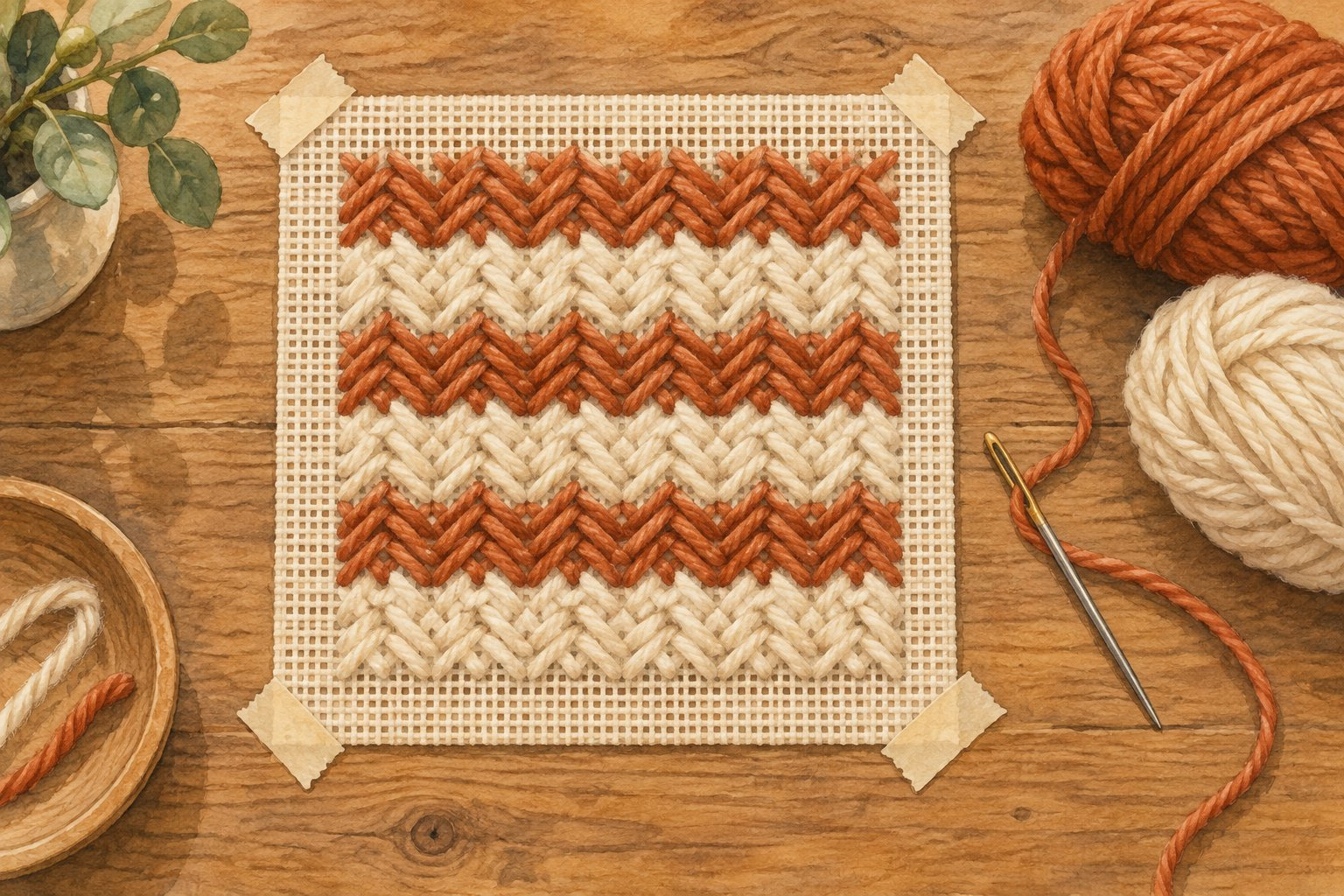
Herringbone stitch is a row of slanted stitches that zigzag along the canvas and cross near their ends, like the bones of a herring - or the tweed of a good coat. On canvas it becomes one repeated movement: a stitch forward, one thread back underneath, and the next row nests into the last. Here is how to work it, where it earns its keep, and the points where eight sources genuinely disagree. Last updated October 24, 2026.
Start here: begin every row at the same edge - the left, working down the area - and start each row with an away knot, because the back carries too little thread to hold a tail (Floss Field, Rittenhouse Needlepoint). Stitch over two canvas intersections, come up one hole back to the left, and let each new row begin one thread below the last.
What the herringbone stitch is
Herringbone is an old stitch with a wide resume. The RSN StitchBank describes it as two rows of slanted parallel stitches that cross near their ends, notes its reverse forms two neat rows of what looks like running stitch - a reversible quality that lends itself to shadow work - and traces it from Elizabethan and Jacobean foliage stems to Assisi work in Italy, Chefchaouen embroidery in Morocco, Telli metal-thread work in Egypt and the Levant, Rabari embroidery in northwest India and Kashmir work in Pakistan. Traditionally it secured one fabric to another; worked evenly it becomes a border or filling stitch (RSN StitchBank). Unwind Studio credits the name to the crossings, which look like the bones of a herring fish.
On counted canvas the stitch compresses into a tight zigzag: each stitch crosses two intersections, the needle steps one thread back under the canvas, and the next row tucks its upper ends under the row above (Floss Field). It is not the same stitch as its lookalikes - more on that in the disagreements section.
How to stitch it
Floss Field's counted method, matching Needlepoint Teacher and Unwind Studio:
- Come up at the top left corner of the area. Go down two canvas threads to the right and two down.
- Come up one hole to the left of where the needle went down. Go down two threads to the right and two up, into the top row of holes.
- Keep zigzagging to the right edge, always coming up one hole to the left of where the needle last went down. Every row is worked from the left, so end the thread at the right edge: weave it back and forth under the short stitches on the back and trim (Floss Field).
- Begin the second row at the left edge, one hole straight below the start of the first. Its upper holes lie under the stitches of the row above - slide them aside with a fingernail or a second needle to find each hole (Floss Field; Needlepoint Teacher suggests the same trick).
- Fill the area from the top down, each new row one canvas thread below the last. Needlepoint Teacher is emphatic: make the first row at the top of the area and work down - never start in the middle or the lower portion.
Two finishing details. First, where a whole stitch will not fit at the end of a row, work a shorter compensating stitch at the same slant, and for a straight top or bottom edge fill the bare intersections between the points with tent stitches (Floss Field) - more on partial stitches in our compensation guide. Second, start every row with an away knot: so little thread lands on the back - two broken lines of short horizontal stitches per row - that there is nothing to bury a beginning tail under (Floss Field, Rittenhouse). When the row is done, cut the knot and weave the tail in like the working end. Thread-start basics are in our start and end thread guide.
Where to use it
- Clothing. The rows look like herringbone tweed, so the stitch suits coats and jackets in a design (Floss Field). Unwind Studio recommends it for clothes too, and Needlepoint Teacher lists clothes among its uses.
- Buildings. The horizontal bands suit siding and boards; alternate two shades row by row to pick out each band (Floss Field, Needlepoint Teacher).
- Animals, birds and foliage. Needlepoint Teacher lists animals in one color, birds and foliage; the RSN notes the stitch's long history in curling foliage stems. Our animal fur guide compares the alternatives.
- Borders and bands. One row alone makes a border (Floss Field; RSN StitchBank). Unwind suggests borders and bands of texture as well.
- Backgrounds. Many rows become a background of small even zigzags (Floss Field); Unwind recommends it for large areas and The Needlepointer for general decorative areas. More in our background stitches guide.
- Dimensional details. The Wool and The Floss teaches a raised closed herringbone variant - stitches looped through a small anchor stitch - for puffy, dimensional shapes; their teacher Colleen demonstrates it on a penguin's beak and notes it works well for leaves.
Threads, mesh and stitch size
The Needlepointer rates herringbone intermediate in silk, wool or cotton on 13, 14 or 18 mesh. Unwind Studio's practical tips: keep crossings consistent, keep tension relaxed and even because crossed stitches pull on the canvas, and choose a thread that covers well - the crossings leave spots where canvas can peek through, so a slightly fuller thread gives a denser texture. Whimsical Stitch stitched a sample in four plies of Splendor on 18 mesh. More on matching thread to canvas in our thread by mesh count chart and on pull in our tension guide.
Stitch size is a genuine variable, not an error: Floss Field, Needlepoint Teacher and Unwind teach it over two intersections, Rittenhouse works it over four with compensating stitches at both ends of each row, Whimsical Stitch diagrams it over two rows and up three, and Floss Field documents a doubled version over four intersections plus a three-intersection single-row border. Pick one size per area and hold it.
Where sources disagree
May rows alternate direction? Floss Field is absolute: every row is worked from the left, and rows worked alternately from both ends are not herringbone at all but another stitch, actually named herringbone gone wrong. Whimsical Stitch agrees the starting point should be consistent - top or bottom, not alternating - for a clean layered pattern, but then gives permission: alternating directions can enhance a woven look on a basket or shrubbery. The safe rule for a first piece is one direction; the honest answer is that the woven mistake has fans.
How hard is it? Floss Field calls it one movement repeated; Unwind and The Needlepointer rate it intermediate; Needlepoint Teacher tags it Needs Thinking; Rittenhouse admits it proved a little challenging to learn but worth it. The movement is simple - what earns the ratings is the one-thread step back, the nesting rows, and the thread management at every row end.
Is it herringbone, Gobelin or woven stitch?Whimsical Stitch built a whole post on mislabeling a herringbone as a Gobelin. Floss Field draws the woven-stitch line precisely: in woven stitch a whole row leans one way and the next row the other; in herringbone both slants alternate along every row and cross. If the crossings zigzag within the row, it is herringbone. Our Gobelin guide shows the straight-stitch family it gets confused with.
Common mistakes
- Rows that look woven like a basket. A row was worked back from the right. Take it out and work every row from the left (Floss Field).
- Bare canvas between rows. A row was skipped - the new row began two threads below the last. A row starts in every hole down the left edge (Floss Field).
- A beginning tail with nothing to hold it. The back carries too little thread; start each row with an away knot instead (Floss Field, Rittenhouse).
- Crossings that flip direction. Keep the stitch order consistent so every crossing sits the same way; mixing them breaks the woven look (Unwind Studio; Rittenhouse checks that top stitches all cross the same direction).
- Dragging thread across the back to the next row.Whimsical Stitch ties off and restarts each row; dragging the thread adds bulk that can show at finishing, especially in framing.
FAQ
What is the herringbone stitch in needlepoint?
A crossed stitch made of slanted stitches that zigzag along a row and cross near their ends, with each new row nesting one canvas thread below the last (Floss Field). The crossings resemble the bones of a herring fish, which gives the stitch its name (Unwind Studio).
Is needlepoint herringbone the same as embroidery herringbone?
Yes, in its counted form (Floss Field). Surface embroidery works it as a single line of spaced stitches between two drawn lines for borders or to hold fabrics together; on canvas it becomes a dense zigzag fill (RSN StitchBank).
What size should I stitch herringbone?
Two intersections is the common teaching size (Floss Field, Needlepoint Teacher, Unwind Studio). Rittenhouse works it over four for a bigger pattern, and Whimsical Stitch diagrams a version up three. Any of them is correct - be consistent within an area.
Why does my herringbone look woven instead of zigzag?
You worked a row back from the right edge. Herringbone rows all run from the same side; rows worked alternately both ways produce a different stitch, traditionally called herringbone gone wrong (Floss Field).
What thread works best for herringbone stitch?
Silk, wool or cotton on 13 to 18 mesh (The Needlepointer). Choose a slightly fuller thread, because the crossings leave small gaps where canvas can peek through (Unwind Studio).
Sources
- Floss Field - Herringbone stitch (counted method, away knot, compensation, row-direction rules, herringbone gone wrong, woven-stitch distinction, size variations)
- RSN StitchBank - Herringbone stitch (surface method, reversible structure and shadow work, history from Elizabethan to world embroidery traditions)
- Needlepoint Teacher - Herringbone Stitch (method, second-needle trick, top-down rule, uses list, EGA Master Craftsman note)
- Rittenhouse Needlepoint - Stitch of the Week: Herringbone (a needlepoint shop; over-four method, away knot, compensating ends, nesting rows, learning-curve note)
- Whimsical Stitch - Herringbone, Gobelin, Whatever (sequence consistency, per-row tie-offs vs dragging thread, alternating directions for woven effects, naming confusion)
- Unwind Studio - Herringbone Stitch Tutorial (a needlepoint designer and shop; name origin, consistent crossings, tension and coverage tips, intermediate rating)
- The Needlepointer - Herringbone Stitch Detail (a needlepoint shop; intermediate rating, thread and mesh picks)
- The Wool and The Floss - Raised Closed Herringbone Stitch (a thread and canvas shop; dimensional variant for beaks and leaves)