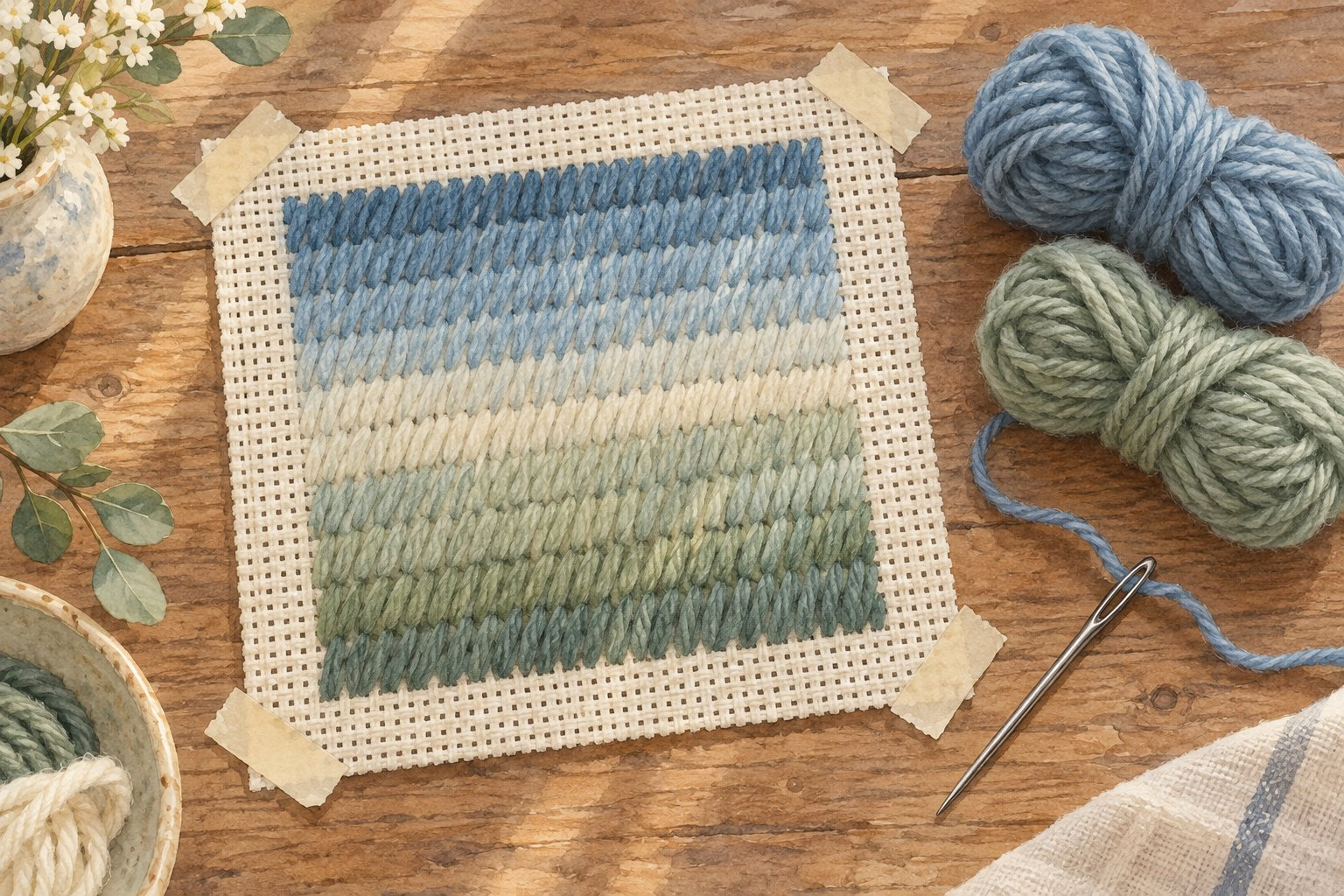
Gobelin is not one stitch but a small family: straight upright stitches, the same stitches slanted, and the encroaching version where each row overlaps the last so colors melt together. All three are simple straight stitches, all three fill canvas fast, and the encroaching version is the classic answer for shaded skies, fur and smooth backgrounds. Here is how to work each one, with the history and the places nine sources disagree. Last updated October 24, 2026.
Start here: learn the encroaching version first. Work a row of slanted stitches over three threads up and one across. Start the next row two threads lower, work it back the other way, and let each new stitch reach one thread up into the row above, taking the needle down between its stitches, never up through them (Floss Field, RSN StitchBank). Overlap every row by one thread and the bands blend into each other.
The Gobelin family
The name is usually credited to the Gobelins tapestry factory in 17th century Paris, though the RSN StitchBank notes it is unclear whether the stitch is genuinely linked to the factory or was simply named for its tapestry-like appearance. Either way the stitch itself was certainly in use from the 1600s (the Victoria and Albert Museum holds pieces featuring it from that century onward), and Mary Thomas documented it in her 1934 stitch dictionary. Historically the name Gobelin stitch has been used for both the upright and the slanted versions, which still causes confusion in older books (RSN StitchBank).
Three members matter today. Straight (or upright) Gobelin is a small vertical stitch, also called tapestry stitch. Slanted Gobelin (what Therese de Dillmont's 19th century Encyclopedia of Needlework simply calls Gobelin stitch) leans one thread sideways and covers better. Encroaching Gobelin, also called interlocking Gobelin, is the slanted stitch with rows that overlap by one thread (RSN StitchBank, Floss Field). Needlework Tips and Techniques adds that straight Gobelin is also the basis of Bargello, where the same upright stitches step up and down the canvas in waves, covered in our Bargello guide.
Straight Gobelin
Straight Gobelin is a vertical stitch over two or more canvas threads, worked side by side in rows that share holes with the rows above and below (Needlework Tips and Techniques, whose Carol demonstrates over four threads in pearl cotton). The RSN StitchBank documents a trammed version, where the upright stitches are worked over a long laid padding stitch, which lifts them for a raised, padded effect.
Carol's useful twist: you do not have to work into adjacent holes. Shifting each stitch slightly diagonally produces a staggered, woven or tiled surface, and repeating the shift builds shapes: her sample trees are nothing but straight Gobelin dropped by one thread per stitch. Leave a gap between stitches on one row and fill the gaps on the next and you get alternating Gobelin, a brick-wall fill she uses for backgrounds such as the sky behind those trees.
Slanted Gobelin
Slanted Gobelin is a tall tent stitch: each stitch crosses one vertical thread and, traditionally, two horizontal threads, though taller versions cross three or more (Floss Field). Work left to right: come up at the top of the row, go down two threads below and one to the left, come up one hole to the right, and repeat; the back shows a long slanted stitch. The next row comes back right to left, up at the bottom of each stitch and down at the top, into the hole shared with the row above (Floss Field; de Dillmont describes the same stitch over two horizontal threads and one perpendicular).
Because it slants, it covers the canvas better than an upright stitch in the same thread (Floss Field). The smooth solid bands suit borders, architectural detail like paneling and shiplap, sky, and sloping hills, and it pairs naturally beside other diagonal stitches. De Dillmont's practical note, quoted on Wikipedia: on a frame you can work the return row from right to left, but stitching in hand you must turn the work around so every row goes the same way.
Encroaching Gobelin
This is the shading stitch. The RSN StitchBank describes it as parallel bands of slanted satin stitch that interlock slightly into the bands above and below, giving a smooth surface ideal for flat or shaded backgrounds; their example works over five threads and encroaches by one. Floss Field teaches the same structure over three threads up and one across:
- Work a row of slanted stitches left to right, up at the bottom, down at the top, one thread to the right.
- Start the next row two threads lower and work it back right to left. The top of each new stitch reaches one thread up into the row above, between its stitches.
- Always take the needle down into the row already stitched, between its stitches. Coming up through that row instead disturbs the lay of its stitches (Floss Field; the RSN StitchBank gives the same rule).
- Continue, overlapping every row by one thread, working the rows in order from top to bottom or bottom to top of the area (RSN StitchBank).
Because the rows overlap, there are no hard lines between them. Change color row by row and the bands blend; Carol at Needlework Tips and Techniques compares it to watercolor, and demonstrates with three shades of blue, two rows each. Her key advice: choose shades that differ only slightly; the closer the colors, the softer the blend. An encroaching straight Gobelin exists too, upright stitches with the same one-thread overlap (Floss Field).
Where to use it
- Shaded skies. The most-repeated use: Fire and Iris Designs love horizontal interlocking Gobelin (their name for the same stitch) for skies because everything looks beautifully blended, and Carol demonstrates the blue-gradient version.
- Fur and hair. Packed close and overlapped, the stitch reads as fur or hair (Floss Field; Fire and Iris blend thread colors for animal fur the same way). Our animal fur guide covers more options.
- Grass, sand and ground. The RSN StitchBank lists grass among its uses, Floss Field adds smooth sand, and Ellen Johnson at Serendipity Needleworks picks the encroached slanted version specifically for smooth beach sand.
- Smooth backgrounds and fills. Flat or shaded backgrounds are the RSN StitchBank's headline use; Floss Field calls the coverage full and smooth, and notes one stitch list recommends the dense result for pillows, wall hangings and other pieces that get wear. More ideas in our background stitches guide.
- Borders and architecture. Slanted Gobelin's solid bands make borders, paneling and shiplap (Floss Field), and a single band of it is a quick frame for a motif.
- Foreground and distance. Floss Field passes on one teacher's depth trick: work the stitch over fewer threads for things far away and over more for the foreground, and slant left when you want the direction to change.
Threads and frame
Carol's thread guidance is practical: wool for texture and durability on cushions and chair seats, pearl cotton for crisp defined stitches (size 5 on 18 count), metallics for accents if you can tolerate the twisting. She stitches her teaching samples in pearl cotton precisely because wool's fuzz hides the formation, but notes that same fuzz is often what you want in a finished piece.
One caution is near-universal for the slanted versions: they pull the canvas. Floss Field warns slanted Gobelin can drag the canvas out of square and recommends working on a frame or stretcher bars, the same assumption behind de Dillmont's 19th century instruction. Our frame guide and stretcher bars guide cover the options.
Where sources disagree
Which stitch owns the name. De Dillmont and modern dictionaries like Wikipedia's entry treat the slanted stitch as Gobelin stitch, full stop. The RSN StitchBank notes the name has historically covered both the upright and oblique versions, and lists straight Gobelin under aliases including tapestry stitch. When an older chart says Gobelin with no diagram, check the stitches around it for a slant.
Encroaching: large areas or small. Unwind Studio recommends encroaching slanted Gobelin for small areas, flowers and mountains, while the RSN StitchBank and Floss Field aim it at smooth backgrounds, the largest areas on a canvas. The reconciliation: the stitch itself scales anywhere, but the blended shading that justifies the overlap only shows over enough rows to change color, which is why the background camp is bigger.
How tall to stitch it. Tradition says over two horizontal threads (de Dillmont; Floss Field's slanted version), Floss Field teaches encroaching over three, the RSN StitchBank demonstrates over five, and Floss Field notes the height is adjustable: fewer threads for distance, more for foreground, per one teacher. There is no wrong height; there is only a consistent one within an area.
Common mistakes
- Stripes instead of a blend. If your color bands look striped, the shades are too far apart; choose colors that differ only slightly so the overlap softens the change (Floss Field; Carol's watercolor advice is the same).
- Disturbed stitches in the row above. Always take the needle down into the previous row, between its stitches, and never bring it up through them (Floss Field, RSN StitchBank). This is the error that ruins the smooth surface.
- Rows worked out of order. Encroaching rows must run top to bottom or bottom to top of the area, each overlapping the row next to it. Hopping around breaks the interlock (RSN StitchBank, Floss Field).
- A canvas pulled out of square. Slanted Gobelin distorts more than straight stitches; mount the piece on a frame or stretcher bars before you start (Floss Field).
FAQ
What is Gobelin stitch in needlepoint?
A family of straight-stitch fills named for the Gobelins tapestry factory: upright Gobelin (vertical stitches, also called tapestry stitch), slanted Gobelin (the same stitch leaning one thread sideways), and encroaching or interlocking Gobelin (slanted rows overlapping by one thread for smooth shading). It has been in use since at least the 17th century (RSN StitchBank).
What is the difference between slanted and encroaching Gobelin?
Same stitch, different spacing. In slanted Gobelin the rows meet edge to edge; in encroaching Gobelin each row reaches one thread up into the row above, so the rows interlock and color bands blend instead of forming hard lines (Floss Field).
Is encroaching Gobelin the same as interlocking Gobelin?
Yes, they are two names for one stitch (Floss Field). Fire and Iris Designs add horizontal interlocking and horizontal encroaching Gobelin to the alias list, and note diagrams for it vary between sources.
What is Gobelin stitch good for?
Encroaching Gobelin is the classic choice for shaded skies, fur, grass and smooth backgrounds (RSN StitchBank, Fire and Iris, Serendipity Needleworks). Slanted Gobelin makes solid bands for borders, sky and architecture (Floss Field), and straight Gobelin underpins Bargello and brick-style alternating fills (Needlework Tips and Techniques).
Do I need a frame for Gobelin stitch?
For the slanted and encroaching versions, yes in practice: the slant pulls the canvas out of square, and Floss Field recommends a frame or stretcher bars. De Dillmont's workaround for stitching in hand is to turn the work around each row so every row stitches the same way.
Sources
- RSN StitchBank - Encroaching oblique Gobelin stitch (history, structure, method over five threads, needle-down rule, row order, uses: filling and grass)
- RSN StitchBank - Straight Gobelin stitch (upright version, tapestry stitch alias, trammed padding, name-history note)
- Floss Field - Encroaching Gobelin stitch (method over three threads, overlap rule, blending, height adjustment, troubleshooting)
- Floss Field - Slanted Gobelin stitch (method, coverage advantage, borders and architecture, canvas distortion warning, Slav variations)
- Needlework Tips and Techniques - Gobelin Stitch and 7 Variations (thread choices, straight and staggered versions, three-shade encroaching demo, alternating brick fill, Bargello link)
- Unwind Studio - Encroaching Slanted Gobelin Stitch (a needlepoint designer and shop; row-by-row method, small-area recommendation)
- Fire and Iris Designs - Horizontal Interlocking Gobelin (a needlepoint shop; alias list, diagram variation note, skies and fur blending)
- Serendipity Needleworks - A Needlepoint Stitch for Sand (Ellen Johnson; encroached slanted Gobelin for smooth sand)
- Wikipedia - Gobelin stitch (de Dillmont definition and the turn-the-work frame note)