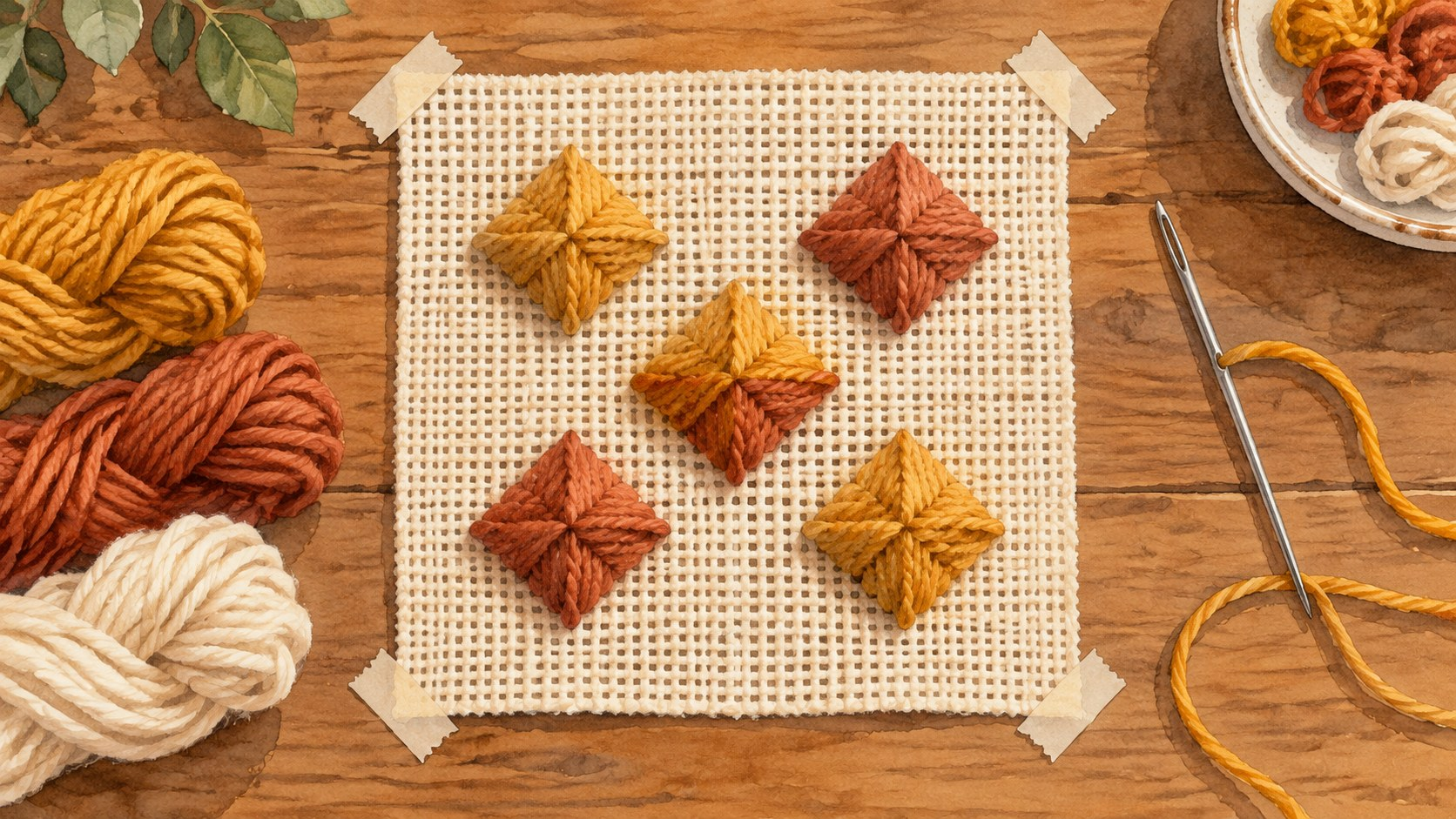
A Rhodes stitch is a pile of long straight stitches that fan around a square (or another shape) on needlepoint canvas, every stitch crossing the center. The crossings stack up into a raised, faceted bump - a little pyramid of thread that catches the light and gives a canvas real texture. It is named for Mary Rhodes, the English needlepoint designer and teacher, and it comes in more variations than almost any other canvas stitch. Last updated October 23, 2026.
Start here: a basic square Rhodes is just straight stitches worked one hole further around the edge each time, all crossing the center. Work a 4-thread square in a smooth perle cotton and you will have the rhythm in minutes. The only real rule: work every Rhodes stitch in a piece the same way, so the top stitch always slants the same direction.
What a Rhodes stitch is
The Royal School of Needlework StitchBank describes Rhodes as a large canvaswork stitch made up of square blocks of slightly raised straight stitches that fan out around the grid and cross in the center, filling all 360 degrees. Floss Field describes the finished look as long stitches that cross the center of a square in turn, building a raised, faceted pyramid.
Janet at Nuts About Needlepoint calls Rhodes "a method more than a stitch," and that is the best way to think about it. You are not learning one fixed shape; you are learning a way to layer straight stitches around any outline - square, circle, rectangle, diamond, heart, octagon, even a star. KC Needlepoint, a shop that publishes stitch tutorials for its customers, puts it plainly: any time you hear the word Rhodes, expect stitches layered on top of each other, and there are "a million different variations."
The stitch takes its name from Mary Rhodes, an English needlepoint designer who loved texture and explored how different stitches worked together in a design. Shannan at Sewing with Bobbin and Fred notes she was also an advocate for tent stitch, and her students helped introduce needlepoint in the United States. If you enjoy raised, geometric canvaswork, the Smyrna cross stitch is a close cousin - another stacked stitch that forms a small bump.
How to work it
Sources number their diagrams differently (more on that below), but the working rhythm is the same everywhere. These steps follow Floss Field's 4-thread square:
- Stitch corner to corner. Bring the needle up at the bottom left corner of your square and go down at the top right corner. This diagonal is stitch one.
- Move one hole along at each end. Come up one hole to the right along the bottom edge, and go down one hole to the left along the top edge. The second stitch sits slightly inside the first.
- Keep moving around the square. Continue shifting one hole along the edge at each end, always in the same direction (Floss Field works counterclockwise). Every stitch crosses the center of the square.
- Go all the way around. Keep going until every hole on the edge of the square has been used. On a 4-thread square that is 8 stitches; the last one runs from the top right corner to the bottom left corner.
The RSN StitchBank works a bigger version (spanning more threads, 12 stitches per square) and starts one canvas thread in from the corner rather than on it, but the logic is identical: each stitch starts one hole further around the edge, the sixth stitch runs from bottom right to top left, and the twelfth closes the square. The RSN adds one practical rule for multi-stitch patterns: always work the stitches in the same order and direction, so the last stitch is always the same.
Queenie at Queenie's Needlework offers a useful trick for rectangles: you can start anywhere in the shape. Starting in a corner means the final stitch is a long one; starting in the middle, where the stitch length is shortest, lets the last stitch bind all the threads down tighter.
Sizes and shapes
A Rhodes stitch can be worked over almost any even count. Needlework Tips and Techniques suggests 4, 6, 8, 10 or 12 canvas threads, and both Floss Field and the RSN note the same stitch works smaller or larger, with combinations of sizes working well together. The count changes the number of stitches in the fan: a 4-thread square needs 8 stitches, while the RSN's larger square takes 12.
| Variation | Shape | Notes |
|---|---|---|
| Square | Square over 4-12 threads | The classic. Full coverage, strongly raised center. |
| Rhodes circle | Round, flower-like | Unwind Studio's tutorial works it over 4 or 5 threads; recommended for small areas and flowers. |
| Rhodes heart | Heart outline | Start with stitch 1-2 so the last stitch is vertical; pretty in a border row. |
| Rhodes diamond | Tall diamond | Each stitch uses a hole diagonal to the previous one around the edge. |
| Half Rhodes | Half square | Worked side by side, looks like little bow ties; alternated in two colors it makes a checkerboard. |
| Rectangle / octagon | Elongated or 8-sided | Bobbin and Fred's octagon uses 16 numbered points; Queenie's rectangles vary thread amounts. |
KC Needlepoint adds that Rhodes can also be worked as ovals and stars - the layering method is what makes it a Rhodes, not the outline.
Thread choices
Because the stitches are long and layered, thread choice shows. The sources agree on the main points:
- Smooth threads work best. Floss Field advises a smooth thread and keeping stitches from twisting. Needlework Tips and Techniques suggests trying thick or thin, matt or shiny threads, and notes the stitch looks especially lovely in silk or rayon.
- Use a laying tool for slippery fibers. Both Floss Field and Needlework Tips and Techniques recommend a laying tool with silk or rayon. Our laying tool guide covers the technique.
- Strip stranded floss first. Bobbin and Fred's top tip: separate stranded cotton into its six strands and recombine them before stitching. This removes the twist so the threads lay flatter and look fuller.
- Variegated thread changes the look. Needlework Tips and Techniques notes variegated or hand-dyed fibers give a beautiful effect, since each leg of the fan can land in a different shade.
- Match thread amount to the job. Queenie showed that a thicker bundle looks the same on the front but builds a much thicker back - worth it on upholstery canvas for a seat cover that will take wear, wasteful on a framed piece. For more on matching fiber to project, see needlepoint thread types.
One caution from Bobbin and Fred: Rhodes is bulky when finished, so do not go too huge with it, especially in a thick yarn.
Where to use Rhodes stitches
Floss Field lists accents, focal points, corners, and rows worked as a border, and rates the coverage as full and strongly raised. The RSN StitchBank categorizes it for filling and shading. Specific ideas from the sources:
- Eyes and small circles. Nuts About Needlepoint shows Rhodes circles used for the eyes on a rooster canvas.
- Flowers and wheels. Unwind Studio recommends the circle version for small areas and flowers.
- Borders. A row of Rhodes squares or hearts makes a dimensional border - our borders guide has more options in the same spirit.
- Checkerboard texture. Half Rhodes squares in two alternating colors create a woven checkerboard (Needlework Tips and Techniques).
- Sparkle accents. A fine metallic thread turns a Rhodes diamond into a glittering focal point, as in the rayon ribbon and metallic examples from the Textures To Dye For pattern.
Where sources disagree
How many stitches, and where to start. Diagrams number the stitch sequence differently. Floss Field works a 4-thread square with 8 stitches, starting on the corner holes. The RSN StitchBank works a larger square with 12 stitches, starting one canvas thread in from the corner. Bobbin and Fred and the RSN both work anti-clockwise; other diagrams travel the other way. Floss Field's own note settles it: stitch diagrams differ on which corner to start from and which way to travel round the square, and any of them works as long as you do every Rhodes stitch in a piece the same way.
Corner start or middle start. Queenie at Queenie's Needlework points out that starting in a corner leaves a long final stitch, while starting in the middle lets the last stitch bind the pile tighter. Most square diagrams start at a corner; for a very large stitch, Floss Field and the RSN instead suggest a single tent stitch over the center to hold the last long stitch down.
One stitch or a family. Some sources treat Rhodes as a single square stitch with a set size, while Nuts About Needlepoint calls it a method and KC Needlepoint counts squares, circles, ovals and stars as variations. In practice, stitchers use "Rhodes" for the whole layered family, with the shape named after it (Rhodes square, Rhodes heart, Rhodes circle).
Tips for a neat result
- Be consistent. Every source that mentions it says the same thing: start every Rhodes stitch at the same place and work in the same direction, so all the top stitches slant alike and catch the light together.
- Keep tension even. Long stitches snag and bag easily. Pull each stitch snug but not tight, and let the layers build the bump - do not force height by over-tightening.
- Anchor huge stitches. On a very large Rhodes, add a single tent stitch over the center to hold the last long stitch in place (Floss Field, RSN).
- Practice on hearts. Nuts About Needlepoint suggests a free Rhodes heart pattern as a low-stakes way to get the rhythm before committing to a canvas.
- Plan the back. If the piece will be used, not framed, remember Queenie's lesson: more thread means a thicker, tougher back.
FAQ
Is Rhodes stitch hard for a beginner?
No. It is only straight stitches laid in a fan, and Needlework Tips and Techniques labels it beginner friendly. Bobbin and Fred call it one of those decorative stitches that looks impressive but is easy once you know the numbering. A 4-thread square is a good first try.
What size Rhodes stitch should I use?
Needlework Tips and Techniques suggests anywhere from 4 to 12 canvas threads. Smaller squares (over 4) suit accents and eyes; larger ones make bold focal points. Bobbin and Fred caution against going too big, because the stitch gets bulky, especially in thick yarn.
Which thread works best for Rhodes stitch?
A smooth thread that will not twist - perle cotton, tapestry wool, silk or rayon. Floss Field and Needlework Tips and Techniques both recommend a laying tool for silk and rayon, and Bobbin and Fred recommend stripping and recombining stranded floss so it lays flat.
Why does my Rhodes stitch look untidy?
The usual causes are inconsistent direction and twisted thread. Work every stitch in the piece the same way so the top stitches all slant alike, and use a laying tool or stripped floss so each leg of the fan lies flat. The bump in the middle is supposed to be there - that is the point of the stitch.
What is the difference between Rhodes stitch and Rhodes circle?
Same method, different outline. A square Rhodes fans stitches around a square; a Rhodes circle fans them around a round outline and looks like a flower or wheel. Unwind Studio publishes it over 4 and over 5 threads, and Nuts About Needlepoint uses it for eyes and small circles.
Sources
- Floss Field - Rhodes stitch (step-by-step 4-thread square, tips on smooth thread, laying tools and anchoring large stitches)
- Royal School of Needlework StitchBank - Rhodes stitch (larger 12-stitch square, consistency rule, uses for filling and shading)
- Needlework Tips and Techniques - Rhodes Stitch: Heart, Square and Diamond Variations (sizes 4-12 threads, heart, diamond, half Rhodes and checkerboard variations, thread suggestions)
- KC Needlepoint - Rhodes Square, 4 over 4 (a needlepoint shop's stitch tutorial; layering concept and the range of Rhodes variations)
- Sewing with Bobbin and Fred - Hand Stitch SOS: How To Rhodes Stitch (Mary Rhodes history, octagon and square numbering, stripping stranded floss, bulk caution)
- Nuts About Needlepoint - Great Stitches for Triangles and Circles (Rhodes as a method, circles for eyes, practice suggestion)
- Queenie's Needlework - Sunday Stitch School Lesson 296: Rhodes Rectangle Stitch (rectangles, starting point choices, thread thickness and the back of the work)
- Unwind Studio - Rhode Circle Stitch (over 4 and over 5) (a shop selling kits and booklets; circle variation over 4 and 5 threads, recommended for flowers)