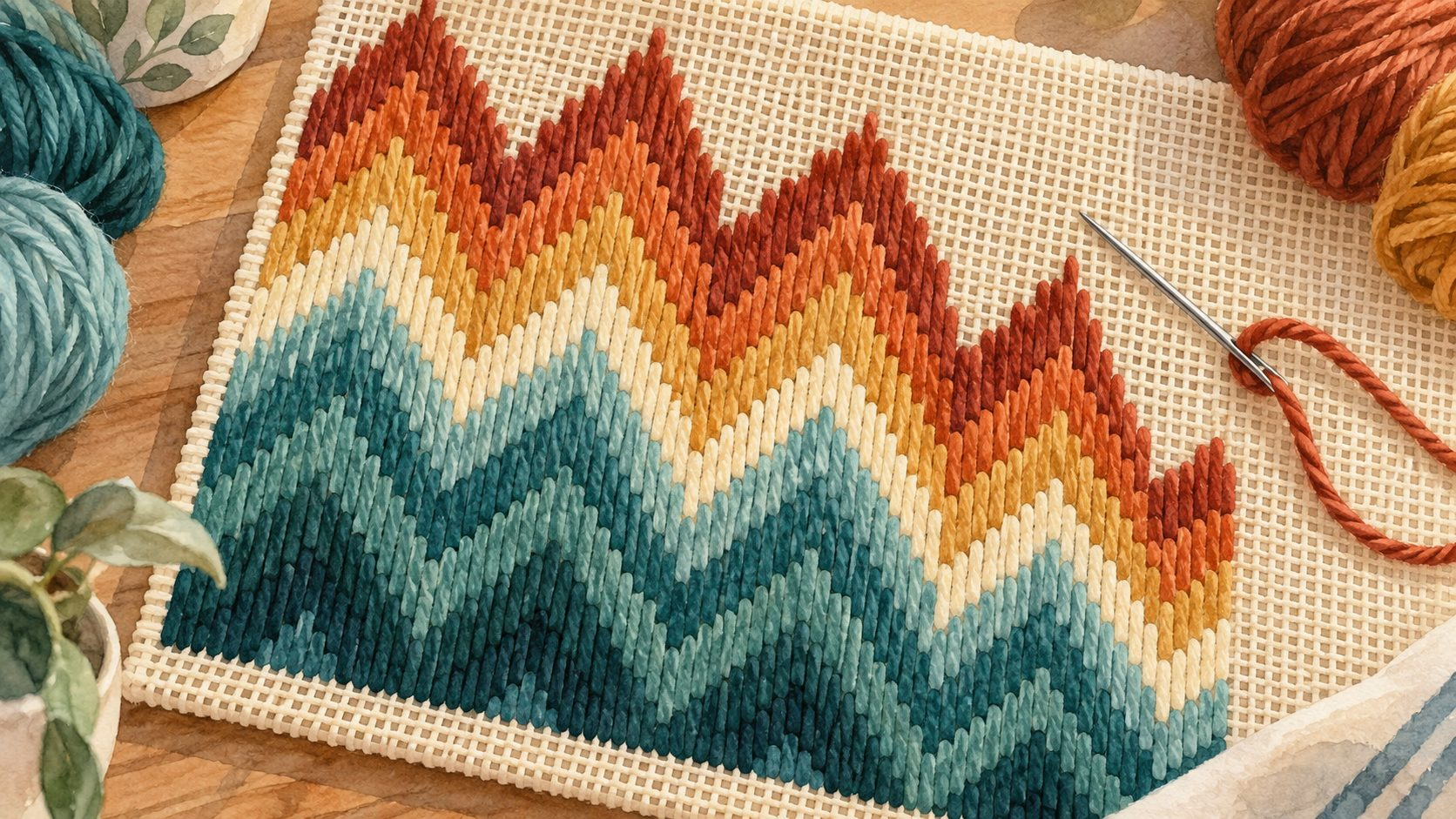
Bargello is the needlepoint style built from one straight upright stitch, repeated in stepped rows that climb and fall into flames, waves and diamonds. It looks complex, but every source we read agrees on the same two points: the stitch itself is simple, and all the care goes into counting the first row, because every row after it copies that row exactly.
Work a first row of upright stitches, each over the same number of canvas threads, stepping each stitch two threads up or down from the last. Check that row against your chart. Then repeat the same line above and below it, one color per row. That is the whole technique. The Royal School of Needlework's stitch bank shows each stitch over four threads with a two-thread step, and says the first complete wave sets the pattern for the whole piece.
What Bargello is
Bargello is a form of needlepoint, or counted thread embroidery on canvas, made entirely of upright flat stitches laid in a mathematical pattern. That is how Wikipedia defines it, and The Spruce Crafts describes it the same way. A Bargello guide from needlepointlns.com adds a rule that separates it from other canvas work: the stitches lie straight along the canvas threads, never on the diagonal. It quotes needlepoint teacher Susan Sturgeon Roberts saying you would never see a diagonal stitch in a true Bargello.
You will see the same technique under several names. Wikipedia, the Embroiderers' Guild of America (EGA) and the RSN stitch bank list Florentine work, flame stitch, Hungarian point, Irish stitch and cushion stitch. Wikipedia notes a wrinkle: the chairs in the Bargello museum use flame stitch motifs, but curved motifs are also common, and those curved pieces would normally be called Bargello rather than flame stitch. So flame stitch is really one Bargello motif, even though the name is often used for the whole technique.
The stitch and the step
A Bargello stitch is one straight stitch up the canvas, over a set number of threads. The RSN stitch bank shows it across four threads, with each stitch stepped two threads above or below the one before. The needlepointlns.com guide says older patterns call this the 4-2 step, citing Nordic Needle, and that patterns also describe it as stitches over 4 with a step of 2, citing Bargello designer Lizart.
- Stitch length varies by pattern. NeedlepointTeacher.com says a stitch can cross anywhere from two to eight threads. Lizart describes Hungarian point patterns that mix stitches over two and over six.
- The step shapes the line. Carol Leather, who has taught embroidery since 1992, explains on her site that a bigger step makes steeper, sharper peaks and a smaller step makes gentler waves, and that grouping stitches at the same height rounds a zigzag into a curve.
- Needle direction follows the slope. Nordic Needle's tip, quoted by needlepointlns.com: where the line climbs, work each stitch from the top down, and where it falls, work from the bottom up. This leaves longer stitches on the back, which Nordic Needle says makes the work strong and helps the stitches lie well. The needlepointlns guide follows that rule for the first row, then switches to a coverage rule from Lizart for the rows after.
- Patterns are geometric, not pictures. The RSN names the flame or wave, where colors rise and fall, as the most common pattern, with oval and stepped patterns as the other classics. The EGA describes flames as sharp zigzags like flickering flames, with ribbon and medallion patterns stepping more gradually into smooth curves.
The first row
Every row in a Bargello piece copies the first row, above or below it, so a miscount in the foundation row repeats across the whole piece. Nordic Needle warns, via needlepointlns.com, that a design can end up far off if its foundation line is wrong. The practical advice is to work the first row slowly and check each group of stitches against the chart before starting the second. Our guide to reading a needlepoint chart covers the counting habit in more detail.
When you add rows, each stitch of the new row goes into the hole where the stitch above it ends, so the rows nest together, as the needlepointlns.com diagrams show. KC Needlepoint notes that wave patterns can also be spaced out, leaving a canvas thread open between rows for a lighter look.
Canvas and thread
- Canvas. Needlework Tips and Techniques suggests a 10 to 14 mesh canvas for beginners: the holes are large enough to see and the stitches cover well. The Spruce Crafts starts beginners on 10-mesh plastic canvas, which needs no taping or frame. On regular needlepoint canvas, The Spruce says to trim it with an extra inch or so on all sides and tape the raw edges with masking tape. Our canvas types guide and mesh size chart go deeper.
- Thread. Traditionally Bargello was stitched in wool on canvas, as Wikipedia and the EGA both note. The Spruce pairs tapestry wool or Persian wool with the canvas size so the stitches cover it. Needlework Tips and Techniques says wool, pearl cotton or even embroidery floss all work. The EGA says contemporary stitchers also use cotton and silk, and that metallic threads and variegated yarns can add shimmer or gradient transitions. Our thread types guide compares the main fibers.
- Needle. A blunt tapestry needle that slips through the canvas holes, per Needlework Tips and Techniques. See our needle guide for sizes.
- Starting and ending. No knots. The Spruce says to leave a small tail on the back and let the first few stitches secure it. The stitchcraft.info instructions say to finish a thread by running the needle through the back of four or five stitches and trimming close. Our start and end thread guide has more options.
Choosing colors
Color is where Bargello gets its depth. The RSN says one color generally goes to one complete wave of the design, and calls a varied use of color essential. The EGA says yarns are typically chosen in ranges of analogous colors to build the shading Bargello is known for. PieceWork magazine, quoted by needlepointlns.com, calls runs of neighboring colors on the color wheel, from light to dark, the classic choice.
Lizart, also via needlepointlns.com, adds a historical note: since about 1900, Bargello has usually been worked in shades of one color, sometimes with a single contrasting row, while seventeenth-century pieces used many colors, often bright ones. If you want to play with color shifts, our variegated thread guide covers how those threads behave in needlepoint.
Four-way Bargello
Four-way Bargello turns the pattern at the diagonals. Wikipedia credits Dorothy Kaestner with creating the style and quotes her own account: in the early 1960s she placed a mirror on a Bargello design to see how it would look with a mitered corner, then graphed a design starting in the center and mitering all four corners. Her book Four Way Bargello was first published in 1972, as both Wikipedia and needlepointlns.com note.
The method, per Wikipedia and the needlepointlns guide: divide the canvas diagonally into quarters, then work the same motif in each triangle, with the stitches vertical in two opposite areas and horizontal in the other two. The result often resembles a kaleidoscope. Nordic Needle warns against ruling the diagonals with a pen, because canvas mesh is not always exactly square and a ruled line can put stitches in the wrong holes. The idea extends to eight-way Bargello, worked in eight directions from the center.
What it is good for
Bargello in wool on canvas is remarkably durable, Wikipedia says, well suited for pillows, upholstery and even carpets, but not for clothing. The EGA makes the same call: because it is a hardwearing technique, it suits high-traffic home decor pieces like rugs, cushions and upholstered furniture, plus accessories like shoes and purses. Needlework Tips and Techniques suggests smaller starter projects: cushions, bags, belts, purses or framed pictures. When a piece is done, our finishing basics guide and pillow finishing guide cover the next step.
Where the name comes from
The name comes from the Bargello in Florence, a palace that is now the Museo Nazionale del Bargello, which holds a set of seventeenth-century chairs upholstered in canvas embroidery worked this way. The RSN, the EGA and Wikipedia all tell that part the same way. Before the palace connection, the EGA dates the earliest known examples to the 14th century, found in Hungary, Italy and Great Britain.
Where the technique itself began is unsettled, and the sources say so. The RSN calls the origins obscure: it has been suggested the style came from fifteenth-century Florentine migrants to Hungary, but there is no hard evidence. Wikipedia notes the Hungarian connection is more than a rumor, though. The Bargello museum's own inventory lists the chairs as seventeenth century with backs and seats done in punto unghero, Hungarian point, and Queen Maria Theresa of Hungary stitched Bargello in the eighteenth century, with her work preserved in the Hungarian National Museum. The EGA repeats a legend that a fourteenth-century nobleman taught the stitch to palace inmates, while noting it is unlikely given short prison stays and poor lighting.
What is better documented is the spread. The RSN says the technique appears on seventeenth-century Icelandic ecclesiastical pieces, was popular on English samplers from the early to mid seventeenth century, and shows up on eighteenth-century Chinese Mandarin squares. The EGA and needlepointlns.com both record a strong revival in the United States in the 1960s and 1970s, when the geometric, colorful look fit interior decor trends; needlepointlns.com counts Erica Wilson among the authors of the Bargello books of those years.
Pattern types at a glance
| Pattern | How it steps | Sources |
|---|---|---|
| Flame or wave | Regular two-thread steps up and down; the most common pattern | RSN StitchBank, needlepointlns.com |
| Oval | Grouped stitches at the same height round the zigzag into a curve | RSN StitchBank, Carol Leather |
| Stepped and diamond | Steeper steps and repeated blocks form angular motifs | RSN StitchBank, Needlework Tips and Techniques |
| Ribbon and medallion | Gradual steps make smooth curves | Embroiderers' Guild of America |
| Hungarian point | Mixes stitch lengths, for example over two and over six threads | Lizart, via needlepointlns.com |
Working tips
- Carol Leather, via needlepointlns.com, suggests a simple zigzag or diamond as a first pattern.
- For large designs, The Spruce Crafts says it helps to start at the middle of your chart; on a small piece, starting near the top edge works.
- Match canvas size and yarn size so the stitches cover the canvas, per The Spruce; on 10-mesh plastic canvas, tapestry wool covers well.
- Is Bargello hard? The stitch is not, per Carol Leather and Nordic Needle, because every stitch is straight. NeedlepointTeacher.com rates it a step harder than easy stitches like continental and brick, and Lizart finds Hungarian point patterns, with their mixed stitch lengths, difficult until you get the hang of them. The careful work is counting, not stitching.
- If you want a custom chart of your own, our photo to needlepoint pattern guide shows how to turn an image into a stitchable canvas.
Where sources disagree
- Where Bargello began: The RSN says the Hungarian origin story has no hard evidence. Wikipedia points to the museum's own punto unghero inventory note and Queen Maria Theresa's preserved work as signs of a real Hungarian connection. The EGA repeats legends on both sides. Nobody settles it.
- How many threads a stitch crosses: The RSN shows the classic stitch over four threads. NeedlepointTeacher.com says anywhere from two to eight. Nordic Needle recommends an even number of threads, and stitchcraft.info says Bargello is usually worked over an even number, commonly four. KC Needlepoint says its Bargello patterns typically go over three or five, odd counts.
- Is it needlepoint or its own thing: Wikipedia and The Spruce call Bargello a type of needlepoint or counted thread embroidery. Needlework sellers and teachers often treat it as a separate style with its own books and patterns. The technique is the same either way.
- Flame stitch means what: Some pages use flame stitch as a synonym for all Bargello. Wikipedia points out that curved Bargello motifs are not flames, so the synonym is loose.
- What to buy: Several of these pages sell kits, canvases or patterns. We did not check current prices.
Questions
Is Bargello the same as needlepoint?
Bargello is a style of needlepoint: counted, upright stitches on canvas. Wikipedia and The Spruce Crafts both describe it that way. It differs from tent-stitch needlepoint mainly in using one long straight stitch instead of small diagonal ones.
Is Bargello good for beginners?
The sources say yes, with one caveat. The stitch itself is simple straight stitches, per Carol Leather and Nordic Needle, and The Spruce Crafts rates its Bargello project beginner level. The careful part is counting the first row, which every later row copies.
What canvas and thread do I need for Bargello?
A 10 to 14 mesh canvas with wool, pearl cotton or floss, per Needlework Tips and Techniques, or 10-mesh plastic canvas with tapestry wool, per The Spruce Crafts. Match the yarn thickness to the mesh so stitches cover the canvas.
What is the 4-2 step in Bargello?
Each stitch crosses four canvas threads, and each new stitch starts two threads above or below the last. The RSN StitchBank shows that spacing, and Nordic Needle says older patterns call it the 4-2 step.
What is four-way Bargello?
A style Dorothy Kaestner developed in the 1960s and published in 1972: the canvas is divided diagonally into four triangles and the same motif is worked in each, turning at the diagonals, which creates a kaleidoscope effect.
Can Bargello be used on clothing?
Wikipedia says no: it is remarkably durable on canvas and suits pillows, upholstery and carpets, but not clothing.