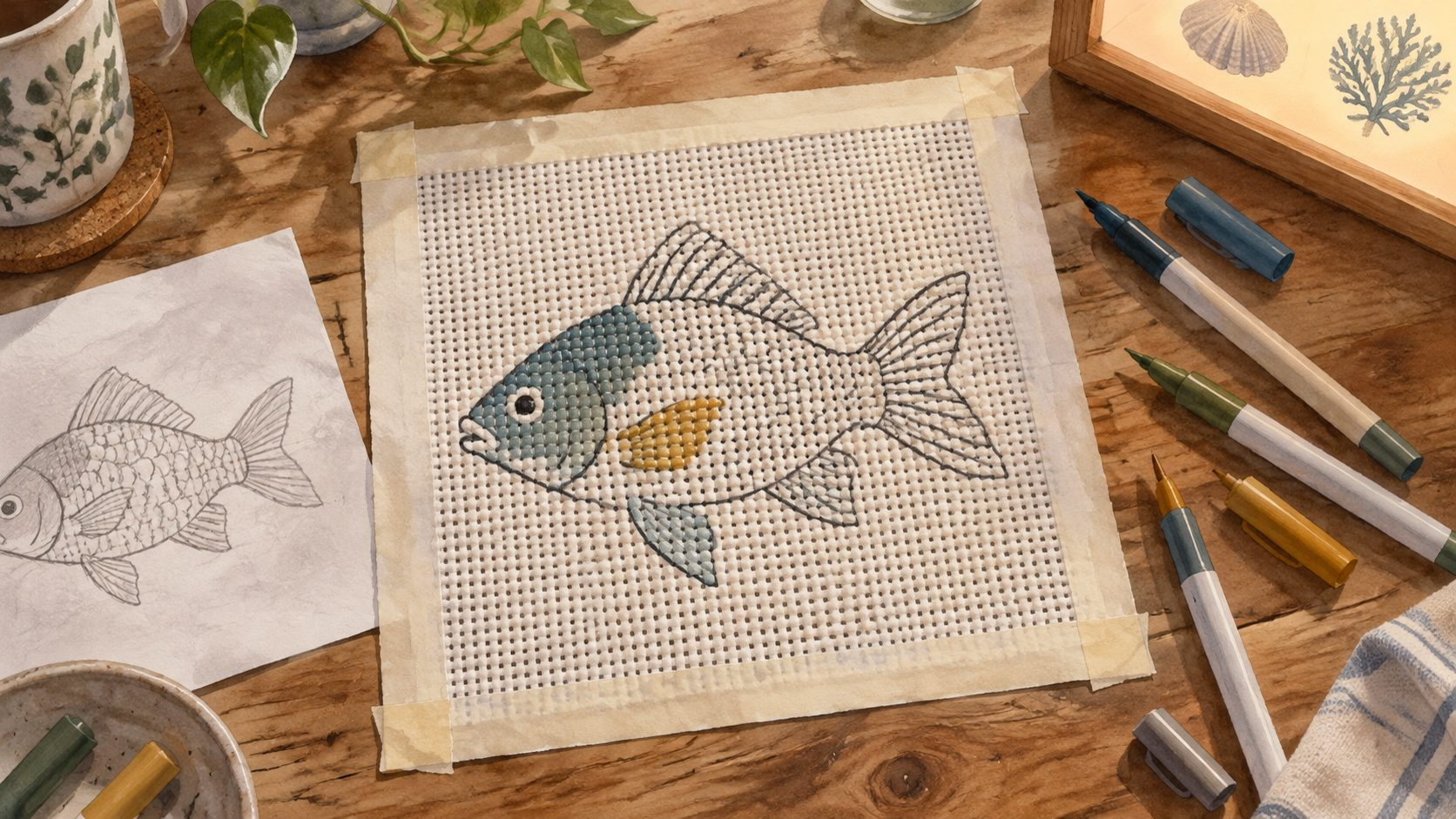
Any pen you use on a needlepoint canvas ends up next to your yarn, and ink that bleeds or rubs off can stain it for good. This guide pulls together eight sources on which pens stitchers use to mark, outline or color canvas, what one tester found, and where the advice splits. The main finding is dull but useful: let the ink dry for a full day before you stitch.
Use a permanent, waterproof pen, ideally a Pigma Micron or a marker made for fabric, mark lightly and let it dry overnight before stitching (Nuts about Needlepoint). Never use pencil, tracing paper, or a pen that is not waterproof, made for fabric or tested (Nuts about Needlepoint, Howdy Honey Needlepoint). Test on a scrap of canvas first.
Why the pen matters
Howdy Honey Needlepoint, a shop selling the pens, says Pigma Micron ink is waterproof and fade-proof and beats pencil, which rubs off, fades so you lose the line, and moves onto fingers and fibers. Nuts about Needlepoint says tracing paper should never be used to transfer a design because its coating rubs off and discolors threads. Needlepoint For Fun lists waterproof, non-alcohol, permanent pens, a fabric pen or a disappearing ink pen as the tool for sketching a design on blank canvas.
What was tested
Janet Perry of Nuts about Needlepoint ran a test of pens on canvas. She marked canvas, wet it, rubbed it, blotted it, and repeated the process 24 hours later after the pens had dried. She also tried heat setting and found waiting did the trick, with heat setting making no difference.
| Pen group | Result reported |
|---|---|
| Plain gel pen (Pilot) | Failed every test. |
| Permanent markers not labeled for fabric (Pigma Micron, extra fine Sharpie, Copic) | All worked after waiting 24 hours. |
| Markers labeled for fabric (ZIG textile, FabricMate, DecoFabric, Marvy) | Worked after waiting 24 hours. Several failed the first blotting test before drying. |
She found the most consistent results with fabric markers, Pigma Microns and Copic markers. She uses Pigmas for transferring designs, marking the outside of a design area and very fine lines, fabric markers for larger areas when the color is right, and Copic otherwise. She also likes Pilot SCA-UF, a fine outliner she says most designers she knows prefer. Metallic markers worked for her but need several days to dry, so she does not recommend them. In the past she found BIC permanent markers and regular Sharpies ran, but she had not let them dry first, so she says she needs to retest. She also warns that any marker's formula can change, so test from time to time.
Pens people name
- Pigma Micron. Named by Nuts about Needlepoint, Needlepoint For Fun, Howdy Honey Needlepoint and Serendipity Needleworks, whose writer says she has never had one bleed or smear, unlike other pens that claim to be permanent. In a Kreinik Facebook thread several stitchers also named Micron.
- Sharpie. Some stitchers in that thread use fine point Sharpies, usually in pale colors for thicker lines. Another says not Sharpie on canvas, and Nuts about Needlepoint says regular Sharpies ran in her older tries.
- ZIG markers. Used for years by one stitcher in the Kreinik thread, who says they can usually be found in a good art supply store. Nuts about Needlepoint tested the ZIG textile marker.
- Identi-Pen. A designer in the Kreinik thread uses the extra fine one just for light outlining. Chilly Hollow says the Identi-Pen set sold by one shop has a sharper end and a blunter end, and that its label says waterproof when dry but not meant for fabric.
- Frixion. One stitcher suggested the heat-erasable Pilot pen, saying the ink disappears with a little heat. That is a stitcher's suggestion in a social thread. We would test it on scrap first (our caution).
- Copic. Nuts about Needlepoint uses Copic for larger areas. Serendipity Needleworks replied in its comments that Copic markers are the only markers it recommends for coloring a canvas, available at craft chains.
How to mark canvas safely
- Pick a waterproof marker, preferably a fine one (Nuts about Needlepoint, Needlepoint For Fun).
- If tracing a design, place the canvas on top of it. Tape the design and canvas to a window or lightbox if it is hard to see, and trace the outlines. Nuts about Needlepoint says to darken the paper outline with a black marker so it shows through (Nuts about Needlepoint).
- Match the pen color to the thread color you plan to stitch, or use pale gray (Needlepoint For Fun).
- Let the ink dry overnight before stitching, because many inks become waterproof only after drying completely (Nuts about Needlepoint).
CraftsUprint also uses a permanent, waterproof fabric marker to write top on the top edge of a new canvas, and an arrow in the top left corner. Our canvas preparation guide and edge taping guide cover the other steps. For the design side see how to design a needlepoint pattern and how to paint your own canvas.
What not to use
- Pencil. Rubs off and dirties fibers (Howdy Honey Needlepoint).
- Tracing paper. The material rubs off and discolors threads (Nuts about Needlepoint).
- Plain gel pens. Failed every test (Nuts about Needlepoint).
- Anything not waterproof, not made for fabric or not tested (Nuts about Needlepoint).
- Dye pens made for the wrong fiber. Nuts about Needlepoint says dye pens are usually fine if the dye is for plant fibers such as cotton, and acrylic paint pens are no problem.
Coloring canvas with pens
For painting a design, Needlepoint For Fun says to sketch with a waterproof marker, then fill in with acrylic paint, thinking of each canvas intersection as a stitch. Serendipity Needleworks says the Micron outlines the components and paint fills them. Our blocking guide matters here too, because water on a marked canvas is the test that finds a bad pen.
Where sources disagree
- Sharpie. Some stitchers in the Kreinik thread use fine Sharpies and others say never. Nuts about Needlepoint says the regular ones ran in her older tries but they were not dried first and need a retest, and her formal test lists extra fine Sharpie among markers that worked after 24 hours.
- Fabric markers or Microns. Nuts about Needlepoint found fabric markers, Microns and Copic most consistent. Needlepoint For Fun names Fabricmate and Pigma Micron. Chilly Hollow notes the Identi-Pen is not labeled for fabric. The sources do not agree on one pen.
- Heat setting. Nuts about Needlepoint says heat made no difference, only waiting. A pen's own instructions may say otherwise, so read the label.
- Metallic markers. Nuts about Needlepoint used them successfully but does not recommend them because of the long drying time.
- Using Copic. Serendipity Needleworks says Copic is the only marker for coloring canvas. Nuts about Needlepoint also uses Copic, but adds fabric markers when the color is right.
Questions
What pen should I use on needlepoint canvas?
A permanent, waterproof marker, with Pigma Micron the most often named (Nuts about Needlepoint, Serendipity Needleworks).
Can I use a pencil?
Not recommended. It rubs off and dirties fibers (Howdy Honey Needlepoint).
How long should ink dry?
Overnight (Nuts about Needlepoint).
Is a Sharpie okay?
Sources are split. Test it on scrap canvas, let it dry a day and wet it.
Can I use tracing paper to transfer a design?
Nuts about Needlepoint says never, because it rubs off and discolors threads.
Sources
- Nuts about Needlepoint, Marking Pens and Needlepoint
- Nuts about Needlepoint, Tracing Paper to Trace Canvas?
- Kreinik Thread Blog, Marking pens for needlepoint canvases
- Chilly Hollow Needlepoint Adventure, Identi-pens for Coloring Canvas
- Needlepoint For Fun, Needlepoint Canvas Painting
- Serendipity Needleworks, Painting Needlepoint Canvases
- Howdy Honey Needlepoint, Pigma Micron Pen
- CraftsUprint, How to Prepare a Needlepoint Canvas for Stitching