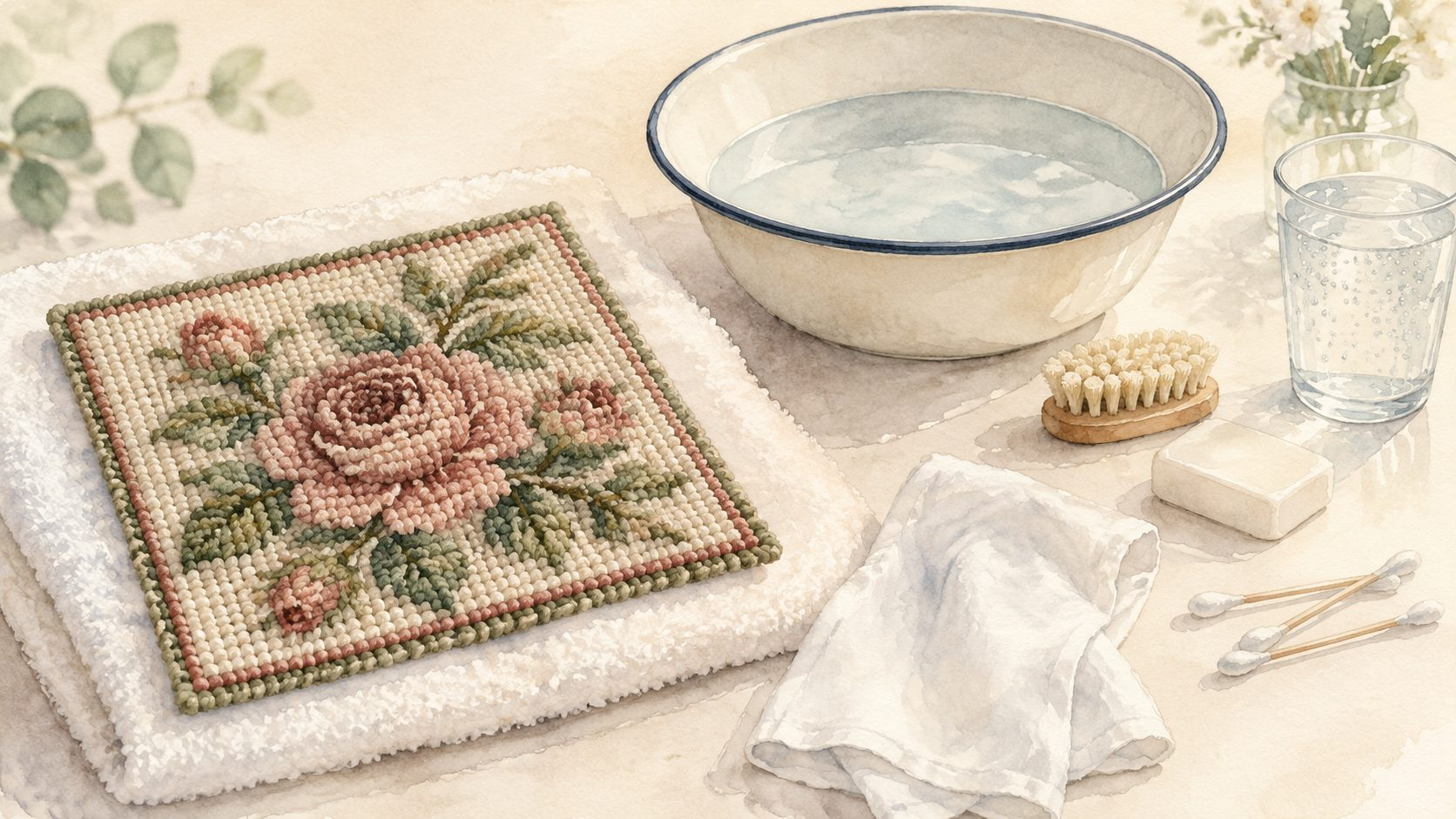
Most finished needlepoint never needs a full wash. The sources we read agree on the order: dust it, test the threads, spot clean, and only then think about washing the whole piece. They disagree sharply about whether soap and water belongs anywhere near needlepoint at all.
Vacuum gently first, using mesh over the nozzle and holding it just above the surface. Test every thread you will wet for colorfastness. Blot stains, never rub. Dry flat, never hanging, and reblock if the shape moved. If the piece is valuable, old, or has beads or ribbon, take it to a professional instead.
Does it need cleaning
DMC says many needlework projects never need to be washed, and that washing hands before stitching and covering the work between sessions may mean you never have to. Yarn Tree makes the same point: be sure the piece really does need cleaning before you start. Cleaning always carries some risk to threads and canvas, so the cheapest fix is the lightest one.
Before any cleaning, Serendipity Needleworks suggests checking the piece for loose threads, tears, and delicate embellishments such as beads, silk ribbon, or buttons, and taking extra care around them. If you have a valuable piece, it recommends a professional textile restorer.
Dust and vacuum first
Three sources start here. Needlepoint.com says to cover the vacuum hose with nylon or another mesh so the suction is gentle, keep the nozzle just above the canvas, and do the front first and then the back. DMC says the same for tapestry and needlepoint homewares. Serendipity Needleworks suggests a soft brush or lint-free cloth, worked in one direction so it does not snag threads, and a low-suction vacuum with a soft brush for larger items such as pillows. Brvsk, a needlepoint pillow seller, suggests a gentle shake outdoors or a soft clothes brush swept in the direction of the stitching.
This may be all you need. Dust is also the main everyday problem, so a light routine beats a deep clean.
Test colorfastness
Every water-based method below depends on the dye staying put. Serendipity Needleworks says needlepoint thread is the main concern, because not all thread is colorfast. It gives two tests. With leftover thread, soak a piece at least 2 inches long for at least eight hours in lukewarm water, then press the wet thread between two white paper towels with a steam iron to see if color transfers. With no spare thread, dab a water-dampened cotton swab on each color, and if any color transfers, do not use water on the piece.
A second Serendipity post gives a quicker thread test: lay at least 2 inches of thread on a moistened white paper towel, fold it over, press, wait at least 10 minutes, and check the towel. It adds that colorfastness can vary between threads and even between dye lots of the same thread. Needlepoint.com suggests wiping the canvas with a white cloth damp with cold water to see if any colors transfer.
The same post says to test each thread you used for a full clean, but only the threads in the affected area when spot cleaning. If you are planning a blocking session, the same test applies, since blocking wets the piece too.
Spot cleaning
- Act gently and promptly. Brvsk says to blot, never rub, with a clean dry white cloth to lift as much as possible.
- Club soda first. Serendipity Needleworks prefers fizzy club soda on a cotton swab or ball, followed by blotting with a dry white cloth, repeating as needed without drenching the area.
- A mild cleaner. If club soda does not work, Serendipity says to test any solution on an inconspicuous area, then blot with a small amount on a white cloth. Brvsk suggests a cloth dampened with cool water and a tiny drop of mild wool detergent, pressed on lightly, then blotted with plain water.
- Never scrub. Serendipity warns rubbing can make colors bleed or threads loosen.
DMC adds a caution for printed designs: do not immerse them in water, and do not dry-clean them. That tip is written for pre-printed embroidery fabric. Many needlepoint canvases are hand painted, so check what your canvas is before you wet it. Our canvas types guide covers the canvas itself.
Washing a whole piece
This is where the sources split, so read the next section too. If you decide to wash, the practical steps from the sources that allow it are:
- Remove any backing, insert, or part that could corrode in water, as Needlepoint.com says.
- Fill a clean basin with lukewarm water. Serendipity Needleworks uses a bar of Ivory soap to make a lightly sudsy solution, dips a white cloth in it, wrings it out, and dabs the surface in small sections with light pressure. Needlepoint.com adds a gentle cleaning solution to a basin and soaks a very stained piece for about 10 minutes, after testing a small area first.
- Rinse. Serendipity blots with a clean cloth dampened with lukewarm water and warns not to saturate the piece, since too much moisture can stretch it.
- Roll it in a towel to take out water. Do not wring.
Brvsk applies this to pillows: if the cover has a zip and a removable insert, hand-wash the cover alone in cool water with wool detergent, press the water out without wringing, dry it flat face down on a towel, and block it square while damp. It says the safest route for a deeper clean is a dry cleaner experienced with hand-stitched textiles, and to mention that it is wool needlepoint.
Drying and reblocking
Lay the piece flat on a clean towel or mesh rack, away from direct sun and heat, as Serendipity Needleworks says, and do not hang it, because hanging can stretch or warp it. If the shape shifted, Serendipity says to block while damp, pinning the edges to a padded board with stainless steel pins or tacks and drying fully in place. Needlepoint.com says to roll the piece in a towel, reblock on a corkboard or stiff board, and allow up to two days to dry. See our blocking guide for the pinning steps and the finishing basics for what comes next. If the piece sits in a frame, see stretcher bars.
Storage and everyday care
Serendipity Needleworks says to keep stitched canvas out of direct sunlight and fluorescent light to avoid fading, to use acid-free matting and UV-protective glass if framing, to store rolled in acid-free tissue in a breathable bag in a cool, dry place, and never to fold it. Brvsk says to clean a pillow before storing it, wrap it in a cotton pillowcase or acid-free tissue and not a sealed plastic bag, and use cedar nearby against moths. It also says to turn and move a pillow now and then so any fading is even.
Where sources disagree
Soap and water or not. Yarn Tree says needlepoint should not be washed in soap and water, because needlepoint canvas has a water-soluble sizing that gives it body and washing removes it. It suggests commercial dry cleaning and asking the cleaner not to press the piece. DMC lists using soap and water to wash tapestry pieces under things not to do, and suggests a professional dry cleaner. Serendipity Needleworks and Needlepoint.com both give hand-washing steps. Serendipity limits them to items that can be taken apart easily and to canvases not yet finished. If the piece is finished, mounted, or valuable, the more cautious sources point to a professional.
Dry cleaning. Needlepoint.com suggests a home dry-cleaning kit for light dust or sweat on wool. DMC says professional dry cleaning if required for tapestry. Yarn Tree prefers commercial dry cleaning without pressing. Home kits and professionals are different things, so a delicate piece is better with the professional.
Soaking. Needlepoint.com soaks a badly stained piece for about 10 minutes. Serendipity Needleworks only dabs with a damp cloth and warns against saturating. Lighter is safer.
The colorfastness test. Serendipity gives a soak-for-eight-hours test, a 10-minute paper towel test, and a swab test. Needlepoint.com uses a cold damp white cloth. All of them look for dye transfer, and a stricter test costs only time.
Questions
Can I wash a needlepoint pillow?
Only the cover, and only if it comes apart easily. Brvsk says to hand-wash the cover alone in cool water with wool detergent, press out the water, and dry flat. For the whole pillow, it says a dry cleaner is safest.
What gets a stain out of needlepoint?
Blot first. Serendipity Needleworks suggests fizzy club soda on a cotton swab, then blotting. For anything stronger, test on a hidden spot first.
Will washing ruin the canvas?
Yarn Tree says washing in soap and water removes the water-soluble sizing from needlepoint canvas. Other sources hand-wash anyway, so decide based on how the piece is built and whether it is finished.
Can I iron needlepoint?
The sources here do not recommend pressing a washed needlepoint. Their drying advice is flat drying, plus reblocking. DMC says never to use a hot iron on needlework in general.
Can Threaded help me keep my canvas clean while I stitch?
Threaded cannot clean a physical piece. You can plan your design and sizing with the needlepoint chart maker, then use the steps above for care.
Sources
- DMC: How to clean and wash finished needlework
- Serendipity Needleworks: Cleaning needlepoint, part 1
- Serendipity Needleworks: Cleaning needlepoint, part 2
- Serendipity Needleworks: Color fastness in needlepoint thread
- Needlepoint.com: Cleaning your needlepoint, 3 tips
- Brvsk: How to care for a finished needlepoint pillow
- Yarn Tree: Washing needlework