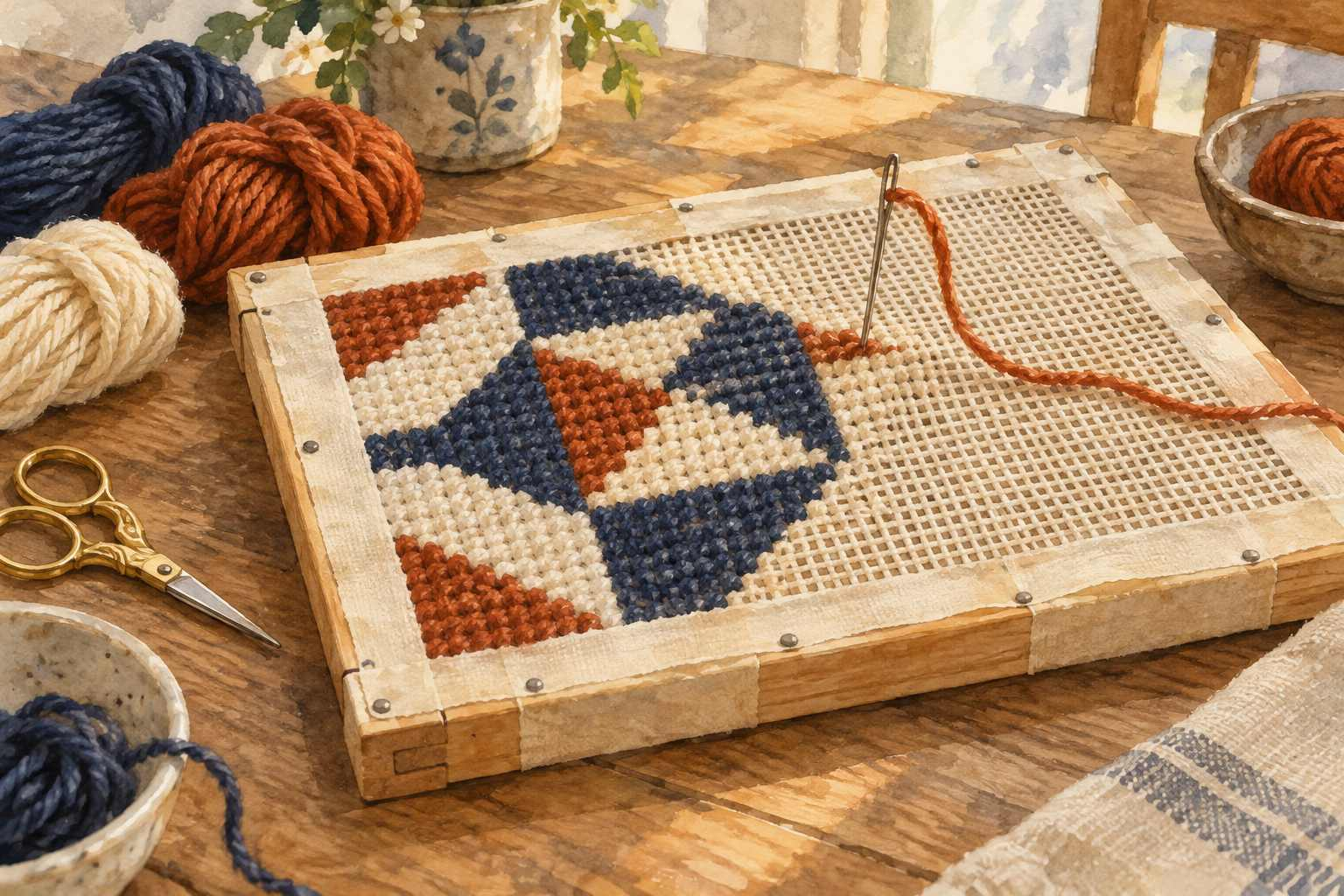
Needlepoint stitchers talk about two ways of moving the needle: stab and sew. Most of the advice that explains the difference is written for embroidery or cross stitch, and only a few sources are about needlepoint canvas. This guide sets out what each method is, which stitches suit each, and how the sources split. It labels every claim by the kind of stitching the source was about. Last updated October 27, 2026.
Start here: the one needlepoint instruction site here, NeedlepointTeacher, ties stab to a canvas on a frame or stretcher bars, and says sewing is quicker but distorts the canvas, so you will need to block. Brooke Thorn, a needlepoint designer, says there is no right or wrong way and that both are enjoyable. The embroidery and cross stitch sources mostly say the same: pick what feels comfortable.
The two methods
Stab means the needle goes straight through the canvas and your hands swap sides: one on top, one underneath, passing the needle between them. Sew means the needle stays on the front or dips down and comes back up in one motion, a bit like sewing on a button. Different sources use other names: NeedlepointTeacher calls stab the "stick" method, and a forum commenter on r/CrossStitch calls sewing the "Danish" method and one-stitch-at-a-time the "English" method.
A note on evidence. NeedlepointTeacher and Brooke Thorn's newsletter are about needlepoint. A r/Needlepoint thread and some NeedlenThread commenters mention needlepoint. The rest are about embroidery or cross stitch, and are used here only where they describe the motion itself.
Stab method
NeedlepointTeacher says stab gives smoother, more even stitches when the canvas is on a frame, and that stitching is slower but you will not need to wet or steam block when you finish. For the hand movement it says to put your dominant hand under the canvas and the other on top, passing the needle from one to the other.
The embroidery sources agree on the trade-off. The Spruce Crafts says stabbing gives higher accuracy and consistent stitch length, and is usually a little slower. NeedlenThread, an embroidery blog, says that for embroiderers whose fabric is held drum-taut in a hoop or frame, stab is often easier: the ground fabric is not disturbed, it is less stressful for the thread, and it is easier to judge the size, shape and tension of each stitch. Sarah's Hand Embroidery says stab suits thick fabric and many layers. Hope & Hart, which sells embroidery kits, calls stab the easiest method for a complete beginner.
Sewing method
NeedlepointTeacher describes sewing as working the needle with your dominant hand while the other holds the canvas, catching a canvas thread underneath and coming back up. It says this is quicker, but the canvas will distort and you need to block it to correct the grid, and that it is best for basketweave or continental. It adds that if you want the sewing method on continental or half cross, you can roll the canvas on a rod to limit distortion, but notes that this is not used much today and that basketweave is impossible with a rod. Our guide to blocking covers the correction.
The embroidery sources describe the same trade-off in their own terms. The Spruce Crafts says sewing can be faster, is easier without a hoop or with fabric that has some give, but can make it hard to see where the needle will come out, so you may need to pick out stitches. Stitch Floral says there is no difference in the finished stitch if you are careful, and that sewing is suited to stitching in hand while a framed piece may loosen. It adds that more friction when pulling thread means the thread wears sooner.
Scooping in tent stitch
Brooke Thorn, a needlepoint designer, teaches a sewing variant she calls scooping. Thorn says to think ahead about the next stitch and wiggle the needle down so it skips a step and comes up again in one motion, instead of stick and poke. Thorn says it works for all tent stitches, including continental and basketweave, and that it makes stitching go faster. For continental, the canvas is turned 180 degrees at the end of a row to start again from right to left. Thorn also says scooping basketweave with even tension helps avoid too much blocking, and mentions leather thimble pads for the middle finger. Thorn says both methods are enjoyable depending on the project, and that there is no right or wrong way.
A r/Needlepoint commenter recommended scooping to a beginner who was stitching in hand, saying everything happens on the front of the canvas, and credited a grandmother for teaching it. A commenter on the thread of Brooke Thorn's post asked whether scooping works on a large piece such as a 20 by 16 inch pillow, worried about handling and bending the canvas. The post had no reply to that in the text we read. For the stitches themselves see basketweave and continental versus half cross.
How your frame decides it
Several sources tie the method to how the work is held. NeedlepointTeacher links stab to a canvas on a frame or stretcher bars. The embroidery sources (The Spruce Crafts, Stitch Floral, NeedlenThread) link stab to taut hoops and frames and sewing to stitching in hand or on fabric with some give. Brooke Thorn describes scooping as the way to stitch in hand. On r/CrossStitch, one commenter says a taut frame means only stabbing works. Another says they stitch in hand but gave up sewing because it messes with their tension. Our guides to whether you need a frame, stretcher bars and even tension cover those choices. Left-handed stitchers have extra options; see left-handed needlepoint.
What the sources cover
- Needlepoint: NeedlepointTeacher and Brooke Thorn. One r/Needlepoint thread supports scooping as a tip.
- Mixed needlework: NeedlenThread. In its comments, one stitcher says they stab for counted cross stitch and needlepoint, and another stitches canvaswork on a frame, anchored to a table or floor stand.
- Embroidery only: The Spruce Crafts, Sarah's Hand Embroidery, Stitch Floral, Hope & Hart.
- Cross stitch only: two r/CrossStitch threads.
Where sources disagree
Is one better? NeedlenThread's author, writing about embroidery, argues for stab, saying it keeps stitch tension more consistent and reduces puckers, and several commenters agree. The Spruce Crafts, Hope & Hart, Brooke Thorn and Stitch Floral say neither is better and it is a matter of preference. NeedlepointTeacher is the one needlepoint source with a recommendation by stitch: sewing for basketweave and continental.
Does it hurt the canvas? NeedlepointTeacher says sewing distorts the canvas and needs blocking. Brooke Thorn says scooping with even tension limits the amount of blocking. They do not say the same thing, and neither gives a measurement.
Tension. On r/CrossStitch, some commenters say the sewing method messes with tension and surface texture, and others like it for big blocks of one colour. One says it leaves ridges in a block of colour. These are cross stitch comments, not needlepoint tests.
Speed. Sewing is quicker in NeedlepointTeacher, The Spruce Crafts and Stitch Floral. On r/CrossStitch some say it was slower for them because they could not control the stitches. One commenter pointed to a frame with a two-handed method as another way to speed up, using a stand. None of the sources timed anything.
Common mistakes
- Using sewing on a drum-taut frame. The embroidery sources say the fabric loosens or the method is hard to use there.
- Skipping blocking after in-hand sewing. NeedlepointTeacher says the canvas distorts.
- Blaming the needle for finger pricks. In the r/Needlepoint thread, the top comment says a proper needlepoint needle is too blunt to prick you, and other commenters point to thread that is too thick for the mesh and a needle size to match, such as a 20 for 14 mesh. See choosing a needle.
- Forcing a method that does not suit you. Several cross stitch commenters tried sewing and went back to stab.
FAQ
Which method is faster?
Sewing, according to NeedlepointTeacher and the embroidery sources. Stab is slower but more controlled. No source timed either.
Do I need to block if I stab on stretcher bars?
NeedlepointTeacher says you will not need to wet or steam block when you use frames or stretcher bars with stab. None of the other sources test this, so check your finished piece.
What is scooping?
A sewing-style way of working tent stitches in which the needle travels through and comes up in one motion, taught by Brooke Thorn and mentioned by a r/Needlepoint commenter.
Can I use both methods on one piece?
Yes. Brooke Thorn says both are enjoyable depending on the project, and some r/CrossStitch commenters use sewing for big blocks and stab for isolated stitches.
Does the method change the stitch?
Stitch Floral says no, for embroidery stitches worked with care. For needlepoint, NeedlepointTeacher links the method to distortion of the canvas and smoothness of the stitches rather than to the shape of the stitch.
Sources
- NeedlepointTeacher - Stab and Sewing Method (a needlepoint instruction site; stab, sewing and rod methods)
- The Renderie by Brooke Thorn - The Scoop on Scooping Your Needlepoint Stitches (a needlepoint designer's newsletter, January 2025; the scooping variant of the sewing method)
- r/Needlepoint - Newbie question: are you stabbing your fingers? (a forum thread, October 2024; needle, thread weight and scooping tips)
- NeedlenThread - Sewing vs. Stabbing: Two Methods of Stitching (an embroidery blog, 2015, with many commenters; mostly about embroidery)
- The Spruce Crafts - Stabbing vs. Sewing: Two Methods for Hand Embroidery (a craft site; about hand embroidery)
- Sarah's Hand Embroidery - Stab and Sew Methods of Stitching (an embroidery reference; about hand embroidery)
- Stitch Floral - Sewing vs. stabbing. What is better? (an embroidery blog, 2020; about hand embroidery)
- Hope & Hart - Beginners Guide: Stab Method vs Sewing Method (an embroidery kit seller; about hand embroidery)
- r/CrossStitch - Stab vs Sew, which do you prefer? (a forum thread, 2018; cross stitch)
- r/CrossStitch - Does anyone NOT do the sewing method? (a forum thread, 2022; cross stitch)