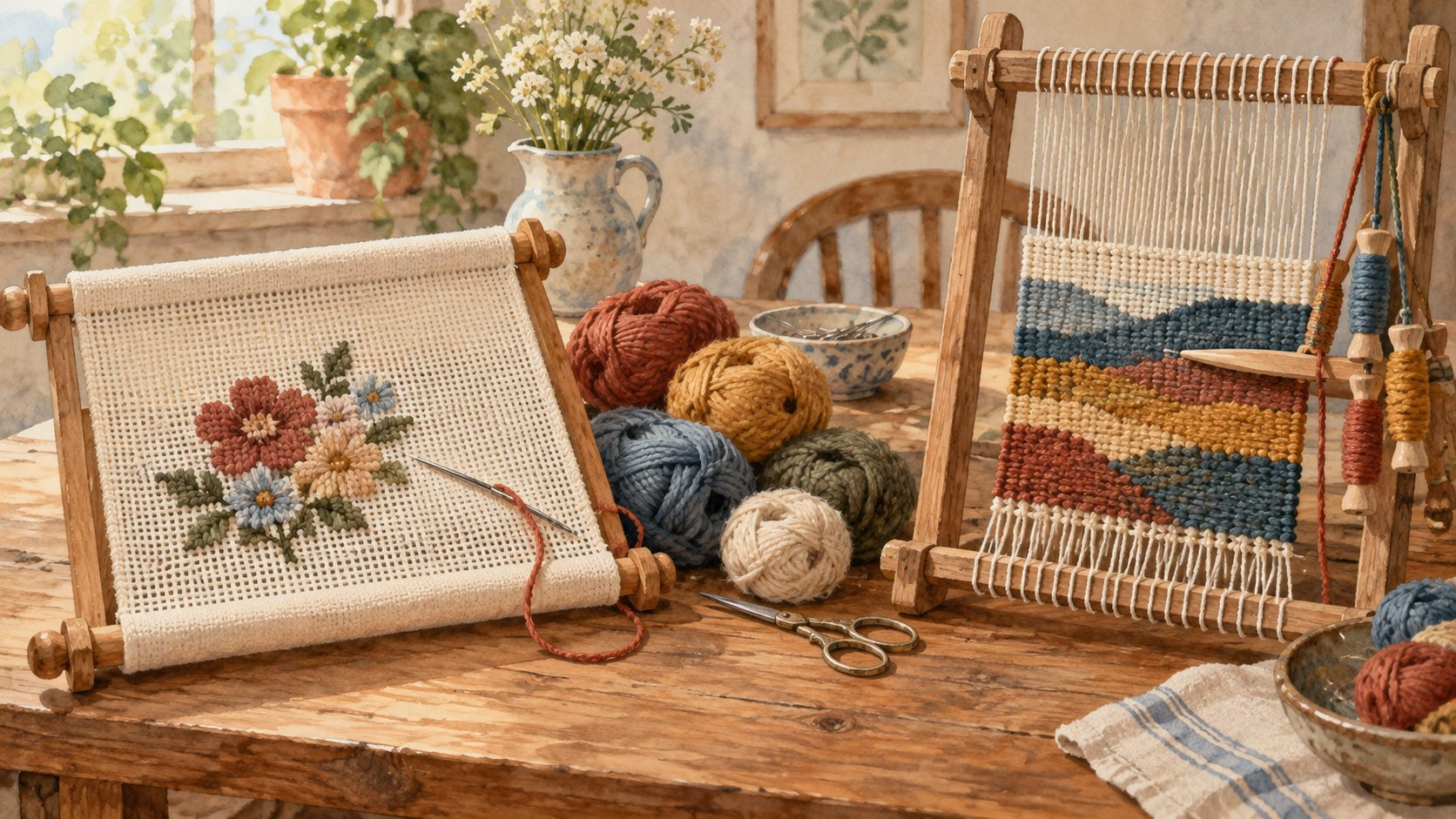
Strictly speaking, tapestry and needlepoint are different crafts: tapestry is woven on a loom, with the picture built into the fabric itself, while needlepoint is stitched with a needle on an open canvas that is already there. In everyday shop language, though, "tapestry" often means needlepoint, especially on British kits. Knowing which meaning you are looking at tells you what you are actually buying.
If a kit, canvas, or wool is labeled "tapestry," it is almost always needlepoint: stitching on printed canvas with a needle. The Royal School of Needlework calls that usage "technically incorrect," per BBC Culture: real tapestry is woven on a loom, weft threads packed over a warp, and it is a separate craft. Both are worth knowing; only one of them comes in a kit.
The short answer
Tapestry is a weaving technique. The design is created during weaving, as colored weft threads are packed over the warp on a loom, so the picture and the fabric are one thing. Needlepoint is an embroidery technique. You start with an existing ground fabric, a stiff open-weave canvas, and cover it completely with stitches using a needle and thread. The Victoria and Albert Museum's name for the whole family is canvas work: embroidery worked on stiff, open-weave canvas, most often in simple tent stitch, with the canvas completely covered.
The confusion is understandable, because the finished pieces can look similar from across the room, and because in the UK and Europe "tapestry" has been used for stitched canvas work for generations. Nuts about Needlepoint is blunt about it: using "tapestry" for tent stitch needlepoint is fairly common in the UK, but it came about because of a mistake.
What woven tapestry is
The British Tapestry Group's definition has three parts. A woven tapestry is hand woven on a loom, vertical (high warp) or horizontal (low warp). The design is formed by the weft threads, packed so tightly that the warp disappears completely, a property called weft facing. And each color of weft works only in its own section of the design rather than running across the whole width, called discontinuous weft. You can recognize a real tapestry by the characteristic ridges where weft passes over warp.
That construction is why tapestries were luxury goods. Mr X Stitch's history of the form explains that woven wall hangings were among the most expensive consumer goods of the late Middle Ages, commissioned by nobility to show status, and rolled up to travel between residences. Weaving one took a professional workshop; it was never a domestic hobby craft. Remnants of tapestry weaving survive from ancient Egypt, dated as far back as 3000 BC, per the British Tapestry Group.
What needlepoint is
Needlepoint starts from a ground fabric rather than making one. Dr. Susan Kay-Williams, Chief Executive of the Royal School of Needlework, told BBC Culture that in embroidery you always have a base fabric, and what separates needlepoint from other embroidery is its ground: a canvas grid of small square holes that must be entirely stitched, foreground and background alike. She also notes needlepoint can only be done by hand, and that full coverage is what makes it hard-wearing, which is why so many historic examples survive.
The American Needlepoint Guild stretches the definition a little wider, per Nuts about Needlepoint: for exhibition purposes, needlepoint is stitching on any "countable ground," which includes evenly woven linens, not just canvas. Within the craft you will also hear petit point, which the V&A defines as canvas work using tiny stitches on the highest thread count canvas, a technique used by Mary Queen of Scots in the embroideries she made during her imprisonment. Our petit point vs gros point guide covers that pair of terms, and canvas types explains the ground fabric itself.
Why the names got mixed
DMC's history of the mix-up: woven tapestries were so complex and time-consuming that in the 1800s people began using needlepoint techniques to stitch faux tapestries on canvas, and the word came to be used for both crafts. Mr X Stitch pushes the imitation further back, noting needlepoint's period of huge popularity in the 17th century, when it often copied the style of woven tapestry for chair covers and hangings that could be made in the home.
The naming accidents go both ways. The Bayeux Tapestry, the most famous "tapestry" in the world, is not woven at all: it is crewel embroidery, colored wool stitched onto pre-woven linen, as Sew Sew Mellow points out. The British Tapestry Group lists it, along with the Quaker Tapestry and the Great Tapestry of Scotland, as embroidered wall hangings rather than woven tapestries. And the V&A's account of Berlin woolwork shows how the stitched kind spread: printed patterns on point paper, sold cheaply as single sheets from Berlin, created a Victorian craze, with more than 14,000 designs imported into Britain by 1840.
What "tapestry" means on a kit
On modern kits and supplies, especially British ones, "tapestry" nearly always means needlepoint. DMC uses the word that way itself, while drawing a house distinction: their "tapestry" kits use small diagonal tent stitches throughout to completely cover a printed canvas, traditionally in pure wool, with no charts to follow, while "needlepoint" indicates a wider range of decorative stitches and threads for texture. Sew Sew Mellow, a UK shop, says it plainly: canvas work, needlepoint, or tapestry are all the same thing, named differently depending on where you are.
The vocabulary follows you into the notions aisle. Tapestry wool is the thick 4-ply wool sold for canvas work, and the blunt needle you stitch with is a tapestry needle, per the usage across these sources; our thread types guide covers where tapestry wool sits among the options. None of it involves a loom. If someone is actually weaving, they will say weaving.
Related terms worth knowing
- Canvaswork: the Royal School of Needlework's preferred term for needlepoint, and the older British word for the whole family, per Nuts about Needlepoint. The RSN notes it is "sometimes incorrectly referred to as tapestry." Vintage British books with "canvaswork" in the title are needlepoint books.
- Counted canvaswork: designers use this for needlepoint worked on blank canvas from charts, to distinguish it from painted or printed canvases, per Nuts about Needlepoint.
- Berlin woolwork: needlepoint worked from printed point-paper charts, the 19th century kit boom described by the V&A.
- Bargello: a specific family of upright canvas stitches in repeating wave patterns, per the V&A; our bargello guide covers it in depth.
- Jacquard "tapestries": machine-woven hangings. The British Tapestry Group calls their status controversial among weavers, since they miss the hand-woven and discontinuous-weft criteria.
Quick reference
| Woven tapestry | Needlepoint | |
|---|---|---|
| How it is made | Woven on a loom | Stitched with a needle on canvas |
| Where the picture lives | Built into the fabric as it is woven | Stitched on top of an existing ground fabric |
| Defining structure | Weft packed over warp, discontinuous wefts | Canvas holes completely covered with stitches |
| Who makes it | Weavers, historically professional workshops | Anyone; the classic domestic craft |
| Comes as a kit | No | Yes, sometimes labeled "tapestry" |
| Famous example | Medieval wall hangings, the Unicorn tapestries | The Bayeux "Tapestry" (actually embroidery), Berlin woolwork |
Where sources disagree
- Is "tapestry" for stitching ever acceptable? The Royal School of Needlework calls the usage technically incorrect, and Nuts about Needlepoint traces it to a mistake. DMC, by contrast, treats stitched tapestry as a legitimate category with its own meaning: tent stitch on printed canvas in wool, distinct from the broader needlepoint.
- Is needlepoint a kind of tapestry? DMC describes needlepoint as "a specific type of tapestry" using its stitched definition. Nuts about Needlepoint says tapestry should properly never be applied to needlepoint at all.
- What counts as needlepoint: the Royal School of Needlework and the V&A tie it to canvas specifically. The American Needlepoint Guild, per Nuts about Needlepoint, allows any countable ground, including evenweave linens, and both counted and free stitches.
Questions
Is a tapestry kit the same as a needlepoint kit?
Almost always, yes. On modern kits, especially British ones, "tapestry" means stitched canvas work: a printed canvas, wool, and a needle. Sew Sew Mellow and DMC both use the word that way. You are buying needlepoint.
Can I learn tapestry weaving with a kit?
Not from a needlepoint kit. Woven tapestry is made on a loom, building the fabric and the picture at once, per the British Tapestry Group. Small-frame tapestry weaving is its own craft with its own equipment.
Why is my stitching wool called tapestry wool?
The name stuck from the era when stitched canvas work imitated woven tapestry, per DMC's account. Tapestry wool is simply the thick wool sold for needlepoint, and tapestry needles are the blunt needles used with it.
Is the Bayeux Tapestry really not a tapestry?
Correct. It is crewel embroidery: wool stitched onto woven linen, not woven on a loom. Sew Sew Mellow and the British Tapestry Group both list it as a famous misnomer.
Which term should I use?
"Needlepoint" is understood everywhere and is the RSN-safe choice. Say "tapestry" in a needlepoint shop and you will be understood too, but in a weaving studio it means the loom craft.
Is canvaswork different from needlepoint?
No. Canvaswork is the British and Royal School of Needlework term for the same stitching, per Nuts about Needlepoint and the RSN. Older British books titled "canvaswork" are needlepoint books.
Sources
- DMC, The Difference Between Tapestry and Needlepoint
- Nuts about Needlepoint, Tapestry, Canvaswork, or Needlepoint?
- The British Tapestry Group, What is Tapestry Weaving?
- BBC Culture, The aristocratic craft making a surprising comeback (with Dr. Susan Kay-Williams of the Royal School of Needlework)
- Victoria and Albert Museum, Embroidery styles: an illustrated guide
- Sew Sew Mellow, Embroidery Techniques: Tapestry vs. Needlepoint
- Mr X Stitch, Tapestry Part 1 (Ruth Singer)
- Royal School of Needlework, Canvaswork