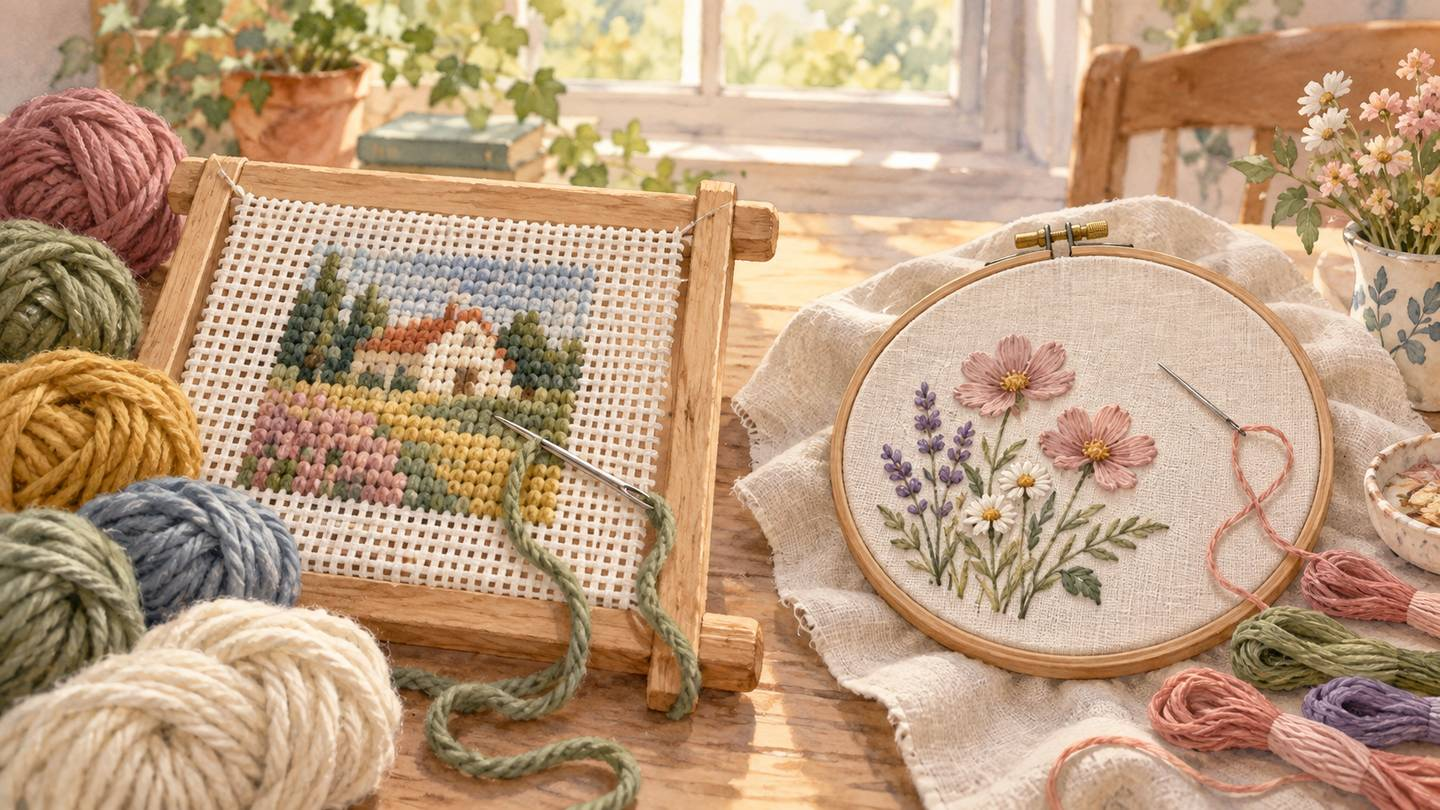
Needlepoint is worked on stiff, open-mesh canvas with counted stitches that cover the ground completely, while embroidery in the everyday sense is worked freehand on fabric with stitches that decorate the surface and let the cloth show through. Technically needlepoint is one branch of embroidery, which is exactly why the two get confused. In practice they feel like different hobbies: one is painting by grid, the other is drawing with thread.
If you want the fastest honest distinction, pick up both projects. Needlepoint canvas is rigid enough to hold its shape, and the design fills in stitch by stitch on a fixed grid until no canvas shows. Embroidery fabric drapes, a hoop pulls it taut, and the stitches follow drawn lines on the surface with fabric visible all around them.
The short answer, expanded
When most people say embroidery, they mean surface embroidery: hoop art, flowers on a denim jacket, monograms on linen. Needlepoint sits in a different branch of the same family. It is a counted craft worked on an open canvas mesh, almost always in tent stitch or its close relatives, and the finished piece is a dense new textile with the canvas buried inside it as a skeleton.
That structural difference shapes everything else: what the materials cost, how the crafts feel to work, what you can make, and how long the finished piece lasts. Needlepoint is rhythmic and decision-light because the grid has already made the placement choices. Surface embroidery is expressive and decision-rich because every stitch has a length, angle, and position that you choose yourself.
The embroidery family tree
Embroidery is the umbrella term for decorating textile with a needle and thread. Under it sit two big branches. Surface embroidery is freeform stitching on woven fabric: crewel work, modern hoop art, goldwork, thread painting. Counted-thread embroidery places stitches by counting the ground fabric's grid: cross stitch, blackwork, and needlepoint. Needlepoint, historically called canvaswork, is the counted branch worked on open canvas with full coverage, and petit point and bargello live inside it.
So needlepoint vs embroidery really means needlepoint vs surface embroidery, and that is the comparison the rest of this guide makes. If your question is actually about the other counted cousin, our needlepoint vs cross stitch guide covers that pairing in detail.
Side by side
| Needlepoint | Surface embroidery | |
|---|---|---|
| Ground | Stiff open canvas, usually 10 to 18 mesh | Woven fabric such as cotton or linen |
| Stitch placement | Counted on the grid | Freehand along drawn lines |
| Core stitches | Tent stitch, plus decorative canvas stitches | Dozens: satin, stem, chain, french knot |
| Coverage | Total, no ground shows | Partial, fabric is part of the design |
| Design source | Painted canvas or printed chart | Pattern transferred or drawn on fabric |
| Typical threads | Wool, silk, heavier cottons | Stranded cotton floss |
| Entry cost | $40 to $500 painted canvas, or a chart plus blank canvas | Under $20 for hoop, fabric, and floss |
| Durability | Upholstery-grade | Decorative |
| Learning curve | Shallow start, deep decorative-stitch ceiling | Steeper start, freehand control from day one |
The ground: canvas vs fabric
Needlepoint canvas is closer to a screen than to cloth: stiff, open, with countable intersections, usually 10 to 18 holes per inch. The stiffness is structural. Because every intersection ends up covered in thread, the finished piece becomes a dense textile in its own right, which is why needlepoint gets made into things that take abuse: pillows, belts, bags, chair seats. Our 13 mesh vs 18 mesh guide explains what the numbers mean for detail and stitching speed.
Embroidery fabric stays fabric. The stitching decorates it rather than replacing it, so whatever you make keeps the drape and the fragility of the ground cloth. That is not a weakness. It is why embroidered linen looks airy in a way needlepoint never will. But it points the two crafts at different end products: things that hang or drape on one side, things that get sat on and used on the other.
The stitches: counted vs freeform
Needlepoint runs on one workhorse: tent stitch, a small diagonal over one canvas intersection, worked as continental for details and basketweave for areas. Decorative canvas stitches exist by the hundred, and designers build entire pieces from them, but you can stitch happily for years using tent stitch alone. The design's complexity lives in the color chart, not the stitch vocabulary.
Surface embroidery inverts that. The stitch vocabulary is the craft: satin stitch for filling, stem stitch for lines, chain stitch for texture, french knots for dots, long-and-short for shading. A beginner sampler is a tour of ten stitches, and control, meaning even length, consistent angle, and smooth curves, is the skill being built. This is why the question which is easier has a real answer: needlepoint is the gentler start. A rigid grid, one stitch, no placement decisions.
Materials and cost
Embroidery's entry cost is famously low: a hoop, a piece of fabric, and a handful of floss skeins come in under $20. Needlepoint's traditional entry point is the hand-painted canvas, typically $40 to $60 for small pieces and $300 to $500 or more for large designs like Christmas stockings, before thread. Painted canvases are hand-made artwork and priced accordingly, and they are the main reason needlepoint has a reputation as the expensive fiber craft.
The affordable path exists, though: work from a printed chart onto blank canvas, counting from a grid the same way cross stitchers do. Blank canvas costs a few dollars, and charted designs can be generated or bought for very little. Thread choice also swings the budget in both crafts; our DMC vs Anchor comparison covers the two big cotton brands, and thread by mesh count explains which fibers suit which canvas.
Durability and what you make
Full-coverage construction makes needlepoint the heavyweight of the two. Victorian needlepoint chair seats are still in daily use, and a properly finished needlepoint belt outlives its buckle. Standard projects are pillows, ornaments, stockings, belts, bags, and upholstery. Once the stitching is done, our finishing basics guide walks through blocking and turning a canvas into a finished object.
Surface embroidery's natural outputs are things that hang or drape: hoop art, garment embellishment, table and bed linens, patches. Framed behind glass it lasts generations. On a cushion cover that gets leaned on every day, it wears in a way needlepoint does not.
Which should you learn?
Pick needlepoint if you want a meditative, low-decision craft, you like bold painterly full-coverage results, you want to make durable objects, or counting appeals to you more than freehand drawing. A small 13 mesh project is a genuinely gentle first fiber craft, and a charted design keeps the cost close to embroidery's.
Pick surface embroidery if you want maximum expressive range on a minimum budget, you like the drawn illustrative look, or an ever-growing stitch vocabulary excites rather than exhausts you. Already a cross stitcher? Needlepoint will feel like home, with the same counting and one new stitch, while surface embroidery is the bigger jump. There is no rule against both; plenty of stitchers keep a hoop for invention and a canvas for unwinding.
Threaded turns any photo into a charted needlepoint pattern you can stitch on blank canvas, skipping the painted-canvas price entirely. Set the mesh count and finished size, pick from 49 thread libraries with free DMC and Anchor presets, and get a PDF with symbols, color preview, and a thread key. See how photo conversion works to go from a picture on your phone to a stitchable chart.
Common questions
Is needlepoint the same as embroidery?
Needlepoint is one branch of embroidery: the branch worked on stiff open-mesh canvas with counted stitches that cover the ground completely. When people say embroidery without qualification they usually mean surface embroidery on fabric, which looks and feels very different to work.
Which is easier, needlepoint or embroidery?
Needlepoint is easier to start: mostly one stitch, a rigid canvas that behaves itself, and no stitch-placement decisions because the grid decides for you. Surface embroidery asks you to control stitch length, direction, and spacing freehand from day one.
Can you use embroidery stitches on needlepoint canvas?
Some stitches cross over; french knots and satin-type stitches appear in needlepoint as accents. But most surface embroidery stitches rely on a tightly woven fabric to anchor into, which open canvas cannot provide, so the full embroidery vocabulary does not transfer.
Is cross stitch embroidery or needlepoint?
Cross stitch is its own branch of counted embroidery, worked on fabric like Aida rather than canvas. It sits closer to needlepoint, since both are counted grid-based crafts, than to surface embroidery.
Why is needlepoint more expensive than embroidery?
The traditional needlepoint entry point is a hand-painted canvas, which typically runs $40 to $500 before thread, while embroidery starts with a hoop, fabric, and floss for under $20. Working needlepoint from a chart onto blank canvas closes most of the gap.
Can you make clothing with needlepoint?
Not comfortably. Full-coverage needlepoint produces a stiff, heavy textile suited to pillows, belts, and upholstery, not garments that need to drape. For decorating clothing, surface embroidery on the garment fabric itself is the right tool.