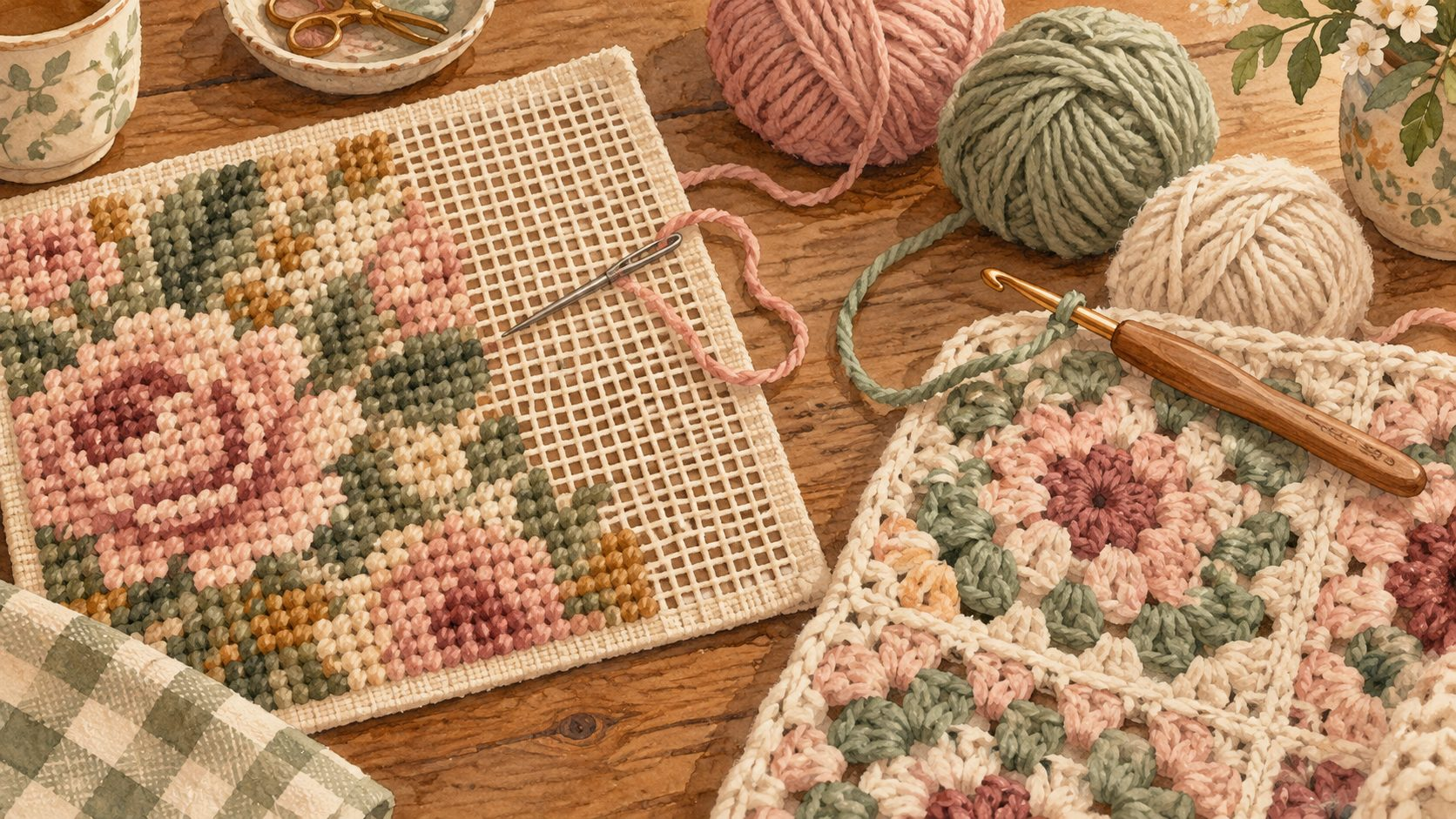
Crochet and needlepoint are both yarn crafts, but they are built on opposite ideas. Crochet creates a fabric from nothing, pulling loops of yarn through each other with a single hook. Needlepoint starts with a fabric that already exists, a stiff open canvas, and covers it with stitches worked with a needle. The results suit different projects: crochet makes soft, flexible things like blankets and sweaters; needlepoint makes firm, durable pieces like pillows and ornaments.
Floss Field's one-line distinction is the cleanest: embroidery, cross stitch, and needlepoint put stitches onto cloth or canvas that already exists, while crochet starts with no fabric at all, because the hook and the yarn make it. If you want garments and blankets, learn crochet. If you want decorative pieces with a painted or charted picture, learn needlepoint. Many stitchers do both.
The short answer
Crochet is looping: one hook draws one yarn through a loop to make a new loop, and the fabric grows a stitch at a time from a single ball (Floss Field). Needlepoint is stitching: a needle carries wool, silk, or cotton thread through the holes of an open-weave canvas until the surface is completely covered (Abigail Cecile, BBC Culture). Crochet's fabric is flexible and drapes; needlepoint's canvas base keeps the finished piece stiff and structured (CyCrochet).
How crochet works
Crochet uses a single hook to interlock loops of yarn. The initial loop is a slip knot followed by a chain, and stitches such as single, double, and treble crochet build on each other directly on the piece, resembling a chain of small knots (Martha Stewart). Because the stitches are simply looped onto the work, there is nothing to transfer between tools and no stitches to drop off a needle, which is one reason Martha Stewart rates crochet as typically easier than knitting for a self-taught beginner. Hook sizes run from fine steel hooks to jumbo Q hooks, matched to the yarn weight; one basic set covers most projects (Martha Stewart).
Stitch height is a real design variable in crochet. Single crochet makes a tight, dense fabric, double crochet a taller and more open one, and textured stitches like the shell, cluster, and popcorn stitches create raised, sculptural effects (CyCrochet). The craft also lends itself to improvisation: you can add rows, change shape, and freeform without a chart.
How needlepoint works
Needlepoint is a counted form of embroidery stitched on a canvas grid with designated holes for the needle (Abigail Cecile). What separates it from other embroidery, per the Royal School of Needlework's chief executive Susan Kay-Williams in BBC Culture, is that the canvas grid must be entirely stitched, foreground and background alike, and that it can only be done by hand. That full coverage is what makes needlepoint hard-wearing, which is why so many historic examples survive.
The stitches themselves are simple to start: the basic tent stitch is one diagonal stitch over one canvas intersection, and most beginners learn it in minutes, then spend years exploring hundreds of decorative stitches (our beginner stitches guide). The design usually comes painted on the canvas or as a chart, so needlepoint is precise and planned rather than freeform. Mesh count matters: 13 or 18 holes per inch are the common choices, and the finer 18 mesh holds nearly twice the detail (see 13 vs 18 mesh).
Tools and materials
Crochet: one hook (sizes from about 2mm steel hooks to 15mm jumbo) and yarn of any weight, from lace to chunky (CyCrochet). Optional extras are stitch markers and a yarn needle for weaving in ends.
Needlepoint: a blunt tapestry needle (sizes 18 to 22 are the common range), canvas (mono or interlock; see canvas types), and thread: tapestry wool is the classic, with silk, cotton floss, and novelty threads for detail (CyCrochet, Abigail Cecile). Many stitchers add a frame to keep the canvas taut, scissors, and a needle minder. The full starter kit is covered in supplies for beginners.
On cost, CyCrochet is blunt: crochet is usually cheaper to start because a hook and a few balls of yarn are all you need, while needlepoint costs more when you add frames, hand-painted canvases, and specialty threads.
What you make
Crochet's fabric stretches, drapes, and can be shaped in three dimensions, so it suits wearables and soft goods: sweaters, scarves, hats, blankets, lace, and amigurumi (stuffed toys), which CyCrochet calls one of crochet's most popular niches. Needlepoint's stitched canvas is firm and durable, so it suits decorative and functional pieces that hold their shape: pillows, wall hangings, belts, ornaments, Christmas stockings, eyeglass cases, and upholstery (CyCrochet, Abigail Cecile). Finishing differs too: crochet usually needs ends woven in and sometimes blocking; needlepoint pieces are framed, sewn into pillows, or made into ornaments by a finisher.
Which is easier?
Both are rated moderate to learn (CyCrochet), but the flavor of difficulty differs. Crochet asks you to build every stitch's structure yourself and manage tension from the start; Martha Stewart notes the single hook makes the toolset minimal and the craft accessible self-taught. Needlepoint's first stitch is trivially easy to learn, and a painted canvas tells you exactly where every stitch goes, but a single piece takes many hours and finishing a piece into a pillow or ornament is a separate skill or expense. If you want a finished thing quickly, a small crochet scarf or a small needlepoint ornament kit (see beginner kits) are both realistic first projects; crochet skills grow into garments, needlepoint skills grow into decorative stitches and bigger canvases.
A short history
Needlepoint is ancient: slanted tent-stitch work appears in artifacts from ancient Egypt around 1500 BC, and the craft surged in Europe after the steel needle arrived in the 16th century, becoming a favorite of Elizabethan nobles (BBC Culture). CyCrochet similarly describes tent stitches in Egyptian and Persian work dating back centuries. Crochet is comparatively young: it emerged in the 19th century, and CyCrochet recounts the tradition of European nuns developing it as a faster alternative to lace-making, while noting the origins are debated.
Quick reference
| Crochet | Needlepoint | |
|---|---|---|
| Main tool | One hook | Blunt tapestry needle |
| Base | None; the fabric is built from yarn | Stiff open-weave canvas that already exists |
| How it works | Loops pulled through loops, one at a time | Thread stitched through canvas holes until covered |
| Typical materials | Yarn in any weight | Tapestry wool, silk, cotton floss, novelty threads |
| Finished fabric | Flexible, drapes, stretches | Firm, structured, hard-wearing |
| Best for | Garments, blankets, toys, lace | Pillows, ornaments, stockings, wall art, belts |
| Planning | Often freeform or from patterns | Painted canvas or chart; precise by design |
| Startup cost | Low (hook plus yarn) | Higher (canvas, threads, often a frame) |
| Age of the craft | 19th century (origins debated) | Ancient; tent stitches from Egypt circa 1500 BC |
Where sources disagree
Crochet's origins. CyCrochet passes on the popular story that nuns developed crochet as a cheaper, faster alternative to lace-making, but notes the craft's true origins are debated. Treat the nuns-and-lace account as tradition rather than settled history.
Which is easier. Martha Stewart calls crochet typically easier than knitting for beginners on tool simplicity; CyCrochet rates crochet, knitting, and needlepoint all "moderate." Neither compares crochet to needlepoint head to head. Our take: needlepoint's first stitch is easier than crochet's first row, but crochet reaches a wearable finished object faster.
Common questions
Is needlepoint a type of crochet?
No. Crochet builds fabric with a hook from yarn alone; needlepoint decorates an existing canvas with a needle and thread. Floss Field groups needlepoint with embroidery and cross stitch: crafts that put stitches onto cloth or canvas that already exists.
Is needlepoint easier than crochet?
The first stitch is: tent stitch is one diagonal line repeated, with the canvas telling you where each stitch goes. Crochet requires learning to form and tension loops from nothing. Over a whole project, the effort balances out differently: needlepoint pieces are slow to stitch and need separate finishing, while crochet grows fast but demands more technique for shaping.
Can I use crochet skills for needlepoint (or the reverse)?
Barely. They share yarn, color sense, and hand-eye rhythm, and both are counted among needlework, the umbrella term for crafts done with a needle and thread or yarn (National Academy of Needlearts). But the motions, tools, and materials are different, so each is learned fresh.
Which should I learn first?
If you dream of making sweaters, blankets, or toys, start with crochet. If you want to stitch pictures, ornaments, and home decor from painted canvases, start with needlepoint. If stress relief is the goal, either works: a 2024 scientific review found needlecraft had an overwhelmingly positive effect on mental health and well-being, and neuropsychologist Dr. Vonetta Dotson describes reduced cortisol and mindfulness benefits from knitting and similar crafts (NAN).
Can one person do both?
Yes, and many do. They complement each other well: crochet for the soft goods wardrobe and gift blankets, needlepoint for the pillows and ornaments. Gen Z and millennial stitchers have driven a revival across all of these crafts (BBC Culture, NAN), so you will be in good company either way.
Sources
- CyCrochet, Crochet vs. Needlepoint: Differences Between These Crafts
- CyCrochet, Mastering Crochet, Knitting, and Needlepoint
- Floss Field, Macrame vs crochet, and how crochet differs from other crafts
- Abigail Cecile, What is Needlepoint?
- Martha Stewart, Knitting vs. Crocheting: What's the Difference and Which Should You Learn?
- BBC Culture, The aristocratic craft making a surprising comeback
- National Academy of Needlearts, The Meditative Power of Needlework