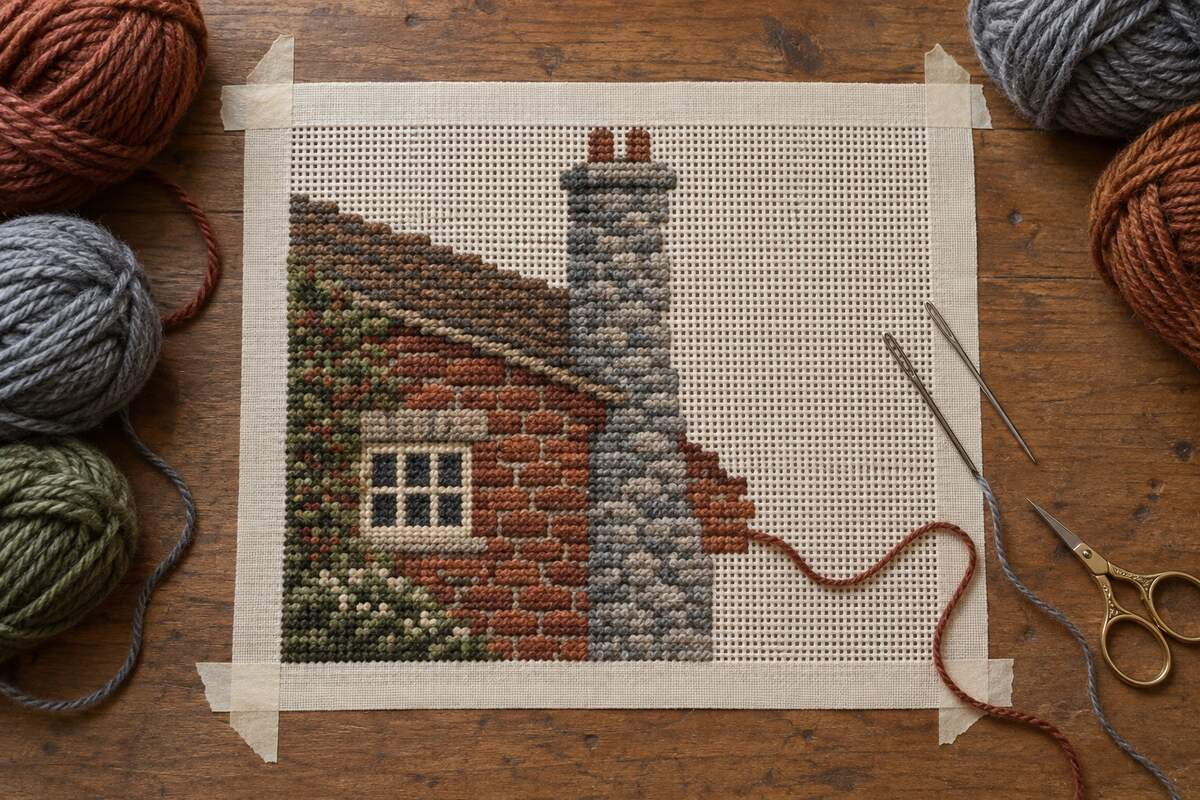
Brick, stone, clapboard and rooflines appear on house portraits, village scenes, lighthouses and fireplace canvases, and each masonry surface wants a stitch with the right scale and direction. Brick stitch, Cashmere, Corduroy and simple Tent all play a part: the skill is matching the stitch unit to the size of the painted bricks and keeping the threads matte. Last updated November 6, 2026.
Start here: Use Brick stitch when the painted bricks are small or you want many rows, Cashmere variations when each painted brick has a rectangular space of its own, and Corduroy for ribbed walls, siding and chimneys. Stitch mortar lines in Tent with a thinner, dull beige thread so they sit below the bricks. Choose matte or slightly shiny threads in brick, stone or wood colours, and offset the rows of units like real brickwork.
Reading the surface first
Nuts about Needlepoint's fireplace study starts with observation rather than stitches. Real bricks are fired clay, usually unglazed, in shades of red, pink, dark yellow-orange, grey and brown; used bricks from demolished buildings can include painted or burnt pieces, and glazed bricks are shiny and can be any colour. Stone and weathered siding vary just as much. Before choosing a stitch, decide which of those surfaces your canvas is showing, because the thread and the stitch size follow from it.
Scale is the second reading. If the canvas paints individual bricks with visible divisions, your stitch units should fit those divisions. If the area is small or the painting only suggests brickwork, a small repeating stitch that reads as brick at a glance is the better tool. Serendipity Needleworks makes the same point from the other direction: Brick stitch is tiny, so it fits teeny spaces where a bigger unit stitch could never compensate.
Threads for masonry
Nuts about Needlepoint's rule is matte or very slightly shiny thread for bricks, with more matte thread for used brick, and it notes that fluffier threads create fuller-looking bricks. Its sample uses a dark burgundy silk for standard brick. For mortar it prescribes a dull beige, thinner than the brick thread, and never white: real mortar is a dull beige, even though painted canvases often show it as pale lines.
Serendipity Needleworks stitched its building sample in Bravo!, a four-ply divisible Pima cotton from Rainbow Gallery in overdyed colours, using 2 plies on Congress Cloth, 3 to 4 plies on 18 mesh, and 5 to 6 on 13 or 14 mesh, stranded and laid smoothly. Overdyed threads earn their place on masonry: The Pampered Introvert calls slight overdye variation the chef's kiss for brick, and uneven colour blends its route to natural stone depth. For crisp ribs it suggests stranded cotton or silk and warns against very fuzzy fibres; for a softer painted-house look it likes silk and ivory blends and matte cottons. Our thread types guide and cotton thread guide cover the families.
Brick stitch and its family
Brick stitch is the obvious name and it earns it. Unwind Studio describes the core technique as flat, parallel straight stitches worked in rows that stagger and offset like a brick wall, with each stitch separated from its neighbour. Serendipity Needleworks calls it easy to execute and easy to compensate, a great first decorative stitch, and notes that turning it on its side into the horizontal version is when the stitches really do look like bricks. Her one warning: be consistent about whether you work the stitches up and down across the row, whatever variation you choose. Our Brick stitch guide walks the base stitch.
The family is bigger than the one stitch. Unwind Studio documents Brick Horizontal for horizontal courses and Double Brick, which pairs identical stitches into larger staggered blocks for bigger areas. Coco Frank Studio, a needlepoint design shop, uses Brick stitch for backgrounds and building facades, including the background of its Paris Round, which is a useful reminder that the stitch reads as masonry even when it is doing quiet background duty.
Nuts about Needlepoint came to Brick stitch late for its fireplace and wished it had tried sooner: for a small fireplace, or anywhere you want to show more bricks, it found the effect fantastic. Choose it when the painted space is too small for Cashmere units or when you want the texture of many small bricks.
Cashmere and box stitches
When each painted brick has its own rectangular space, Nuts about Needlepoint calls Cashmere stitches the perfect size and shape, as long as the space is two canvas threads or wider. Fit the size of the Cashmeres to the painted space, and when the design shows more than one row of bricks, offset the rows so the units interlock like real brickwork; its sample uses a horizontal offset pattern in the Flemish bond style. The troughs between the units then read visually as mortar without any extra stitching. Our Cashmere stitch guide covers the base stitch.
For mantles with tile or brick insets, Nuts about Needlepoint switches to Box stitches to show the individual tiles. Carved or moulded wood mantles take combinations of Gobelin and Tent to match the moulding shapes.
Corduroy for walls and siding
The Pampered Introvert champions Corduroy stitch for architecture: a layered straight stitch technique that builds vertical or horizontal ribs, giving dimension, light shadow play and what it calls architectural realism on beach cottages, storefronts, lighthouses and chimneys. Worked horizontally with slight colour shifts it reads as rows of brick courses or aged brick; worked vertically it becomes clapboard siding; with uneven blends it suggests natural stone.
Its technique notes are simple and firm: keep stitch length consistent, work in rows, and do not pull too tight or you lose the rib dimension that is the whole point. It suggests Corduroy for exterior walls, chimneys, foundation stone, garden walls and brick storefronts.
Mortar lines and details
Where the painting shows mortar as pale lines, stitch them in Tent with a matte beige thread thinner than the brick thread. Nuts about Needlepoint's reasoning is visual hierarchy: a thinner thread sits lower than the Cashmere or Brick stitches around it, so the mortar recedes instead of dominating. Where the painting shows no mortar, let the troughs between stitch units do the work and skip it entirely.
For the wood and trim around masonry, Nuts about Needlepoint uses Tent for single-thread lines, Oblique Continental for a rope-like edge, and Gobelin, straight or diagonal depending on the edge, for wider mouldings, thickening the thread for Straight Gobelin. Where edges of the brick area cut stitches in half, compensate; our compensation guide explains how, and Brick stitch's tiny units make it the easiest of these options to fit into corners.
Where sources disagree
What is Brick stitch for? Unwind Studio recommends Brick and its variations for skies, rolling hills, clothing textures and mountains as much as for masonry. Coco Frank Studio and Serendipity Needleworks reach for it on buildings and facades. It is a general texture stitch that happens to be named after bricks; use it where its scale fits, not only where the label matches.
Unit stitches or texture stitches? Nuts about Needlepoint fits Cashmere units to each painted brick. The Pampered Introvert builds walls from ribs of Corduroy. Serendipity Needleworks fills with small Brick stitch. The choice follows the painting: explicit brick divisions want fitted units, suggested brickwork wants an all-over texture.
How realistic should the colour be? Nuts about Needlepoint specifies matte threads in true clay colours and dull-beige mortar. The Pampered Introvert and Serendipity Needleworks both lean on overdyed threads for aged brick and stone. Overdye gives depth; flat matte gives control. Busy painted canvases usually want the former, formal house portraits the latter.
FAQ
What is the best needlepoint stitch for brick?Brick stitch for small spaces and many rows, Cashmere variations when each brick has its own painted rectangle, and horizontal Corduroy when you want raised courses. Offset the rows in all three so the wall reads as brickwork rather than stripes.
What stitch should I use for stone? Corduroy with uneven colour blends is The Pampered Introvert's route to natural stone depth. For fitted areas, the same Cashmere and Brick units used for brickwork work in stone greys and tans.
What thread is best for brick and stone? Matte or slightly shiny threads: stranded cotton or silk for crisp texture, overdyed cottons for aged surfaces, and a thinner matte beige for mortar lines. Avoid very fuzzy fibres if you want crisp ribs.
How do you stitch mortar lines? In Tent stitch with a thread thinner than the brick thread, in a dull beige rather than white, so the lines sit below the bricks. Skip mortar entirely where the stitch units already create visible troughs.
Is Brick stitch hard to compensate? It is one of the easiest. Serendipity Needleworks calls it easy to compensate because the units are so small; fit partial units into edges the way our compensation guide describes.
What stitch should I use for clapboard siding?Corduroy worked vertically is The Pampered Introvert's pick for the clapboard illusion on cottages, storefronts and painted wood homes.
Sources
- Nuts about Needlepoint - How to Stitch a Fireplace (a needlepoint expert and teaching site; brick colours and threads, Cashmere sizing, mortar in Tent, mantle stitches)
- Serendipity Needleworks - A Needlepoint Stitch for Buildings (a needlepoint teaching site; Brick stitch for buildings, thread ply counts and laying)
- The Pampered Introvert - The Corduroy Stitch for Brick and Stone Walls (a needlepoint designer's blog; Corduroy technique, brick, stone and clapboard uses, thread picks)
- Unwind Studio - Brick Stitch, Brick Horizontal and Double Brick (a needlepoint kit seller; the Brick stitch family structure and instructions)
- Coco Frank Studio - Brick Stitch (a needlepoint design shop; Brick stitch on backgrounds and building facades)