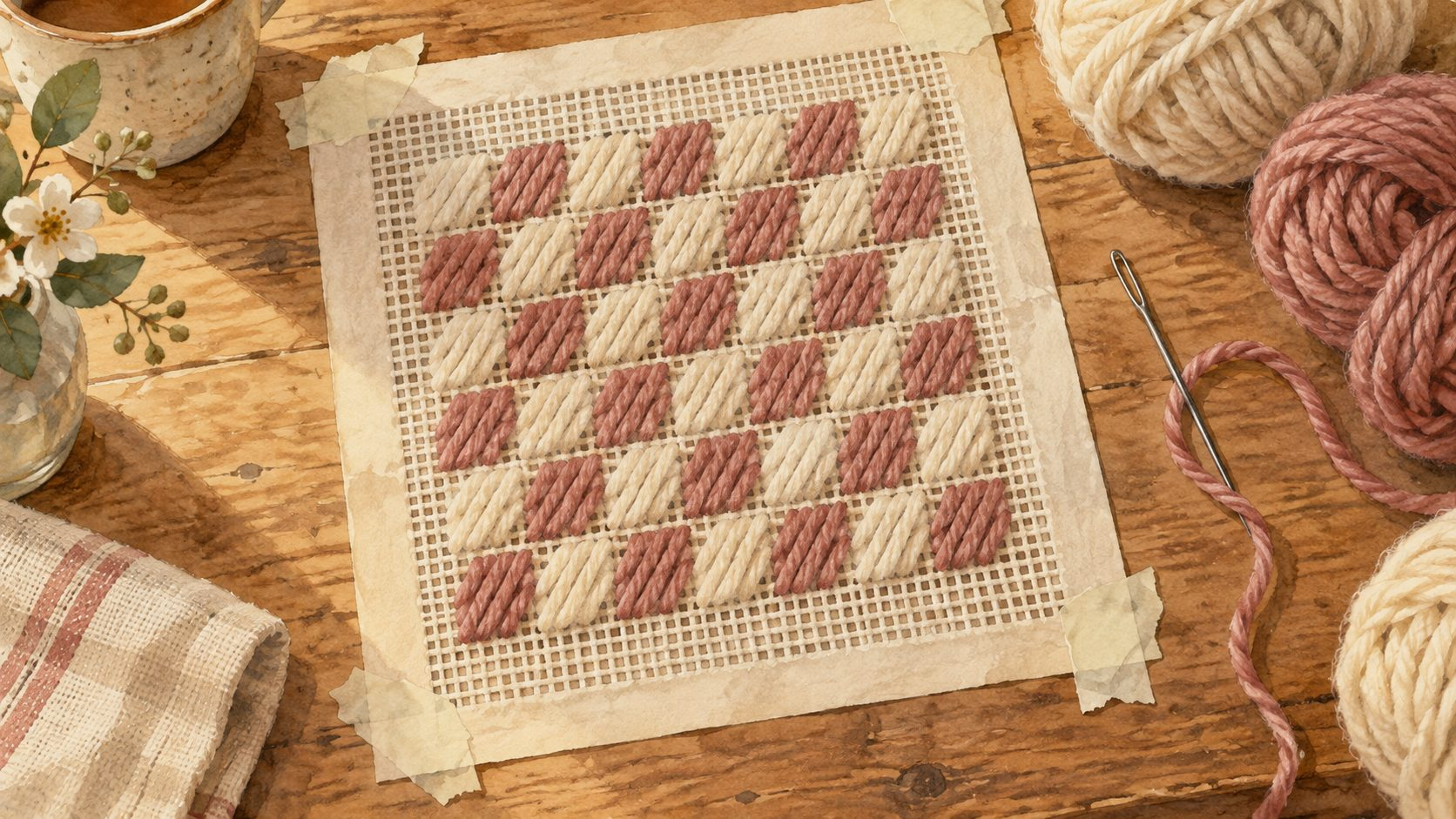
Cashmere stitch is mosaic stitch stretched into a rectangle: four small diagonal stitches that fill a block two threads wide and three tall. It is easy to learn and covers well. It also has more than one layout under the same name, which confuses people reading different sources. This guide pulls together eight sources on how to work it, where to use it, and where they disagree.
Work a tent stitch over one intersection, then two diagonal stitches each over two intersections, one under the other, then a final tent stitch at the lower right (Floss Field, RSN StitchBank). The next block shares holes with the first. Keep the same order in every block (Unwind Studio). Block it when you finish if the area is large (Unwind Studio).
What cashmere stitch is
Floss Field calls it a rectangular box stitch two threads wide and three tall: a tent stitch, two longer stitches and a tent stitch. Unwind Studio gives the same shape as four diagonal stitches, one short, two long and one short, and says it is a close relative of mosaic stitch. Needlepoint for Fun calls it a larger mosaic stitch worked 1, 2, 2, 1. Needlepoint Teacher says to think of the unit as one continental stitch, two long stitches over two intersections and another continental stitch.
| Stitch | Unit | Source |
|---|---|---|
| Mosaic | Small square of three stitches | Unwind Studio, Floss Field |
| Cashmere | Rectangle of four stitches, 2 wide by 3 tall | Unwind Studio, Floss Field |
| Scotch | Larger square of graduated stitches | Unwind Studio |
Our Scotch stitch guide covers the larger relative.
How to work it
- Work a tent stitch over one intersection in the top left corner of a rectangle two threads wide and three tall (Floss Field).
- Below it, work two diagonal stitches, each over two intersections, one under the other (Floss Field, RSN StitchBank).
- Finish with a tent stitch at the lower right (Floss Field).
- Work the next rectangle beside it so the two share the holes along the edge. The next row lies directly below and shares holes the same way (Floss Field).
Unwind Studio adds a tip: keep the order short, long, long, short in every rectangle so the rows line up. Needlepoint Teacher says that because you can think of the block as a unit, you can work it horizontally or vertically and the result is the same. Floss Field says the same about working the blocks across, down or along a diagonal. See our beginner stitches guide for the tent stitch that opens and closes each block.
Grid, diagonal and condensed
Most current diagrams show separate blocks lined up in a grid, according to Floss Field. It also says a nineteenth-century encyclopedia and at least one current stitch list describe cashmere as worked in diagonal rows, one stitch over one intersection and then two over two. RSN StitchBank calls that version condensed cashmere and says the end of one rectangle overlaps the start of the next. It adds that Mary Thomas calls this version plain cashmere in her Dictionary of Embroidery Stitches, but is alone in this, so the Stitch Bank keeps the more widespread name.
Needlepoint for Fun describes the diagonal version as sharing the small stitch, so the last tent stitch of one unit is the first of the next, in the pattern 1, 2, 2, 1, 2, 2, 1. It suggests it for clothing, fields and sloping hillsides. Morgan Julia Designs describes Diagonal Cashmere as stepping each unit by starting the first long stitch one canvas thread to the right of the tent stitch just completed, in staggered columns.
Variations
- Condensed or diagonal cashmere. Blocks run together down a diagonal. Floss Field says shops suggest it for architecture, for movement and as a quick, well-covering background that is easy to compensate.
- Cashmere checker. Cashmere blocks alternate with blocks of tent stitch (Floss Field, Unwind Studio).
- Framed cashmere. Each unit is surrounded by tent stitches for a more structured, tiled look (Unwind Studio).
- Staggered cashmere. Floss Field says offsetting the blocks so they step down a diagonal gives staggered cashmere. Stitchmate describes it as rows offset like brickwork.
- Vertical and reverse. KC Needlepoint lists a vertical cashmere, which makes an upright rectangle, and a reversed version.
- Rows and random patterns. Needlepoint for Fun suggests horizontal rows for a beak, vertical rows with tent rows between as a background, and elongated or bent versions for a patio. Needlepoint Teacher suggests stitching it diagonally in two or more colors.
When to use it
Floss Field names backgrounds, buildings and paving, and filling areas large or small. KC Needlepoint calls the vertical version great for buildings and sidewalks. Morgan Julia Designs suggests the diagonal version for rooftops, brickwork, window panes and tiled floors, and says it can echo painted highlights and shadows. Unwind Studio and Stitchmate point to clothing, with Unwind Studio saying the dense texture looks like knitted fabric, good for jumpers and scarves. Stitchmate adds upholstery and quiet backgrounds. Needlepoint Teacher says it suits most areas.
For other background choices see our background stitches guide. For buildings see our brick stitch guide.
Canvas pull and edges
Unwind Studio says the long diagonals can slightly distort the canvas on big areas, and suggests relaxed tension and blocking at the end. Stitchmate rates distortion as moderate and says to work on a frame with light tension. See our guides to stretcher bars and blocking.
At the edge of a shape, Floss Field says to carry the pattern as far as it fits and fill the rest with shorter stitches at the same angle, and that plain tent stitches are an accepted substitute where a part block would look awkward. Stitchmate says the same about shorter diagonals or tent stitches. Our compensation stitches guide has more.
Stitchmate says thread is the same as for tent stitch on your mesh, since diagonal stitches cover well.
Where sources disagree
- Which layout is plain cashmere. Floss Field says most current diagrams show separate blocks in a grid, and notes older sources and one dictionary treat the diagonal version as plain cashmere. RSN StitchBank calls the diagonal version condensed cashmere. Go by the diagram, not the name.
- Distortion. Stitchmate rates it moderate. Unwind Studio says slight on big areas. Other sources do not address it.
- Snagging. Stitchmate rates snag risk low to moderate and says the two long stitches snag a little more than mosaic. Other sources do not address it.
- Skill level. Unwind Studio calls it a beginner stitch and Needlepoint Teacher calls it easy.
- Stitch count wording. Needlepoint for Fun calls it 1, 2, 2, 1 and Unwind Studio calls it four stitches. They describe the same unit.
- Retail context. Needlepoint for Fun and Stitchmate are shops or tools that sell products. Read their suggestions as advice from a seller.
Questions
What is the difference between cashmere and mosaic stitch?
Mosaic is a tent stitch, one longer stitch and a tent stitch on a square two threads each way. Cashmere has two longer stitches, making the block three threads tall (Floss Field).
Is cashmere stitch easy?
Unwind Studio and Needlepoint Teacher say yes. If you can do mosaic, cashmere is one extra long stitch per unit (Unwind Studio).
Can I work it diagonally?
Yes. See condensed or diagonal cashmere (Floss Field, RSN StitchBank, Morgan Julia Designs).
What is it good for?
Backgrounds, buildings, paving and fabric-like areas such as clothing (Floss Field, Unwind Studio).
Does it distort canvas?
Somewhat. Use light tension, a frame and blocking (Unwind Studio, Stitchmate).
Sources
- Floss Field, Cashmere stitch
- RSN StitchBank, Condensed cashmere stitch
- Unwind Studio, Cashmere Stitch
- Needlepoint For Fun, Cashmere needlepoint stitch
- NeedlepointTeacher.com, Cashmere Stitch
- KC Needlepoint, Cashmere Stitch Vertical
- Stitchmate, Cashmere Stitch Needlepoint
- Morgan Julia Designs, Diagonal Cashmere Stitch