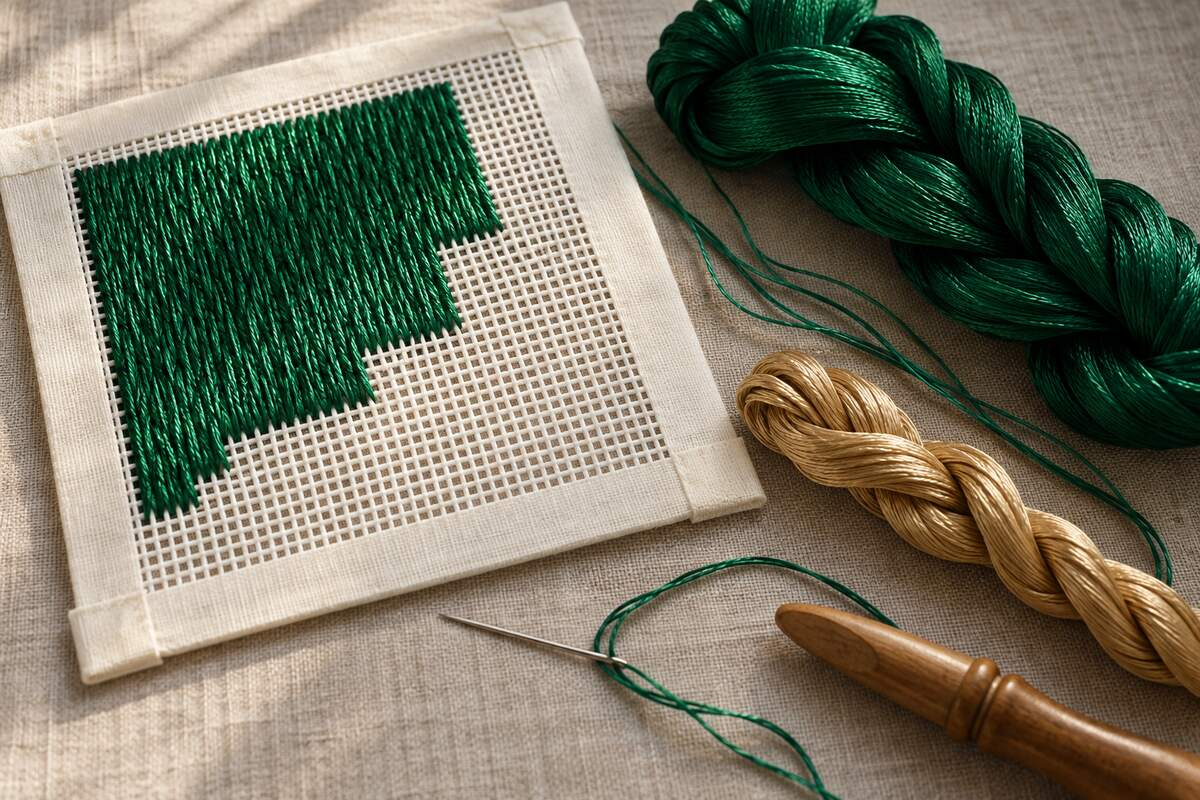
Silk is the luxury fiber of needlepoint: nothing else has its luster, and stitched silk seems to glow from inside the canvas. It is also the fiber stitchers swear off after one bad skein, because silk's quirks - snagging, fly-away strands, water sensitivity - are real but solvable. This guide covers the two kinds of silk thread, the lines shops actually stock, strand counts by mesh, and the handling habits that make silk behave. Last updated November 2, 2026.
Start here: For a first silk project, choose a single-strand spun silk like Pepper Pot - one strand covers both 13 and 18 mesh, it does not fray or untwist easily, and it needs no strand-counting. Save the divisible silk flosses (Splendor and its cousins) and shiny twisted filaments (Trebizond) for when you want to control coverage or maximize sheen. Whatever silk you use, keep lengths short, condition your hands, and stitch up and down rather than with a sewing motion.
Why stitchers love silk
Ellen Johnson of Serendipity Needleworks calls herself a pushover for silk: the lustrous sheen, buttery softness and luminescent colors make it her single favorite thread type, and the diversity of silk threads means there is a right one for almost any project. NeedlepointTeacher.com adds the physics behind the glow: silk has a truly unique look and feel, and long, straight stitches traveling in different directions let light play on the fibers, so a single color can read as two tones. It recommends long stitches like bargello patterns to show silk off, rather than small, dense stitches where the light effect disappears. For stitch ideas, see the bargello stitch guide.
Silk's place in the project matters too. Johnson's thread-choosing advice starts with the finishing plan: fancy threads like silk are right for pieces that are purely for show, while items that will be used or worn heavily - her example is a belt - call for sturdier fibers like wool. For the full fiber picture, see needlepoint thread types: wool, cotton and silk.
Filament silk and spun silk
Johnson explains that all silk thread is one of two types. Filament silk is reeled from the cocoon in extremely long, extremely thin fibers - the highest quality silk - and comes flat or twisted. Spun silk is made from shorter fibers spun together like wool or cotton. The difference is tactile: filament silks have the highest shine but are fragile at the fiber level, while spun silks are softer, steadier and more forgiving in the needle.
Her practical take on the two filament forms: she prefers twisted filament silk such as Trebizond, because flat silk snags more easily and can be fly-away and hard to manage. Trebizond can be used straight off the spool - her preference - or divided like a floss. NeedlepointTeacher adds that whatever the form, silk deserves a laying tool: taking extra time to make the fibers lie straight on the canvas is what produces the beautiful stitches silk is capable of. See how to use a laying tool in needlepoint.
The main silk thread lines
The shop wall divides into a few families. Single-strand spun silks: Pepper Pot Silk from Planet Earth Fiber is Johnson's long-time favorite - a non-divisible single strand, roughly the size of #5 perle cotton, in 227 solid colors and 16 tone-on-tone hues, with a soft twist that lets the fibers expand and fill the canvas holes. Williamsburg Needlepoint names Pepper Pot, Vineyard Silk and Essentials as its go-to 18 mesh silks, and Planet Earth Silk and Silk & Ivory (a silk-wool blend) for 13 mesh.
Divisible silk flosses: Rainbow Gallery's Splendor is the best-known - a 12-strand silk you divide to suit the mesh. NeedlepointTeacher groups it with Soie Cristal, Soie d'Alger and Gloriana silk floss (12 two-ply strands, high luster, easy to work), and lists Kreinik's silk family for special effects: Silk Mori (a 6-strand floss slightly finer than cotton floss, the least shiny, ideal for petit point and details like eyes), Silk 'N Colors (separable into three groups of four strands, 333 color combinations), and Silk Serica (a 3-ply filament with the most sheen, usable as a pearl thread or separated for very high shine). Twisted pearl-style silks like Rainbow Gallery's Grandeur (a #5 pearl weight dyed to match Splendor colors) work straight off the card. Silk ribbon rounds out the family for long stitches and surface effects.
Matching silk to your mesh
STITCH Needlepoint Shop's published strand chart gives the working numbers. On 18 count canvas: Pepper Pot Silk one strand, Planet Earth 6-ply silk four plies, Splendor four plies. On 13 count: Pepper Pot still one strand, Planet Earth 6-ply six plies, Splendor six to seven plies. The chart also notes Silk & Ivory as one strand on 13 mesh when lightly painted. Serendipity's Pepper Pot guide agrees on one strand for both meshes and adds two fitting tips: on 18 mesh, use a slightly larger needle than usual - she recommends a #22 tapestry - and the thread's soft twist does the rest. For the broader strand-count picture, see needlepoint thread by mesh count.
Stitching with silk
The sources converge on a short list of habits. Keep lengths short: NeedlepointTeacher warns that a long strand of a twisted silk like Grandeur loses luster and untwists as you stitch - if that happens, twirl the needle between finger and thumb to restore the twist - and advises shorter lengths for Silk 'N Colors so the luster survives. Use the stab method, not the sewing method: NeedlepointTeacher is explicit that with all silks the needle should travel up and down through the canvas like a sewing machine, and to avoid the sewing motion. Work on a frame if you can - it keeps tension even and leaves both hands free for the laying tool; see stretcher bars, sizes and mounting. And choose stitches with light play in mind: long, straight stitches in varied directions flatter silk; basketweave backgrounds in silk work too (see how to do basketweave stitch), but the fiber's drama is in the shine.
Why silk snags and how to stop it
Janet Perry of Nuts about Needlepoint wrote the definitive troubleshooting post after a Facebook thread full of stitchers swearing off silk. Her diagnosis: when silk is difficult, it is very difficult, and one disastrous skein makes people write off the whole fiber - but the problems have three concrete causes and three fixes. First, dry hands: smooth single-strand filaments like Trebizond catch on rough skin, so use lotion - many silk stitchers lotion up every time they sit down to work. Second, filament silk itself: the extremely long, thin fibers are fragile and hook easily. Third, the fiber's natural structure - silk from a cocoon has tiny hooks in it, since the strands are meant to attach to each other. Short lengths, smooth hands and gentle handling disarm all three. Her larger point stands: do not blame the fiber for one brand's bad skein.
Water, sunlight and blocking
NeedlepointTeacher cautions that silk is sensitive to water and sunlight, and advises doing everything possible while stitching so the finished piece will not need blocking - clean hands, careful tension, no dragged threads. NeedlepointTeacher also notes that some silk lines warn about bleeding: Gloriana states its dark colors and reds may bleed and should be hand washed in cold water, and Felicity's Garden, a silk-wool blend, says its dyes are colorfast but should be tested before stitching. If a silk piece does need blocking, treat it as a last resort and read how to block needlepoint first - and keep finished silk out of direct sun for display.
Where sources disagree
Off the spool or divided? Johnson stitches Trebizond straight off the spool but notes it can be divided like a floss; NeedlepointTeacher suggests separating Silk Serica's plies specifically to maximize shine on long stitches, while working Grandeur exactly as it comes off the card. The same "twisted silk" category gets opposite handling advice depending on the effect wanted - divided for maximum light play, whole for convenience and coverage.
Is silk strong or delicate? Both, say the sources. NeedlepointTeacher calls silk very strong while noting each individual fiber can break; Perry's snagging diagnosis depends on the same fragility. Meanwhile Johnson's choosing advice steers heavy-use projects to wool, treating silk as a show-piece fiber. The reconciliation: silk thread has tensile strength, but its surface beauty is fragile - abrasion, water and rough hands are the enemies, not weight-bearing.
One strand on both meshes? STITCH's chart and Serendipity both put one strand of Pepper Pot on 13 and 18 mesh - unusual in a world of mesh-by-mesh strand counts. Williamsburg lists Pepper Pot among its 18 mesh go-tos and reaches for other silks on 13. If your 13 mesh canvas is densely painted or your tension is tight, test first; a second strand or a thicker line like Silk & Ivory may cover better.
FAQ
Is silk a good thread for beginners?
With the right line, yes. Pepper Pot was designed to be well-behaved: Serendipity reports it does not fray easily, resists untwisting and tangling (huge for silk), and covers both common meshes with one strand. The snag-prone flat filaments and multi-strand flosses ask more of your hands and habits, so they are better as a second silk.
I am allergic to wool. What silk should I use?
Serendipity names Pepper Pot Silk as a terrific wool substitute for stitchers with wool allergies - it covers like a #5 perle, comes in 227 solids, and stitches up smoothly on both 13 and 18 mesh.
How many strands of Splendor do I need?
Per the STITCH shop chart: four plies on 18 mesh and six to seven plies on 13 mesh. Splendor has twelve divisible strands, so one skein yields multiple needles' worth; adjust by a ply if your tension leaves canvas showing.
Why did my silk thread lose its shine?
Almost always length or untwisting. NeedlepointTeacher warns that a long strand of twisted silk loses luster and the twist comes undone - cut shorter lengths and twirl the needle between finger and thumb to restore the twist. Abrasion from repeated passes through the canvas dulls silk too, which is why short lengths are the universal advice.
Can I wash or block a finished silk piece?
Minimize both. Silk is sensitive to water and sunlight (NeedlepointTeacher), and some lines' dark colors may bleed - Gloriana advises cold hand washing for those. Stitch cleanly enough to avoid blocking, and test any cleaning on a spare length first.
Sources
- Serendipity Needleworks - Splendiferous Silk Thread (needlepoint teaching blog by Ellen Johnson)
- Serendipity Needleworks - All About Pepper Pot Silk Thread (needlepoint teaching blog)
- Serendipity Needleworks - Choosing Needlepoint Threads (needlepoint teaching blog)
- NeedlepointTeacher.com - Silk Threads (teaching site)
- NeedlepointTeacher.com - More Silk Threads (teaching site)
- Nuts about Needlepoint - I Will Never Use Silk Again! (needlepoint blog by Janet Perry)
- Rainbow Gallery - Splendor (thread maker)
- STITCH Needlepoint Shop - How Many Strands? (retailer)
- Williamsburg Needlepoint - Threads 101 (retailer)