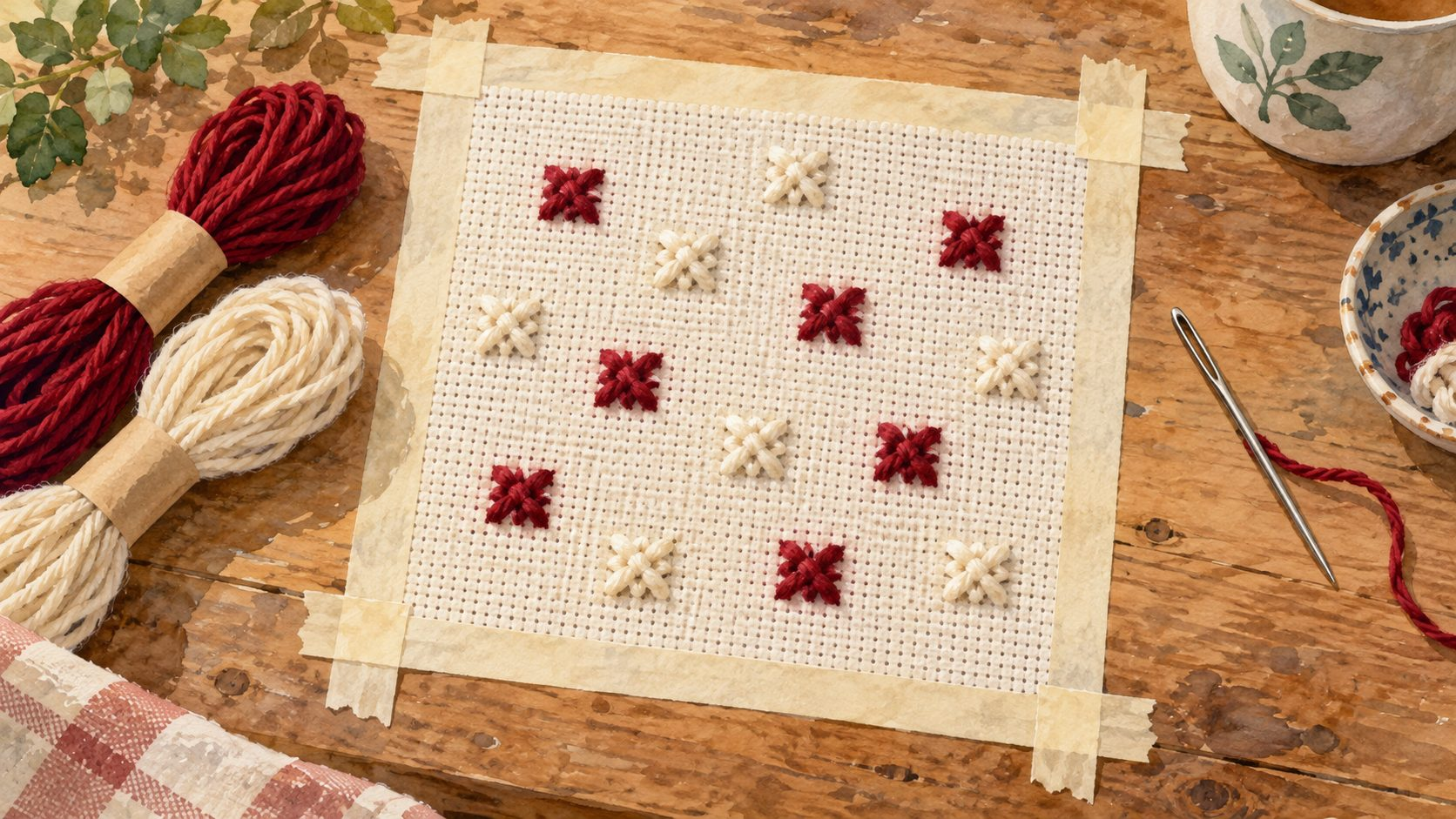
A Smyrna cross is a plain cross stitch with an upright cross worked on top, making a small raised square bump. It is one of the easiest ways to add texture and depth to a canvas. Sources disagree about its size, its names and even which stitch goes down first. This guide pulls together eight sources on how to work it and where to use it.
Work a cross stitch over two canvas threads each way. Add an upright stitch over the middle, then a horizontal stitch across the middle (Floss Field). Work the four stitches in the same order on every cross and finish each cross before starting the next (Floss Field, KC Needlepoint). Use a slightly thinner thread than usual, because the stitch is layered (Floss Field, Serendipity Needleworks).
What a Smyrna cross is
Floss Field describes a cross stitch with an upright cross worked on top of it, making a raised square bump over two canvas threads each way. KC Needlepoint gives the same structure and says that because it is layered it stands up off the canvas slightly. Wikipedia defines it as a cross stitch worked over two or more threads with a straight cross stitch over the top.
It has collected many names. Floss Field lists double cross and Leviathan stitch, and says one reference also calls it railway stitch, a name said to come from how quickly it covers the ground. Practical Embroidery adds Devil Stitch to the list. It was a Berlin wool work stitch, popular in the Victorian period and again in the 1950s and 1960s (Floss Field, Wikipedia).
| Fact | Source |
|---|---|
| Cross stitch plus upright cross on top | Floss Field, KC Needlepoint, Wikipedia |
| Usually over 2 threads each way; larger versions exist | Floss Field, Wikipedia |
| Names: double cross, Leviathan, railway, Devil Stitch | Floss Field, Practical Embroidery |
| Popular in Victorian times and the 1950s-60s | Floss Field, Wikipedia |
How to work it
- Work a cross stitch over two canvas threads each way: lower left to upper right, then lower right to upper left (Floss Field).
- Work an upright stitch over the middle of it, from bottom to top (Floss Field).
- Finish with a horizontal stitch across the middle, from left to right (Floss Field). Poppy Monk says to keep the horizontal bar on top.
- Work the next cross beside it on the next two threads, sharing the holes along the edge; the next row goes directly below in the same way (Floss Field).
Serendipity Needleworks says to work in horizontal rows and complete each stitch unit before moving on, and that on mono canvas you should execute each unit as you work across the row to help prevent canvas distortion. The Embroiderers' Association of Canada describes the same stitch as a cross stitch followed by a plus sign, and notes it works on aida cloth as well as needlepoint canvas. If cross stitch is new to you, see our beginner stitches guide.
When to use it
Floss Field names accents, snowflakes, small areas and bumpy fillings, and says a single cross makes a snowflake, a button or a small bush, while a row or two makes a border. Set beside plain cross stitches over a single intersection, it gives a sense of depth. KC Needlepoint says the crosses can be worked in neat lines or individually, depending on how the canvas is painted. Poppy Monk suggests a single one for an earring or a square object. Practical Embroidery calls it a thick, durable filling that covers well, and says it is also used as a detached stitch for stars or sparkles, and for mending and crazy quilting. Sirithre has seen individual crosses used as stars in a sky or as flowers, and shows a full-coverage piece worked entirely in Smyrna crosses.
Serendipity Needleworks used Smyrna crosses for the larger snowflakes on a Christmas canvas, pairing them with smaller standard cross stitches for the tiniest flakes to create depth. For more accent ideas see our guides to stitches for flowers and background stitches.
Thread choices
Because the stitch is layered, bulk is the main risk. Floss Field and Serendipity Needleworks both suggest a slightly thinner thread than you would otherwise use. Floss Field warns that a highly metallic thread reflects so much light that the separate stitches cannot be seen and the cross looks like a blob; Serendipity Needleworks says the same and suggests mildly sparkly threads instead. For snowflakes, Serendipity Needleworks used two strands of Soie d'Alger with two strands of Accentuate on 18 mesh. KC Needlepoint's sample used Neon Rays Plus. Those are individual stitchers' choices, not rules. See our thread types guide.
Variations and lookalikes
- Leviathan or double cross. The same stitch worked larger. Floss Field says some writers keep the name Smyrna for the small version while one reference uses the names for one stitch. Wikipedia quotes Therese de Dillmont's 1884 Encyclopedia of Needlework describing a plain cross over four threads each way with an upright cross on top, worked over six or seven threads with more stitches added.
- Double straight cross. The reverse order: a large upright cross first with a small diagonal cross on top (Floss Field). Serendipity Needleworks used it for a snowy hill, with one thread for the tall upright cross and another for the smaller diagonal cross to keep the stitch definition clear.
- Algerian eyelet. Sirithre says the Smyrna cross looks similar, but the eyelet's stitches all meet in the middle while the Smyrna crosses stitch all the way across each time.
- Star stitch. Practical Embroidery says the technique is very similar, but a star stitch is shaped as a circle and the double cross has a square shape.
Where sources disagree
- Size. Floss Field, KC Needlepoint and Poppy Monk describe two threads each way. De Dillmont's encyclopedia says four, or six to seven with more stitches (via Wikipedia). Treat two as the modern default and four as the larger version.
- Which stitch goes down first. Floss Field and the EAC work the diagonal cross first and the plus on top. Sirithre says either order works as long as you are consistent within a piece. KC Needlepoint and Serendipity Needleworks stress keeping the same arm on top throughout.
- Names. Smyrna, double cross, Leviathan, railway and Devil Stitch are all used (Floss Field, Practical Embroidery). Whether Smyrna and Leviathan are the same stitch or size variants depends on the writer (Floss Field).
- Structure wording. Most sources say an upright cross over a diagonal cross. Sirithre's diagram discussion describes stitching a plus and putting an X over it, or the reverse. The finished look is the same if you are consistent.
- Sellers. KC Needlepoint, Poppy Monk and Serendipity Needleworks sell threads, kits or classes. Read their thread suggestions as a seller's view.
Questions
How big is a Smyrna cross?
Two canvas threads each way in the small version, so it fills the same area as four tent stitches (Floss Field). Larger versions go over four or more threads (Wikipedia).
Is Smyrna cross the same as double cross stitch?
Usually yes. Some writers keep Smyrna for the small version and Leviathan or double cross for larger ones (Floss Field).
What is it good for?
Accents such as snowflakes, stars, buttons and small bushes, plus borders and bumpy textured fillings (Floss Field, Practical Embroidery, Sirithre).
Why does my Smyrna cross look like a blob?
The thread is too reflective or too thick. Use a slightly thinner, less metallic thread (Floss Field, Serendipity Needleworks).
Does it work on aida for cross stitch?
Yes, the EAC notes it works on aida cloth as well as needlepoint canvas.
Sources
- Floss Field, Smyrna cross stitch
- KC Needlepoint, Smyrna Cross Stitch
- Wikipedia, Smyrna stitch
- Serendipity Needleworks, Using Crossed Stitches on Your Needlepoint
- Sirious Stitches, Smyrna Cross: The Double Cross Stitch
- Practical Embroidery, Double Cross Stitch
- Poppy Monk, Needlepoint Stitch Library
- Embroiderers' Association of Canada, Smyrna Cross Stitch (PDF)