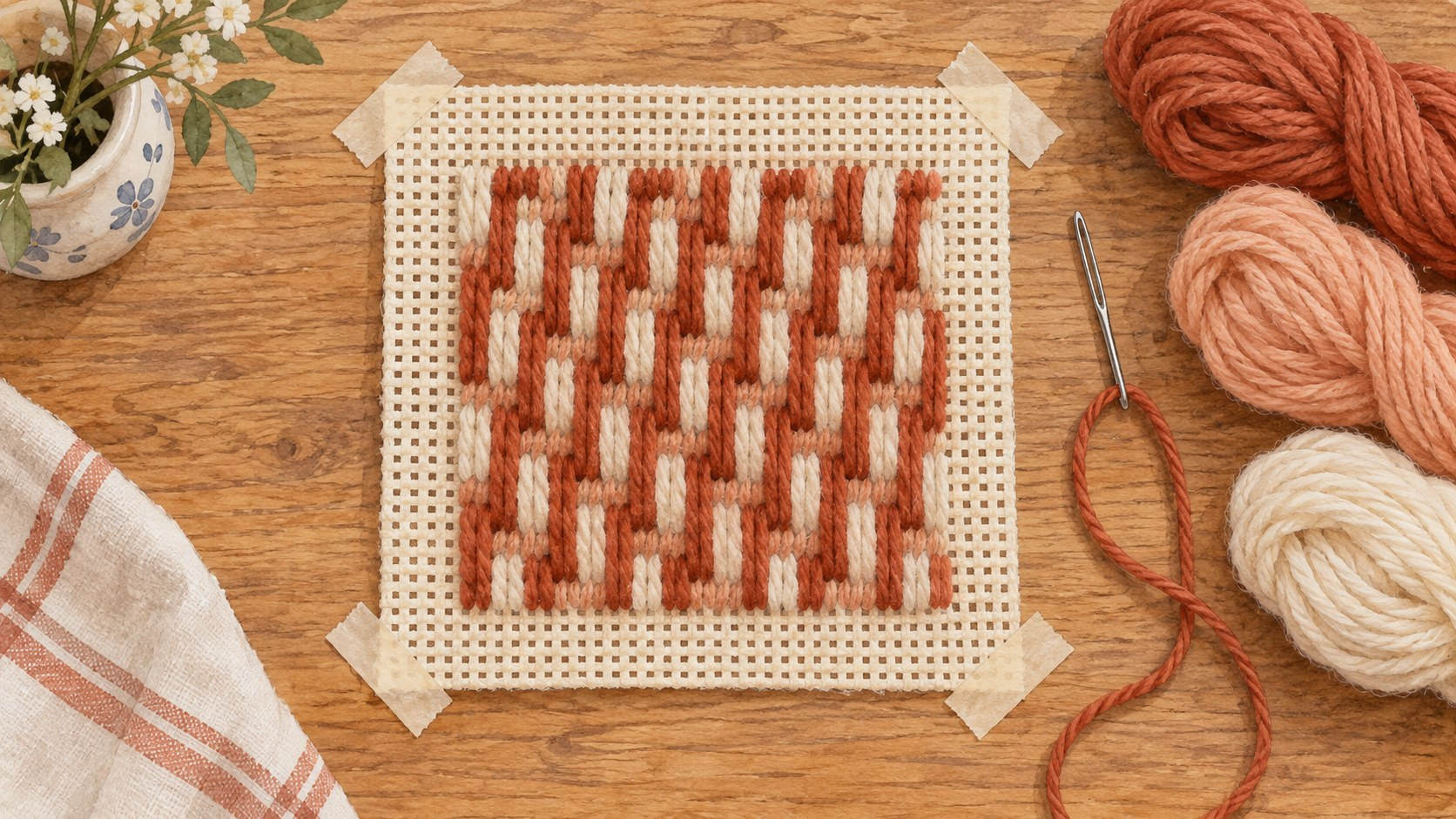
Parisian stitch is a flat canvas stitch of alternating long and short vertical stitches - usually over four threads and two - worked in rows that interlock like bricks. The result is a small, even, woven texture with dense coverage on both sides of the canvas, which is why generations of stitchers have reached for it as a background. It has been in print since 1847, and it is one of the easiest decorative stitches to learn after tent stitch. Last updated October 24, 2026.
Start here: row one alternates long stitch (over 4 threads), short stitch (over 2), long, short across the canvas. Row two swaps them: a short stitch under every long one, a long stitch under every short one, so the rows lock together. Use a thread a little thicker than you would for tent stitch, and the canvas disappears.
What Parisian stitch is
The Royal School of Needlework StitchBank describes it as a medium-sized flat canvas stitch of alternating long and short stitches worked in horizontal bands, categorized for filling. Floss Field describes the finished surface as a small, even texture with a dense cover on both sides of the canvas, and notes it is a neutral stitch - the eye does not travel along it in any direction, which is exactly what a background needs.
The stitch is old. The RSN and Floss Field both cite an 1847 British publication, The Illuminated Book of Needlework, where it appears under the name Josephine stitch. Unwind Studio, a shop that sells needlepoint kits, lists another alias: Old Florentine. Therese de Dillmont's Encyclopedia of Needlework (quoted on Wikipedia) recommended it as a grounding "where the material is not intended to be completely hidden."
How to work it
The modern count is four threads and two (Floss Field). The method, consistent across Floss Field, the RSN and Sew Sew Mellow:
- Start with a long stitch. Work a vertical stitch over four canvas threads.
- A short stitch beside it. Next to it, work a vertical stitch over two threads, centered on the long one.
- Repeat across the row. Long, short, long, short, to the edge of the area.
- Swap on the next row. Place a short stitch directly below each long one and a long stitch below each short one, so the stitches interlock. Repeat for every following row.
Sew Sew Mellow describes the same rhythm as "a simple vertical stitch worked in horizontal bands." Unwind Studio's diagram works the pair as a stitch skipping one row followed by a stitch skipping three, which is the same 2-and-4 structure counted from a different edge.
Double and horizontal Parisian
Two variations come up across the sources:
- Double Parisian. Two long stitches, then two short, in each repeat. Floss Field notes the look is more woven, and passes on one stitch list's advice to use it sparingly as a background because it is so striking - the pattern starts to compete with the subject instead of sitting behind it.
- Horizontal Parisian. The same stitch turned on its side, so the bands run vertically. Floss Field relays one shop's recommendation of it for small areas and small pieces.
Threads and coverage
Straight upright stitches cover less than slanted ones, so thread choice decides whether canvas peeks through. Floss Field's guidance is specific: use a thread a little thicker than for tent stitch, because straight stitches need more strands than slanted ones for the same cover, and a flat, ribbon-like thread covers the canvas better in this stitch. KC Needlepoint, a shop publishing stitch tutorials for its customers, makes the same call from the shop floor: they love Parisian in a flat fiber like Neon Rays Plus for better coverage.
If you do see canvas between stitches, Floss Field's troubleshooting entry says to thicken the thread. For help matching fiber to mesh, see needlepoint thread types and how to tell canvas mesh count.
Where to use Parisian stitch
The sources agree it is above all a filling and background stitch. Floss Field lists backgrounds, large areas and textured fills, and adds that teachers use it for clear skies, the smooth breast of a bird, and grass. Unwind Studio recommends it for small areas, large areas, backgrounds and flowers. The Art Needlepoint Company's stitch course praises its coverage across small areas and suggests borders, vases, pottery, walls in a house scene, and whimsical details, worked in one color or two.
Because the texture is neutral, it sits behind a subject without pulling the eye - unlike diagonal stitches, which create movement. For calmer or busier alternatives in the same role, see needlepoint background stitches and stitches for sky and water.
Parisian vs Hungarian stitch
The two are often confused because both interlock long and short vertical stitches. Floss Field draws the line clearly: Parisian is continuous - long, short, long, short with no gaps - while Hungarian stitch groups its stitches in threes with a gap between groups. Unwind Studio likewise lists Hungarian as Parisian's closest relative. If your rows show a repeating diamond of three-stitch clusters, you are stitching Hungarian, not Parisian.
Where sources disagree
The count. Modern sources (Floss Field, RSN, Sew Sew Mellow) work Parisian over four threads and two. De Dillmont's 19th-century Encyclopedia of Needlework, quoted on Wikipedia, gives a long stitch over three threads and a short stitch over one. Both interlock the same way; the modern 4-and-2 gives a chunkier texture, the older 3-and-1 a finer one.
Whether the canvas should show. De Dillmont recommended Parisian as a grounding where the fabric is not meant to be completely hidden - a deliberate semi-sheer ground. Modern teaching aims for full, dense coverage and reaches for thicker or flatter threads to get it. Same stitch, opposite goals, a century apart.
Double Parisian as a background. Some stitch lists treat double Parisian as just another background option. The stitch list Floss Field quotes advises using it sparingly as a background because the doubled texture is striking enough to upstage the subject.
Tips for a clean texture
- Center the short stitch. Floss Field centers each short stitch on the long one beside it; that alignment is what makes the woven look regular.
- Keep tension even. Flat stitches show every pull. Our even tension guide covers the habits that keep rows uniform.
- Compensate freely. Parisian is a plain pattern and easy to cut off at an outline: shorten each stitch at the edge and carry on (Floss Field).
- Try two colors. The Art Needlepoint Company notes the texture is more emphasized in two colors - alternate rows or alternate stitches for a subtle stripe.
FAQ
Is Parisian stitch good for beginners?
Yes. It is only vertical straight stitches over 2 and 4 threads, and The Art Needlepoint Company teaches it in the first month of its stitch course, right after tent stitch. The only skill to learn is keeping the interlock consistent from row to row.
Why can I see canvas between my stitches?
Your thread is too thin. Straight stitches need a thicker thread, or more strands, than slanted stitches for the same coverage (Floss Field). Switch to a thicker or flatter fiber - shops like KC Needlepoint favor flat ribbon-style fibers for this stitch.
What is the difference between Parisian and Hungarian stitch?
Parisian runs long-short-long-short continuously with no gaps; Hungarian groups stitches in threes with a gap between groups (Floss Field). Looked at from a distance, Parisian makes an even weave and Hungarian makes a diamond-textured pattern.
Is Parisian stitch the same as Josephine stitch?
Yes - the stitch appears as Josephine stitch in an 1847 British needlework book (RSN StitchBank, Floss Field). Unwind Studio also lists the alias Old Florentine. All three names describe the same interlocking long-and-short vertical stitch.
Can I use Parisian stitch for a background?
It is one of the classic background stitches: neutral in direction, dense on both sides of the canvas, and quick to work over large areas. Reserve the doubled version for accents - it is striking enough to compete with your subject.
Sources
- Floss Field - Parisian stitch (4-and-2 method, coverage and thread guidance, double and horizontal variations, Hungarian comparison, troubleshooting)
- Royal School of Needlework StitchBank - Parisian stitch (interlocking row method, filling classification, Josephine stitch in the 1847 Illuminated Book of Needlework)
- Wikipedia - Parisian stitch (quoting Therese de Dillmont's Encyclopedia of Needlework: the 3-and-1 count and the not-fully-hidden grounding)
- Unwind Studio - Parisian Stitch (a shop selling kits and booklets; diagram counting, Old Florentine alias, uses from small areas to flowers)
- KC Needlepoint - Parisian Stitch (a needlepoint shop's stitch tutorial; flat fibers like Neon Rays Plus for coverage)
- Sew Sew Mellow - Parisian (a shop's step-by-step; long and short stitches in horizontal bands, end-to-end row placement)
- The Art Needlepoint Company - Stitch Course, Month 1 (a kit company's stitch course; coverage on small areas, borders, vases and walls, one color or two)