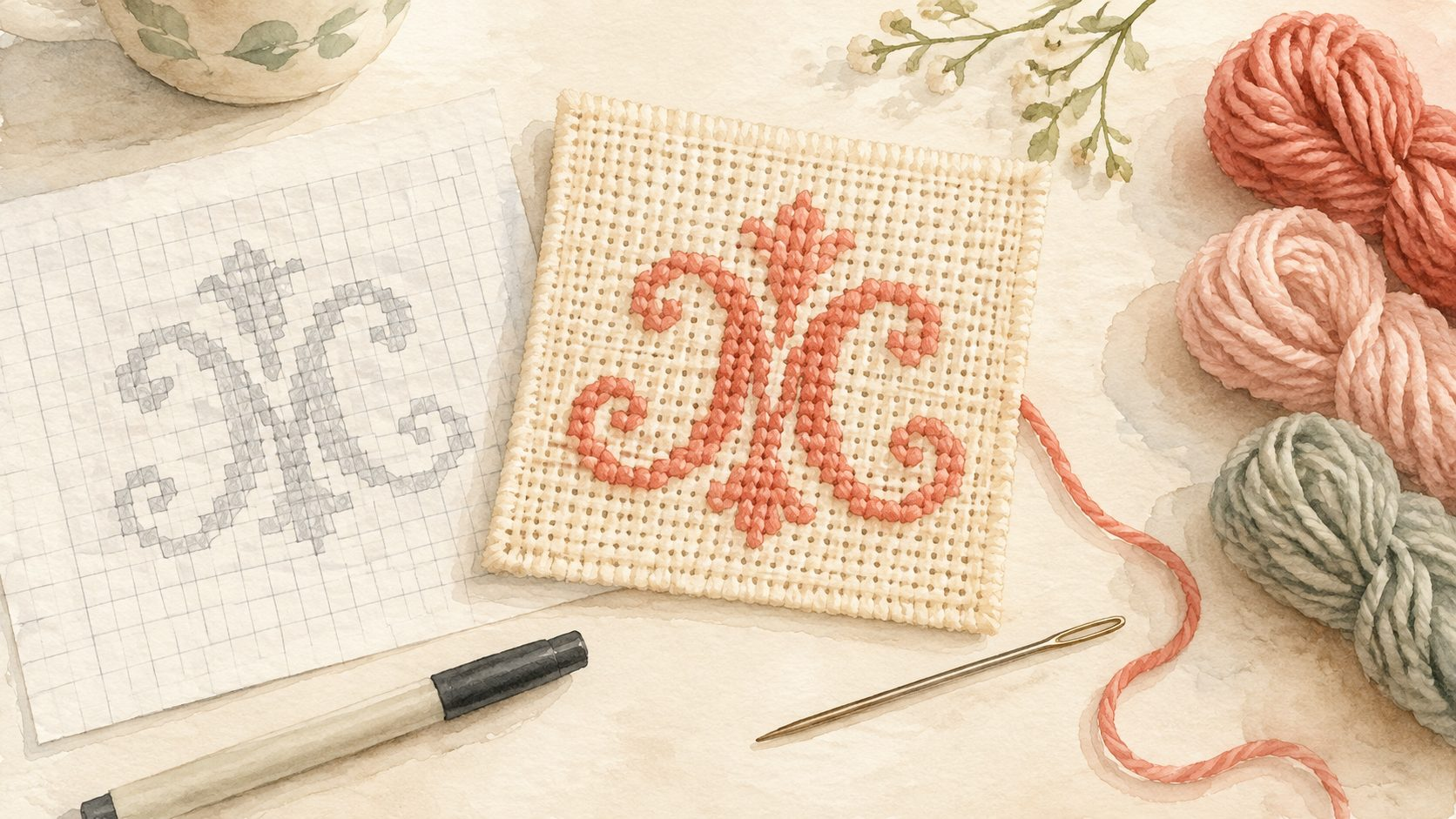
Letters are one of the trickiest parts of needlepoint. A tent stitch turns a curve or diagonal into steps, thin lines look pixelated, and one wrong count can leave a name off center. Shops and designers handle it a few different ways. This guide compares the methods and the stitches, and notes where sources disagree.
If your canvas already has letters painted on, pick a stitch based on letter size: tent stitch for small or detailed letters, backstitch or satin stitch for thin or large ones. If you are adding your own name or monogram, graph it on paper first and count from the center. Plan the letters before you choose a background stitch.
Methods compared
| Method | Best for | Watch out for |
|---|---|---|
| Count from a charted alphabet | Adding names or dates to a blank area (Needlepoint For Fun, Unwind Studio) | Needs graphing and careful centering |
| Paint or mark letters on the canvas | Custom fonts and larger lettering (Needlepoint For Fun, Nuts About Needlepoint) | Use a marker meant for fabric, not pen or pencil (Bristly Thistle) |
| Backstitch over the canvas | Thin lines and script (Poppy Monk, Unwind Studio) | Photograph the canvas first if stitching over tent stitch (Poppy Monk) |
| Tent stitch | Small, clear letters (Needlepoint.com, Unwind Studio) | Stepped diagonals and curves (Poppy Monk) |
| Satin stitch | Small letters needing full coverage, or thick letters (Needlepoint.com, Poppy Monk) | Readability if the direction fights the letter shape |
Counting from a chart
Needlepoint For Fun says to pick an alphabet from a book or free online chart, transfer the letters you need to graph paper that matches your canvas scale, such as 18 holes per inch, and use that to check size and spacing before stitching. It says cross stitch alphabets can be adapted to tent stitch and that you can scale a chart up or down by doubling or halving stitch counts. It recommends finding the center of the lettering and the center of the canvas and counting outward from there. Unwind Studio gives similar steps: plan on squared paper, count to the starting point, and think of chart squares as intersections, not the holes. Its free alphabet chart comes in an original, a serif, and a sans serif version, and Unwind notes the same word comes out smaller on 18 mesh than on 10, so simulate the text first. If you have not worked from a chart before, read how to read a needlepoint chart. You can also build your own with the needlepoint chart maker. Mesh changes size, so see 13 vs 18 mesh.
Bristly Thistle describes a hands-on version for painting names: cut a paper blank to see the size, choose an alphabet that matches the canvas design, graph the letters, cut them out to adjust spacing (it says the spacing is seldom the same between letters), then mark the vertical center with a pin and count from the center and bottom line to the first intersection.
Painting or marking letters
Needlepoint For Fun says you can type letters in a word processor, print them, and lay the paper under the canvas to check size and centering before outlining them with a gray or pale blue waterproof fabric marker, then fill them with satin stitch or tent stitch. Bristly Thistle warns against pencil, pen, or permanent marker, and prefers acrylic paint or a textile marker in gray because it can be stitched over with almost any color. It also says a computer-printed name painted straight onto the canvas can look stamped, and that your needlepoint shop can paint lettering for you. Nuts About Needlepoint traces a monogram with an extra-fine marker made for fabric, then colors it in with wide-tipped markers and lets it dry overnight, and says to color intersections accurately so you know where to stitch. Prepare the canvas first: see how to prepare a canvas.
Which stitch for letters
Needlepoint.com says the biggest influence is letter size. Large letters, such as a stocking name, suit tent stitch or basketweave for a classic, durable look, or a vertical stitch such as Parisian if you have room and keep coverage and readability in mind. Small letters, such as on a travel round, can take satin stitch for full coverage. Sometimes tent stitch is the clearest choice for a clean font. Poppy Monk lists four options: backstitch, which follows any line and lets you use thinner or thicker thread; cross stitch, which has no direction and avoids the stepped look of tent stitch on up-and-left lines; horizontal satin stitch for thicker letters; and tent stitch. Unwind Studio says to use tent stitch for tight spaces and block letters, and backstitch for flowing script and crisp line work. Learn the basics in stitches for beginners and basketweave.
Monograms and backgrounds
Nuts About Needlepoint says strongly graphic designs like monograms are stitched in tent stitch, which limits background choices because irregular letters need lots of compensation. Its strategies are to isolate the monogram with a tent stitch border in the monogram color, change the scale of the background pattern to very large or very small, frame the monogram with a wide border, and make the monogram the brightest, most saturated color with value contrast against the background. It also says you can change spacing when transferring the design, but not the size, and suggests multiplying the space in inches by 72 to estimate the starting point size for a middle letter, then test fitting prints under the canvas. Needlepoint.com adds that the background can muddy letters: horizontal or vertical background stitches can make letters harder to read, while a diagonal stitch lets them show. See our background stitches guide. For finished items, see pillows and ornaments.
Thread and stitching tips
Poppy Monk says that if the lettering is darker than the background, stitch the paler areas first when you can to reduce shadowing, avoid dragging dark thread behind pale stitches, and start and end dark threads using adjacent dark stitches. It also says a tent stitch box around the lettering keeps a decorative background from overwhelming the words, and that individual stitch placement does not have to be perfect. If you slip, see fixing mistakes.
Where sources disagree
Painting by computer. Needlepoint For Fun suggests printing a font from a word processor to size and trace it, while Bristly Thistle says printing a name from a computer and painting it on often looks stamped and says hard work by hand or an alphabet matched to the design works better. Both agree on checking size under the canvas first.
Marker color. Needlepoint For Fun suggests gray or pale blue waterproof fabric markers. Bristly Thistle prefers gray textile marker or acrylic paint. Nuts About Needlepoint colors its monogram to match the thread. Test any marker on scrap canvas first.
Best stitch. Needlepoint.com prefers tent stitch or basketweave for large letters and satin for small ones. Poppy Monk and Unwind Studio suggest backstitch or cross stitch for thin lines. The answer depends on line thickness and mesh.
Questions
What is the easiest way to add a name to a canvas?
Sources lean toward graphing the name on paper from a charted alphabet and counting from the center (Needlepoint For Fun, Unwind Studio).
Why do my letters look pixelated?
Poppy Monk says tent stitches create stepped lines on diagonals and curves. Backstitch or cross stitch can look smoother on thin lines.
Will the same chart fit any canvas?
Unwind Studio says its free alphabet chart works on any mesh but the finished size changes with mesh count.
Can I ask a shop to paint letters?
Bristly Thistle says your favorite needlepoint store can paint lettering for you, even to match previously stitched stockings.
Sources
- Needlepoint.com: Needlepoint Lettering
- Poppy Monk: Four Ways to Stitch Needlepoint Letters
- Nuts About Needlepoint: Making a Needlepoint Monogram
- Unwind Studio: How to personalize a needlepoint canvas
- Unwind Studio: Needlepoint Letters and Numbers for Personalization
- Bristly Thistle: Needlepoint Lettering
- Needlepoint For Fun: Needlepoint Lettering