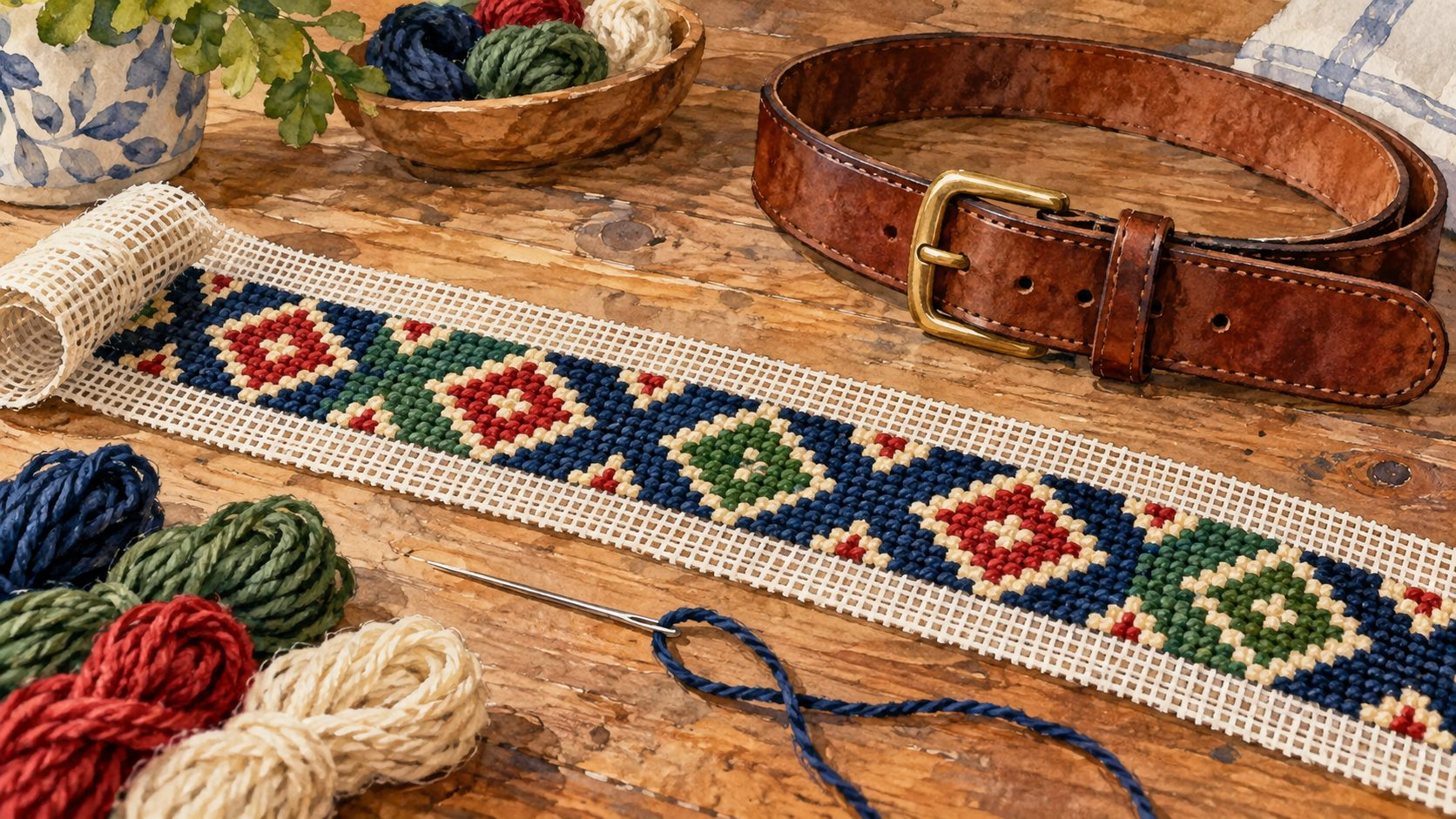
A needlepoint belt is a long strip of stitched canvas that a finisher mounts on leather with a buckle. The stitching is the easy part: most sources say to work it in basketweave and be done. The part that trips people up is sizing, because belt size is not pant size, the stitched piece is shorter than the finished belt, and every finisher wants the ends and edges a slightly different way. The recurring advice across the sources is simple: pick your finisher before you stitch the ends.
Measure a belt you actually wear, from the buckle to the hole you use most. That number is your belt size, and it is not your pant size. Stitch a strip of 18 mesh canvas shorter than that number (your finisher says how much shorter), in basketweave, with two extra rows along the top and bottom edges unless your finisher asks for a binding stitch instead. Send it out to be mounted on leather.
Sizing the belt
Every source that covers sizing leads with the same warning: belt size and pant size are different measurements, and the number stamped on a store-bought belt is usually the waist size, not the belt size. Needlepoint.Com, M's Canvashouse, Stitching Fox and Sign of the Arrow all say to measure a belt that fits: lay it flat and measure from the buckle (including the buckle) to the hole you use most. Stitching Fox notes this finished measurement is placed at the center hole of the five adjustment holes on the finished belt, leaving two holes of adjustment each way. Floss Field adds that belt size usually comes out 2 to 3 inches more than the pant size.
The stitched canvas is shorter than the belt size, because leather at each end carries the buckle and the holes. How much shorter depends on the finisher. Needlepoint.Com says the stitched length is 6 inches less than the belt size, so a 36-inch belt needs 30 inches of stitching. M's Canvashouse and Stitching Fox say about 4 inches less. Floss Field's survey of published instructions found figures from 4 to 6 inches less, and its advice is to treat your finisher's figure as final.
The ends get covered. Leather will hide the first and last stretch of your stitching: M's Canvashouse says 1.5 inches per end, Stitching Fox and Sign of the Arrow say about 2 inches per end. Floss Field's practical takeaway: keep initials, dates and anything you want seen away from the ends.
Canvas and thread
- Mesh. Most belt canvases are 18 mesh mono, per Floss Field and Good Threads. The Spruce Crafts says the finer the mesh, the more detail you can work, and picks #18 mono for a narrow belt with detailed motifs. Our mesh size chart shows how counts compare.
- Width. Floss Field says most belt canvases are 1.25 inches wide, which is 22 stitches on 18 mesh, though makers differ: one uses 20 rows as standard and another asks for 24. Sign of the Arrow says to stitch 1.5 inches for a standard 1.25-inch finished belt, because the extra rows roll under. The Spruce Crafts says to stay at or under 1.75 inches wide if you want the finished belt to pass through most belt loops.
- Canvas color. The Spruce Crafts suggests matching canvas color to thread value: tan or black canvas keeps dark threads from showing through, while white or ecru suits lighter threads.
- Thread. The Spruce Crafts says Persian wool works well for most belts, with silk or cotton floss as accents, and says to limit metallics and skip textured fibers that will not stand up to repeated wear. Floss Field recommends pearl cotton size 5 or six-strand floss on 18 mesh, notes published charts run from 4 to 6 strands of floss, and says to stitch a small test patch to check coverage. Our thread types guide compares the fibers.
- Frame. Floss Field recommends a scroll frame for belts: it helps keep the long strip square, and you roll the canvas along as you go.
Planning the design
The Spruce Crafts says to choose the belt's closure before cutting canvas, because the buckle style sets the length you need. It lists leather buckles with tab closures, two-part metal or plastic clasps, and tie-style closures with cords as good options, and warns that prong buckles need eyelets that can detract from the look, while a thick belt may not fit a slide-through buckle.
Floss Field splits belt designs into repeats (stripes, a key pattern, a row of motifs) and picture sequences, and gives three working rules: start stitching at the center of the canvas and work toward both ends so the design stays centered; leave the last inch or two at each end as plain background until the length is confirmed with the finisher; and remember the belt is seen from a distance, so simple shapes and strong contrast read best. The Spruce Crafts adds that small repeating Bargello motifs are especially effective on belts, which our Bargello guide explains how to stitch.
Stitching the belt
The consensus stitch is basketweave. Sign of the Arrow's finishing sheet states flatly that basketweave is the preferred method for stitching belts. Needlepoint.Com says belts should be stitched in all basketweave or tent stitch for durability. Floss Field says to use basketweave wherever you can, because it is the most hard-wearing form of tent stitch and the one most likely to keep the canvas square, and to drop to continental only for single lines and small areas where basketweave will not fit. Our basketweave guide covers the technique and our tent stitch comparison explains when continental wins.
Good Threads lists the stitches it considers belt-appropriate: tent stitch for sturdy flat designs, basketweave for even texture over larger areas, continental for beginners (with more care needed to avoid distorting the canvas), and Florentine stitch as a decorative accent for borders or small areas. Block the finished strip before sending it out; our blocking guide shows how.
Edges: extra rows or a binding stitch
Finishers want the two long edges of the belt handled one of two ways, and they do not agree, so ask yours first.
- Extra rows (folded or rolled under). Needlepoint.Com says to stitch 2 to 3 extra rows along the top and bottom of the design, which the finisher rolls over to form the edge. Stitching Fox asks for exactly 2 extra rows top and bottom, and says neither should be the outside edge of the canvas; it folds them under for a finished edge with no bare canvas showing. Sign of the Arrow says it does not suggest a binding stitch and builds its widths around rolled turn rows.
- Binding stitch. Maison Needlepoint describes the binding stitch as a sturdy, decorative stitch that wraps and seals the raw canvas edge, used on pieces that get heavy handling: belts, keychains, bag straps, bookmarks. The Chilly Hollow blog's tutorials describe a "back three, up one" rhythm, worked right to left, on the two long edges only, never the ends. M's Canvashouse gives a rule of thumb: on 18 count canvas, a belt 18 to 22 stitches wide takes a binding stitch, and anything wider gets folded; on 14 mesh, binding suits 14 to 16 stitches wide. If the finisher applies the binding, it asks you to send extra thread, about one skein of pearl cotton for both sides of a belt.
Finishing
Mounting a belt on leather is specialist work, and most sources say to send it out. Floss Field reports that needlepoint shops and belt makers take belts in for finishing: the finisher mounts the strip on a leather backing, adds the leather ends and buckle, and you usually choose the leather color and buckle metal. Published turnaround times run from about six weeks to four months or more, longer before Christmas, so ask early. M's Canvashouse describes two leather types: soft calfskin in many colors, used for D-ring and children's belts, and heavier saddle leather, which cannot be used on ring closures.
There is one do-it-yourself route. Nuts about Needlepoint describes a fashion belt based on the grosgrain ribbon D-ring belt, from Ridgewood Needlepoint: because it skips leather and a buckle, it needs no specialist finishing. The method: block the needlepoint, work a row of continental then a row of interlocking cross (binding stitch) along each side for strength, keep stitches to four threads long or less, and set the width from the ribbon: measure the ribbon, multiply by your canvas mesh, and add 6 threads. It is a fashion belt, not one for hard use. Our finishing basics guide covers general finishing terms.
What finishers ask for
| Finisher | Stitched length vs belt size | Leather covers per end | Edges |
|---|---|---|---|
| Needlepoint.Com | 6 inches less | Not stated | 2 to 3 extra rows, rolled |
| Stitching Fox | About 4 inches less | About 2 inches | Exactly 2 extra rows, or your binding stitch |
| M's Canvashouse | 4 inches less | 1.5 inches | Binding stitch on narrower widths, fold on wider |
| Sign of the Arrow | 4 or 6 inches less, by belt style | 1.5 inches | Extra rows rolled under; no binding stitch |
Working tips
- Start stitching at the center of the strip and work toward the ends, per Floss Field, so any length adjustment comes out of the plain ends.
- Check your finisher's edge and length requirements before you stitch the ends, per Floss Field and Chilly Hollow; the answer changes your row counts.
- Keep stitches on the body of the belt to four threads long or less, per Nuts about Needlepoint's D-ring belt method.
- Measure a worn belt rather than trusting the size stamped on it, per M's Canvashouse and Stitching Fox.
- Stitch a coverage test patch with your chosen thread on 18 mesh, per Floss Field.
- If you want a custom repeat of your own, our photo to needlepoint pattern guide shows how to chart an image for canvas.
Where sources disagree
- How much shorter than the belt size to stitch: Needlepoint.Com says 6 inches less. M's Canvashouse and Stitching Fox say about 4 inches. Sign of the Arrow's diagrams show both, depending on belt style. Floss Field says get the number from your finisher.
- How much of each end leather covers: M's Canvashouse and Sign of the Arrow say 1.5 inches; Stitching Fox says about 2 inches.
- Binding stitch or extra rows: Sign of the Arrow does not suggest a binding stitch and rolls turn rows. M's Canvashouse picks binding or fold based on belt width. Some finishers accept either, per Stitching Fox.
- How to measure: Every finisher says to measure a worn belt from buckle to the most-used hole. The Spruce Crafts instead describes measuring your waist over clothing, subtracting the buckle length and adding 6 inches. The finisher method is the safer one, since it matches how they build the belt.
- What it costs: Finishing prices and kit prices appear on several of these pages. We did not check current prices.
Questions
Is belt size the same as pant size?
No. All the finishing sources warn they differ. Measure a belt that fits, from the buckle to the hole you use most; Floss Field says the result is usually 2 to 3 inches more than the pant size.
How much canvas do I stitch for a 36-inch belt?
It depends on the finisher: 30 inches by Needlepoint.Com's rule (6 inches less), about 32 inches by M's Canvashouse and Stitching Fox (4 inches less). Confirm with whoever will leather the belt.
What stitch should I use for a needlepoint belt?
Basketweave, per Sign of the Arrow, Needlepoint.Com and Floss Field, because it is the most durable tent stitch and keeps the canvas square. Use continental for single lines and tight spots.
Do I need a binding stitch on my belt?
Only if your finisher wants one. Some finishers roll two extra stitched rows under instead. Chilly Hollow and Floss Field both say to ask before doing the work.
Can I finish a needlepoint belt myself?
A leather-backed belt with a buckle is specialist work, usually sent to a finisher. Nuts about Needlepoint describes a D-ring and grosgrain ribbon fashion belt you can finish yourself with basic sewing.
What canvas is best for belts?
18 mesh mono is the standard per Floss Field and Good Threads. The Spruce Crafts says finer mesh gives more detail and suggests 18 mesh for narrow belts with motifs.
Sources
- Floss Field: How to Make a Needlepoint Belt
- Needlepoint.Com: Everything You Need to Know About Stitching a Belt
- Needlepoint.Com: Belt Finishing
- Stitching Fox: Belt Finishing Guidance
- M's Canvashouse (The Meredith Collection): Belt Sizing Information (PDF)
- Sign of the Arrow: Belt Finishing Diagrams (PDF)
- The Spruce Crafts: How to Make a Needlepoint Belt
- Good Threads: Tips for Perfect Belt Stitching
- Nuts about Needlepoint: Needlepoint a Geometric Belt
- Maison Needlepoint: Mastering the Binding Stitch
- Chilly Hollow: Using the Binding Stitch on a Belt Canvas
- Chilly Hollow: How to End and Restart Binding Stitch