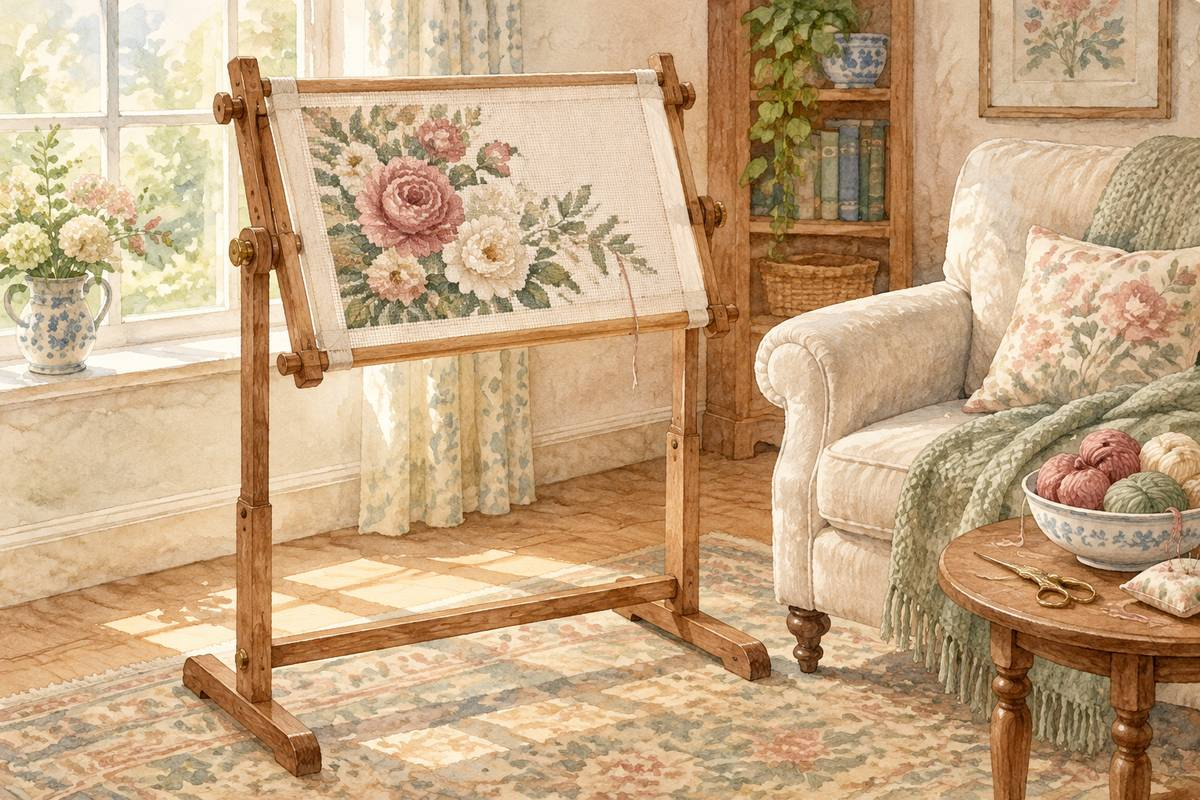
Somewhere around the second or third canvas, most stitchers meet the same problem: one hand holds the canvas, the other does all the work, and both of them get tired. A needlepoint stand is the tool built to fix that - a holder that grips your framed canvas so both hands are free to stitch. Stands come in a few distinct shapes, and the right one depends mostly on where you sit when you stitch and how big your projects are. This guide walks through the types, what each one is good at, and how to choose, based on what needlepoint shops, teachers and stitchers actually say about them. Last updated October 29, 2026.
Start here: A stand is a helper, not a requirement - plenty of stitchers happily work in hand. If you want one, choose by where you stitch: a floor stand for stitching in a favorite chair or sofa, a lap or table stand for a desk, kitchen counter or smaller projects, and a table clamp when portability matters most. Whatever you buy, confirm the stand's clamp or holder fits the frame you actually use before you pay.
What a stand actually does
A stand holds the frame, and the frame holds the canvas. Once the project is mounted and the holder takes its weight, you stitch two-handed: one hand above the canvas and one below, passing the needle between them. Mr X Stitch's needlepoint column calls that a much faster way to work, and names the other two reasons stitchers reach for a stand - hand fatigue from holding the canvas, and posture. Paired with the right chair, a stand lets you sit back instead of hunching over the work in your lap. World of Needlepoint makes the same point from the other side: holding a frame in position is tiring for hands and arms, and attaching the frame to a lap or floor stand is how many stitchers avoid that fatigue.
There is a second, quieter benefit. Floss Field notes that a stand keeps your tension more even, because the canvas stays drum-tight and square while you work, and a piece stitched that way often needs little or no blocking afterward. It also means the canvas is handled less, so the work stays cleaner over a long project.
None of this makes a stand mandatory. The Spruce Crafts calls a stand a matter of preference rather than a requirement, and Unwind Studio, a needlepoint designer and seller, actively prefers stitching in hand with the canvas rolled, for the mobility. Their framing guide still lists stands as the natural partner to a frame when you want both hands free. If you are still deciding whether you need any frame at all, start with whether you need a frame for needlepoint; a stand only makes sense once a frame is in the picture.
The shapes a stand comes in
Mr X Stitch groups needlework stands into three types. Floor stands rest on the floor in front of you or to your side while you stitch. Lap stands either balance on top of your lap or have a base that tucks under your thigh as you sit. Table clamp stands attach to a table or worktop and are the most portable of the bunch. Floss Field adds the sit-on style as its own variant: a base that slides under your thigh, so your own seated weight anchors the stand.
Those shapes trade the same three things against each other: stability, footprint and portability. A floor stand is the steadiest and the most adjustable, but it lives where it lives. A lap or table stand is smaller and lighter but suits smaller frames. A clamp goes anywhere there is a table, as long as there is a table.
Floor stands
A floor stand is the classic stitching-chair companion. Serendipity Needleworks, a needlepoint teacher and former shop owner writing about the Needlework System 4 line, lists what makes one useful: it folds for storage, weighs about 4.5 pounds, adjusts to any angle, and its base slides under most furniture, so the canvas hangs over your lap while you sit back in the chair. Needlepoint.com, a seller that stocks the same line, gives the floor stand's main arm as 36 inches from floor to connector knob, and recommends the floor stand for stitchers who like large projects, precisely because it is not dependent on a surface - you can move it closer or farther away as the project size demands.
The travel version is the same idea made collapsible. Needlepoint.com describes a travel floor stand whose telescoping arm sets to 27, 33 or 38 inches and packs small; Serendipity says its TravelMate collapses enough to fit in a suitcase, and weighs the same 4.5 pounds as the full-size floor stand. If you stitch in hotels or at a stitching group, that is the model aimed at you. Our guide to taking needlepoint on a plane covers the travel side of the hobby more broadly.
For very large work, floor stands pair with scroll frames instead of stretcher bars: Needlepoint.com notes scroll bar frames in sizes like 12 to 20, 18 to 30 and 24 to 40 inches for projects such as stockings and growth charts, and Serendipity mentions that two floor stands combined with a rug scroll frame can even hold a rug canvas.
Lap and table stands
A lap or table stand is the small-project specialist. Needlepoint.com describes its table/lap stand as the right pick if you stitch at a desk or kitchen counter, with the bonus that the same base rests in your lap for stitching in a favorite chair or working a small project in bed. Serendipity prefers a table/lap stand for smaller projects like ornaments, notes it folds flat for carrying, and warns of one limit: this style only accommodates a small or medium scroll frame, so big canvases stay with the floor stand.
Weight figures for these stands vary by model and by source - Needlepoint.com puts its lap stand base at 3 pounds, Serendipity measured her table/lap stand at 1.75 pounds - but the shared point is that they are light enough to move around the house without thinking about it.
Table clamps
A table clamp stand skips the base entirely and grips the edge of a table, desk or counter. Needlepoint.com describes its table clamp as adjusting from 1 to 6.5 inches above the table top, weighing 1.5 pounds, and attaching to almost any table without damaging the surface. Mr X Stitch calls table clamp stands the most portable type. The obvious constraint is the one in the name: you need a suitable surface wherever you plan to stitch, and the clamp height is fixed by the table, so the ergonomics depend on pairing it with the right chair.
Matching a stand to your stitching
The sources all reduce the choice to the same two questions. Where do you stitch most often? And how big are your projects? Needlepoint.com's advice is to consider where you stitch most: desk or counter stitchers get the table/lap stand, chair-and-sofa stitchers with larger projects get the floor stand, and frequent travelers get the collapsing travel version. Serendipity's advice, after years of fitting customers in a brick-and-mortar shop, is to test drive the models if you possibly can, and if you have no local shop, to talk to several people who own the stand you are considering before deciding.
Mr X Stitch adds budget to the list and offers a practical route around the price: many local needlepoint shops carry a variety of stands, and some loan them out so you can figure out which one suits you before buying. The Spruce Crafts gives the same counsel - try the model the shop has on hand to see if it works for you - and notes that stands range from medium-priced to elaborate and expensive.
One cost structure is worth knowing before checkout. On the Needlework System 4 line, the base and the clamp that holds your frame are sold separately, and Serendipity points out that this piece-by-piece approach makes the system very customizable but more expensive overall. The consolation, as Needlepoint.com notes, is that one clamp moves back and forth between a floor base and a lap base, so a second base does not mean a second clamp. The same seller lists optional add-ons - clamp lights, scissor trays, carry bags - and Serendipity singles out the radius arm extension as the one extra that makes fine angle adjustment much easier. None of this is required on day one; it is a system you can grow.
Check the frame fit before buying
Floss Field raises the compatibility warning every buyer should hear: some floor stands hold stretcher bars, scroll frames and hoops, but many stands are made for hoops and will not take a heavier needlepoint frame, so check that the stand fits your frame before you buy. In practice that means knowing two things when you shop: what kind of frame you stitch on (stretcher bars or scroll frame) and how the stand grips it (a clamp sized for stretcher bars, scroll-rod holders, or a hoop-style jaw). If you have not settled on a frame yet, our guide to stretcher bar sizes and mounting is the place to start, and keeping even tension explains what the frame-and-stand combination is protecting.
Names stitchers mention
Mr X Stitch names three brands that needlepointers champion time and again, in no particular order. Needlework System 4 is an interchangeable range of stands and accessories in lightweight aluminum and stainless steel, valued because you can build the ideal stand for any scenario out of the components. K's Creations offers portable stands in stainless steel and wood, and is often praised for a swiveling ball joint that allows optimal positioning. Lowery Workstands are lightweight aluminum and stainless, fully adjustable, with the columnist personally favoring a Lowery for its compactness, hand-friendly levers and an extra-long L bar that lets the stand work from almost any seat. Serendipity adds, from a shop owner's perspective, that System 4 products are made in the United States, sold through needlework shops, and backed by a warranty with repairs or replacement parts handled directly - her own two stands have run for more than ten years without a problem. That durability point is her answer to sticker shock: a stand is an investment in the hobby, and the benefits of using one outweighed the initial cost for her.
Where sources disagree
Whether a stand is worth it at all. The shop and teacher sources are uniformly positive, but the community is honestly split. Stitching the Night Away, a stitching community blog, asked readers whether they use a stand, and the comments range from stitchers with arthritis or carpal tunnel who call a stand the thing that lets them keep stitching at all, to stitchers who felt restricted rather than freed and went back to holding their work. Unwind Studio lands on the same nuance from the designer side: they prefer handheld stitching for its mobility and treat frames and stands as a valid choice, not an upgrade everyone needs.
What the lap stand weighs. Needlepoint.com lists its System 4 lap stand base at 3 pounds; Serendipity Needleworks, writing about the same product line, gives her table/lap stand as 1.75 pounds. Model revisions or which pieces are included likely explain the gap - treat any published weight as approximate and check the current listing for the exact model you are considering.
Small projects: stand or hand. Serendipity recommends the table/lap stand for small projects like ornaments. Floss Field notes the opposite end of the range: a small frame can simply be held in one hand, and it is the large ones that are easier in a stand. Both can be true - it depends on whether your hands want the help.
FAQ
Do I need a stand for needlepoint? No. The Spruce Crafts calls a stand a preference rather than a requirement, and plenty of stitchers work in hand with the canvas rolled. A stand becomes valuable when holding the work causes fatigue, when you want the speed of two-handed stitching, or when a large frame is awkward to hold.
Floor stand or lap stand for a first stand? Match it to your chair and your projects. Stitching in a favorite armchair with larger canvases points to a floor stand; stitching at a desk or on smaller pieces points to a lap or table stand. If you can test drive both, Serendipity's advice is to do that before spending anything.
Will a stand hold my scroll frame? Often, but not always - and size limits matter. Floss Field warns that many stands are built for hoops and will not take a heavier frame, and Serendipity notes the System 4 table/lap stand only takes small or medium scroll frames. Check the holder type and the maximum frame size against your frame before buying.
Can one clamp work on more than one stand base? On the Needlework System 4 line, yes: Needlepoint.com confirms a single frame clamp moves between the floor stand and the lap stand, so owners of both bases only buy the clamp once.
Is a stand worth it for hand or wrist pain? That is one of the strongest reasons stitchers give. Mr X Stitch lists hand fatigue as a primary use case, and in Stitching the Night Away's community discussion, stitchers with arthritis and carpal tunnel describe a stand as what allows them to keep stitching. A stand holds the work so your grip does not have to.
What else belongs in a comfortable stitching setup?The stand holds the project; the rest is seating and light. Mr X Stitch pairs a stand with the right chair for posture, and our guide to lighting and magnification for needlepoint covers the other half of comfortable long sessions. New stitchers assembling a kit can start with needlepoint supplies for beginners.
Sources
- Needlepoint.com - The Must Have Stand for the New Year (a seller, January 2021; choose by where you stitch, one clamp shared between bases, scroll frames for large projects)
- Needlepoint.com - All About Needlework System 4 (a seller, February 2024; floor, lap, table clamp and travel stand specs)
- Serendipity Needleworks - Needlepoint Stands From Needlework System 4 (a needlepoint teacher and former shop owner, January 2021; test drive first, table/lap for small projects, pieces sold separately)
- Mr X Stitch - Needlepoint Frames and Stands: Quick Guide for Achy Stitchers (a needlepoint column, July 2022; the three stand types, two-handed stitching, the brands stitchers champion)
- Floss Field - Needlepoint Frames and Stretcher Bars (a needlework guide site; stand shapes, frame compatibility warning, sit-on stands)
- The Spruce Crafts - Use Stretcher Bars and Frames to Work a Needlepoint Project (a craft reference site, updated 2019; a stand is preference not requirement, try in the shop first)
- Unwind Studio - How to Do Needlepoint With or Without a Frame (a designer and seller, March 2022; the case for handheld stitching, stands as the partner to a frame)
- World of Needlepoint - Guide to Needlepoint Frames and Hoops (a needlepoint reference site; stands answer frame-holding fatigue)
- Stitching the Night Away - Stitchqueries: Do You Use a Stitching Stand? (a stitching community blog, May 2011; reader experiences for and against stands, including arthritis and carpal tunnel)