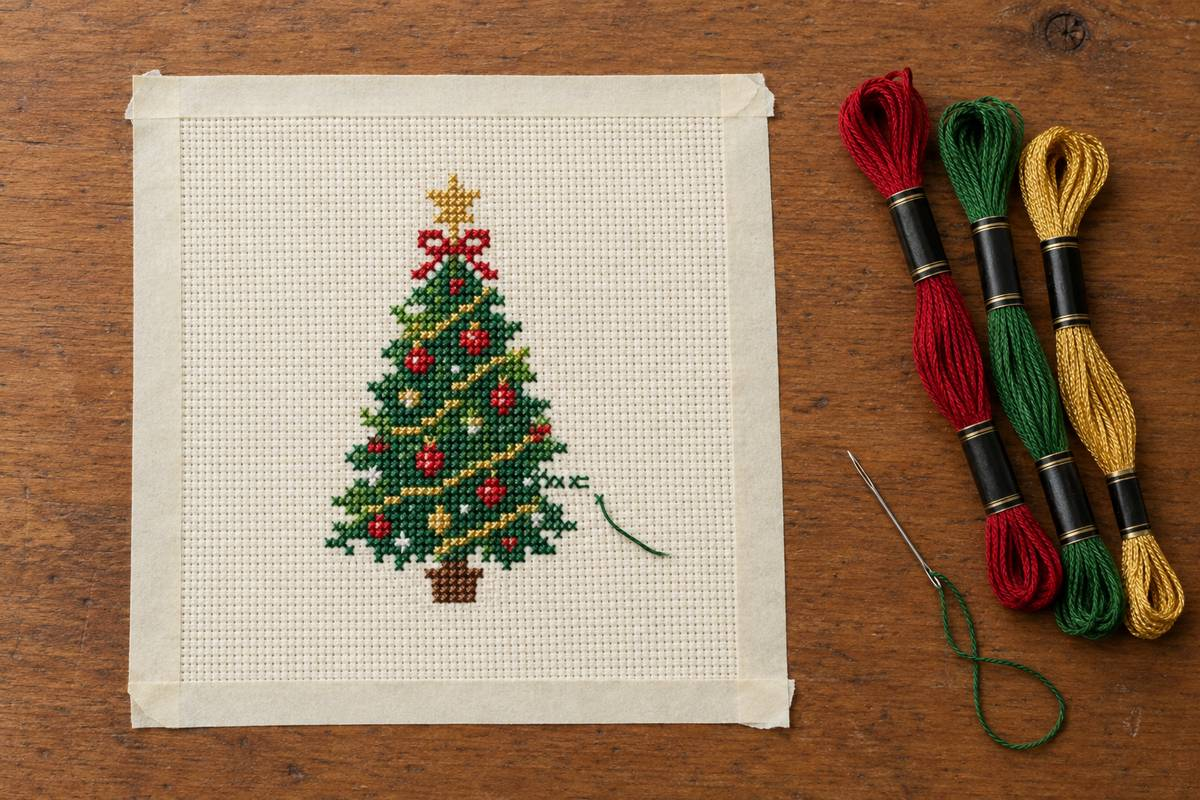
Christmas is the busiest season in cross stitch, and the pattern choice matters more than in any other month, because December 25 is a deadline that does not move. The right pattern is the one that matches the time you actually have left, the finishing route you plan to use, and the person who will receive it. This guide sorts the main kinds of Christmas cross stitch patterns, the styles you will see in shops and magazines, how to work out what fits the calendar, and how to plan the finishing so the piece is wrapped, not half done. Last updated November 14, 2026.
Start here: Work backward from Christmas, not forward from today. Pick the finishing route first (card, ornament, stocking, framed piece), estimate the stitching hours from the stitch count, and choose a pattern that fits the hours you really have. Small motifs stitched in November beat a sampler abandoned in December.
The main kinds of Christmas patterns
Roundups from World of Cross Stitching, a UK cross stitch magazine, sort the Christmas library into three big groups, and they are a useful way to shop.
- Christmas cards. Small motifs, often under 40 or 50 stitches square, stitched on Aida or perforated paper and mounted into a card blank. Jenny Barton's free Rudolph and Santa card designs on the magazine's site even add a jingle bell as a finishing touch. Cards are the fastest group and the only one that works as a batch project.
- Stockings. The biggest commitment: a full-size stocking is a large stitched panel plus sewing. World of Cross Stitching treats stockings as their own category because the chart is only half the project.
- Ornaments and decorations. The middle ground: small to medium motifs finished as hanging ornaments, hoop decorations, garlands or tags. This is where most stitchers spend the season.
Sew What, Alicia?, a sewing and craft blog that rounds up more than 30 Christmas patterns each year, adds two more groups worth knowing: pattern bundles (matched sets with one aesthetic, such as plaid ornaments or a set of robins) and Christmas samplers, larger wall pieces that collect many small motifs on one piece of fabric.
Each group has a dedicated guide here: Christmas ornaments, making a Christmas stocking, and stitching cards on perforated paper.
Styles: traditional, modern and punny
Sew What, Alicia?'s roundup is a good map of the styles on offer. Traditional patterns lean on classic reds and greens, Santas, nativity scenes and holly borders. Modern patterns pull toward Scandinavian and folk looks: muted palettes, gnomes, Nordic Santas and mid-century reindeer. The blog singles out a "watercolor" style that uses negative space, such as lettering formed by the unstitched fabric.
Then there are the pun patterns, a whole category of their own: "Dachshund through the snow," "Get figgy with it," avocado Santas and sloths in Santa hats. These stitch up quickly because the joke carries the design, and they make good gifts for people who do not want a traditional look.
Designers matter as much as styles. Shannon Christine Designs, a cross stitch pattern shop, keeps a dedicated Christmas collection, and crosstitch.com, an online pattern store, groups its Christmas charts in one browsable category. Buying from a named designer usually means a cleaner chart, a tested color list and support if a symbol confuses you.
How much stitching can you fit in before Christmas
The honest way to choose is by stitch count, not by how the picture makes you feel. Our guide to how long cross stitch takes shows the math: divide the pattern's stitch count by your own stitches per hour, and you get the hours. A card motif of a few hundred stitches is an evening. A medium ornament of a few thousand is a week of evenings. A full-size stocking or sampler can run to tens of thousands of stitches, which is a project you start in autumn, not December.
The size calculator converts a design's stitch count into inches on your fabric count, so you can check that a "small" pattern is actually small. Two habits save the season: pick one big piece at most, and fill the rest of your list with small motifs that finish in a sitting or two.
If you like company while you stitch, Christmas stitch alongs release a seasonal design in parts over the weeks before the holiday. Our stitch along guide explains how SALs work and what the sign-up windows look like.
Free patterns vs paid patterns
There is a real abundance of free Christmas charts. World of Cross Stitching offers free downloads such as the card designs above, and Photo2Stitch publishes a set of eight free small Christmas motifs as printable PDF and OXS files, sized for cards and ornaments. Free charts are ideal for batch stitching cards and tags, and for testing a style before you commit to a paid sampler.
Paid patterns buy you polish: full backstitch and detail work, larger scenes, coordinated bundles and designer support. A paid chart from a shop like Shannon Christine Designs or crosstitch.com is also the way to go for a centerpiece gift, where a mistake in a free chart would cost you more time than the pattern price.
One rule applies to both: check the designer's terms before you sell anything stitched from someone else's chart, and never redistribute the chart itself. Our cross stitch copyright guide covers what designers typically allow.
Finishing is the real deadline
Stitching the last cross is not the end. Cards need mounting into blanks, ornaments need backing, cording or framing, and stockings need lining and sewing. Plan at least a few days between your last stitch and gifting, and longer if anything is being framed professionally.
Match the pattern to the finish from the start. A motif destined for a card should fit the card window. An ornament design should have a shape that trims cleanly or fits a ready-made ornament frame. A sampler needs a frame size you can actually buy. Our guides on finishing ornaments three ways and hoop finishes cover the most common routes, and cross stitch gift ideas has more on what makes a stitched gift land well.
Where sources disagree
When to start. World of Cross Stitching publishes its Christmas pattern roundup in mid-November and treats the season as wide open, while sewists who plan stockings and samplers treat autumn as the real start. Both are right for their project size: cards and ornaments are November work, stockings and big samplers are September and October work.
Free or paid. World of Cross Stitching mixes free downloads with paid designs from its shop and favorite designers, and its free card patterns are genuinely usable. Sew What, Alicia? leans toward independent Etsy designers whose small paid patterns fund more designs. Free is fine for batch stitching; pay when the piece is the gift itself.
Traditional or modern. Sew What, Alicia? celebrates the pun and gnome end of the spectrum, while the magazine's free patterns and shop skew traditional. There is no rule here. Stitch to the recipient's taste, and remember that a modern palette dates faster than a classic one, which matters for a piece meant to come out every year.
FAQ
What is a good first Christmas cross stitch project? A card motif or small ornament: a few hundred stitches, a handful of colors, and a finish you can do in an evening. World of Cross Stitching's free card patterns and Photo2Stitch's free small motifs are built exactly for this.
Is it too late to start a Christmas stocking? In mid-November, a full-size stocking is tight but possible for a fast stitcher with free evenings. Estimate the hours from the stitch count first, and have a backup plan, such as stitching the cuff panel this year and the rest for next.
Where do I find free Christmas cross stitch patterns? World of Cross Stitching's Christmas roundup, Photo2Stitch's free motif set, and designer blogs all publish free charts. Check the license before gifting or selling finished pieces.
What fabric count should I use for ornaments? Fourteen-count Aida is the default for cards and ornaments because the holes are easy to see and the motifs stitch up at a gift-friendly size. Our Aida count guide covers the trade-offs.
Can I sell ornaments I stitch from a Christmas pattern? Only if the designer's terms allow it. Most paid patterns license personal use and gifts, not commercial production. The copyright guide explains the usual terms.
Sources
This guide draws on the following sources. Where their advice differs, it says so above rather than blending them.
- World of Cross Stitching, UK cross stitch magazine: Christmas cross stitch patterns for seasonal stitching, worldofcrossstitching.com. Source for the card, stocking and ornament categories, the free Jenny Barton card designs, and the mix of free and paid patterns.
- Sew What, Alicia?, craft blog: Christmas Cross Stitch Patterns, sewwhatalicia.com. Source for the style map (small, easy, modern, bundles, Scandinavian, punny and sampler groups) and the negative-space watercolor note.
- Photo2Stitch, pattern tool site: Free Christmas Cross Stitch Patterns: 8 Small Motifs, photo2stitch.com. Source for the free small motif set in PDF and OXS formats.
- Shannon Christine Designs, cross stitch pattern designer: Christmas collection, shannonchristine.com. Source for the designer-collection example.
- Crosstitch.com, online pattern store: Christmas category, crosstitch.com. Source for the shop-category example.