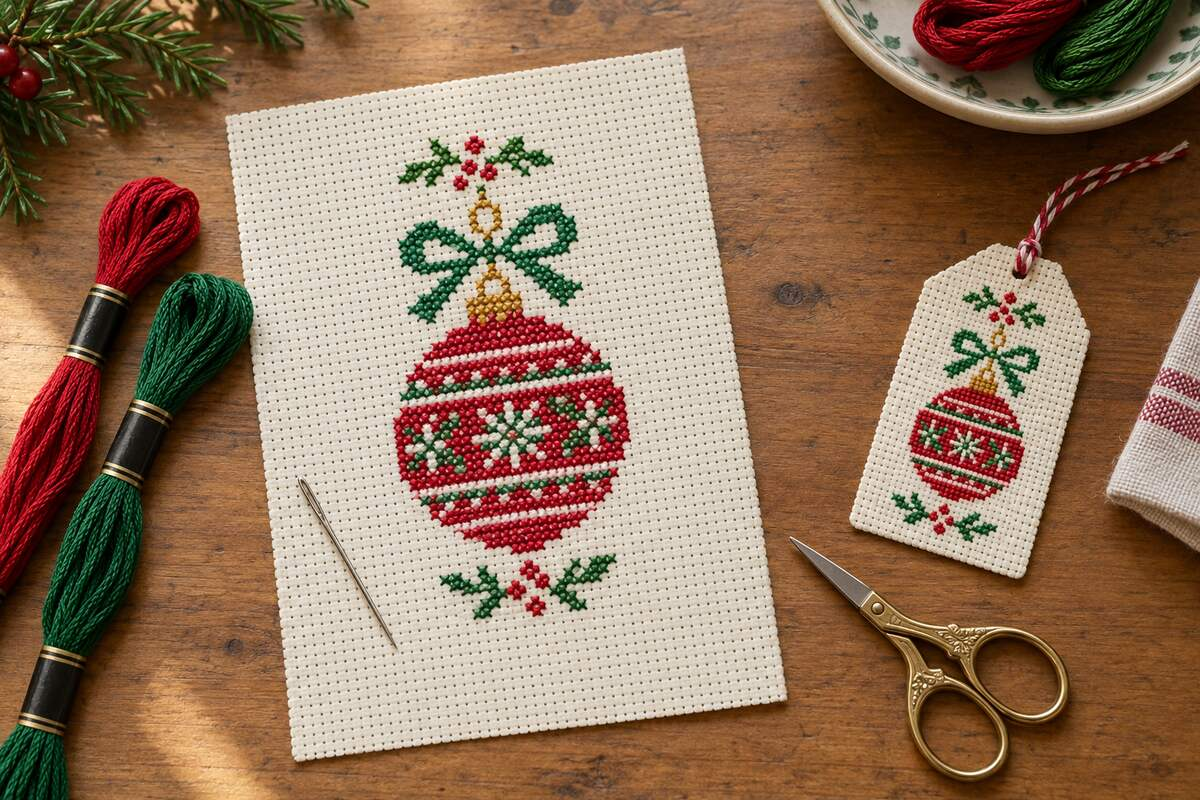
Perforated paper is a thin, sturdy card punched with a regular grid of holes, almost always 14 count, that you cross stitch exactly like Aida. It does not fray, it cuts cleanly into any shape, and it needs no hemming or hoop, which makes it the classic base for ornaments, greeting cards, gift tags, bookmarks and magnets. The trade-off: it is paper, so it can tear, crease and never be washed. Last updated November 6, 2026.
Start here: Stitch on 14 count perforated paper with two strands of floss and a size 24 tapestry needle, in hand with gentle tension. Keep thread carries short on the back, avoid pulling tight enough to tear the holes, and cut the finished design out through a row of holes. Back it with felt or card to finish. Keep it dry and keep your hands clean, because paper cannot be washed.
What perforated paper is
Perforated paper is closer to a thin card than to paper. It comes punched with an even grid of holes, most commonly 14 holes per inch, so any chart designed for 14 count Aida works at the same size. Catkin and Lillie notes that 14 count is effectively the only option in shops, though Sirious Stitches has seen 10 count fairly often, and Martha Beth's reference page lists only 14 count.
It is not a new material. Sirious Stitches dates perforated paper to 1820 for bookmarks, and Catkin and Lillie points out the Victorians used it for greeting cards, small tokens and trinket bowls. Martha Beth describes it as coming back into vogue after roughly a century of oblivion.
Mill Hill is the brand most stitchers encounter, sold in sheets that cut easily to size, in natural white, painted colours and metallics. Catkin and Lillie found white perforated paper costs about the same as 14 count white Aida in UK shops, with painted versions a little more expensive. Satsuma Street, a pattern designer whose holiday ornaments are stitched on it, likes it because you can cut complex shapes without the fraying you would get with fabric. Sirious Stitches adds that the holes are easy to see, which makes it friendly for beginners, and that you can make your own from cardstock with an awl and a grid if you cannot buy it locally.
What to make with it
Ornaments are the classic use: Satsuma Street's holiday ornament designs are mostly stitched on 14 count perforated paper, and Mill Hill's beaded ornament kits are many stitchers' first encounter with the material. Beyond ornaments, the sources agree on a reliable list: greeting cards and gift tags (glue the motif on flat or with foam pads for depth), bookmarks, fridge magnets backed with felt and magnet tape, pins and brooches, hair clips, cake toppers, and layered designs where several stitched layers stack into a 3D effect.
You can stitch almost any chart on it, not just designs intended for paper, as long as the design does not lean on fractional stitches. If you want to chart your own small motif, our free pattern maker guide covers turning an image into a stitchable chart, and pixel art to cross stitch is a natural fit for small ornament-sized grids.
The closest alternative is plastic canvas, covered in our plastic canvas guide. Catkin and Lillie prefers paper: it has more flex, it is lighter for layered pieces, and once a shape is backed with card or felt the extra sturdiness of plastic barely matters. Paper loses on durability and washability, so choose plastic for anything that will be handled hard or needs cleaning.
Stitching on paper
Cut a piece the size of your design plus a small border, around 3 cm per side, to hold onto. Unlike fabric, the edges will not fray, but Catkin and Lillie warns the border can get grubby and will be trimmed away, which matters because you cannot wash the piece at the end.
Work in hand. You cannot put perforated paper in a hoop or Q-snap without bending it, and bent paper creases or splits. Sirious Stitches offers a workaround for anyone who needs a frame for hand comfort: stitch scrap fabric to the edges of the paper and frame that fabric instead, or use a magnetic frame. Martha Beth recommends the stab method rather than sewing method, since the paper does not give the way fabric does.
Tension is the make-or-break skill. Needlery warns that pulling stitches too tight can rip the paper between holes, and suggests keeping as many holes between your stitches as the design allows; where a design uses long stitches, keep the carries long on the back too instead of zigzagging. For the same reason, avoid knots: start with an away knot or tape the tail to the back and weave it in later, and keep thread carries short and caught down, since long floats show through unstitched paper. Our guide to starting and ending thread covers away knots and weaving in tails.
For coverage, two strands of floss is the standard on 14 count, matching Aida. Catkin and Lillie stitched comparison samples and liked the density of three or four strands for some pieces, at the cost of harder stitching and more thread; its practical note is that the loop start only works with an even number of strands. With two strands, it recommends laying or railroading the threads for the smoothest coverage, which our railroading guide explains.
Backstitch and fractionals
Backstitch works exactly as on fabric, with one structural limit: the needle can only go through existing holes, so you cannot place backstitch halfway between holes or through the middle of a stitch the way you can on fabric. Needlery adds a stress tip: work each backstitch leg past the current hole by at least one hole rather than coming up in one hole and going straight back down the next, because short back-and-forth stitches concentrate tension on a single hole and can tear it. A sharp needle helps when a hole is already crowded with stitches.
Fractional stitches are the other casualty of a punched grid. Martha Beth documents a workaround for a three-quarter stitch: work the half cross first, bring the needle up at the corner where the quarter stitch ends, slip it under the half cross and back down the same hole so the quarter stitch hangs on the half stitch, without puncturing the paper. Her own verdict is that quarter stitches done this way are not very effective, and the cleaner answer is to choose designs that avoid partial stitches altogether. Catkin and Lillie agrees fractionals are essentially off the table.
Cutting and finishing
Cut the design out with small sharp paper scissors or a craft knife, not your embroidery scissors. The usual approach is to cut through the centre of the next row of holes beyond the stitching, which leaves a very slightly serrated edge Catkin and Lillie likes. Martha Beth frames the same choice differently: cut through a row of holes for a scalloped edge, varying the cut point within the row for more or less scallop, or cut just below a row of holes for a straight edge. Cutting closer to the stitching risks snipping a thread, so go slowly.
Finishing is where paper shines: no hemming, no fray check, no turning under. Back the piece with felt or card to add stiffness and hide the back, then add the hardware for the project: magnet tape for magnets, a pin back for a brooch, foam pads to raise a motif on a card. Needlery finishes ornaments with wide double-sided tape onto wooden shapes, applied to the back before cutting so the tape and paper trim together.
If you tear the paper mid-project, do not abandon it. Needlery's repair is archival-quality tape over the back of the tear, a hole re-punched through the tape, and careful restitching, with a second piece of tape to hold the area. And repeat the golden rule: keep the finished piece dry. Water weakens the paper along the stitched lines, so prevention, clean hands and a clean workspace, is the only real cleaning strategy.
Where sources disagree
Bigger or smaller needle? Catkin and Lillie moved up from a size 26 to a size 24 because the smaller needle dropped straight back out of the holes when pushed up from the back. Needlery argues the opposite direction: the needle must be smaller than the holes or it can tear the paper. Both are reacting to the same thin margin between hole and paper; Martha Beth's #24 or #26 tapestry recommendation sits in the middle. Start with 24 and size down if the paper shows stress.
Does the right side matter? Some paper has a smoother right side and a rougher wrong side where the punches exit. Martha Beth and Needlery say to find and use the right side; Catkin and Lillie says if you cannot easily tell, and no paper will show in the finished piece, it does not matter.
How many strands? Two is the default on 14 count everywhere, but Catkin and Lillie happily stitches three or four for density on showpiece ornaments. More strands means more pressure on the holes, so heavier coverage and paper safety pull against each other.
Paper or plastic? Catkin and Lillie prefers paper for its flex and lightness; Needlery treats the two as near-interchangeable for ornaments; Sirious Stitches lists paper's fragility and no-wash rule as real cons. For ornaments and cards the choice is taste; for anything washable it is plastic.
FAQ
What count is perforated paper? Almost always 14 count, so charts for 14 count Aida stitch out at the same size. Sirious Stitches has seen 10 count occasionally, and if you punch your own from cardstock you can choose any grid you like.
Can you wash perforated paper cross stitch? No. Water weakens and tears the paper along the stitched lines. Keep hands and the work surface clean while stitching, and treat finished pieces as display-only.
Do you need a hoop for perforated paper? No, and a hoop or Q-snap can actually crease or split it. Stitch in hand with gentle tension. If you need a frame for comfort, mount scrap fabric around the paper and frame the fabric.
Can you do fractional stitches on perforated paper? Not in the usual way, because the needle can only pass through punched holes. Martha Beth documents a hanging quarter stitch that loops under a half cross, but recommends choosing designs without partials instead.
What needle and thread for perforated paper? A size 24 or 26 tapestry needle and two strands of stranded cotton is the standard pairing for 14 count. Switch to a sharp needle for crowded holes and backstitch.
What can you make with perforated paper?Ornaments, greeting cards, gift tags, bookmarks, magnets, pins, hair clips, cake toppers and layered 3D pieces. Anything small, display-only and happy to stay dry.
Sources
- Catkin and Lillie - Cross Stitching on Perforated Paper (a cross stitch designer; brands and cost, needle sizing, strand comparisons, project ideas and cutting)
- Sirious Stitches - Perforated Paper for Cross Stitch (a stitcher's resource blog; history, pros and cons, kits, and making your own perforated paper)
- Martha Beth - Perforated Paper Techniques (a needlework reference page; right and wrong side, needle sizes, stitch-by-stitch notes and the quarter stitch workaround)
- Needlery - Perforated Paper (a needlework guild archive republishing a Nordic Needle newsletter; tension hazards, backstitch direction, tear repair and tape finishing)
- Satsuma Street - Cross Stitch Materials (a cross stitch pattern designer and seller; why it chooses perforated paper for ornament designs, plus needle and fabric basics)