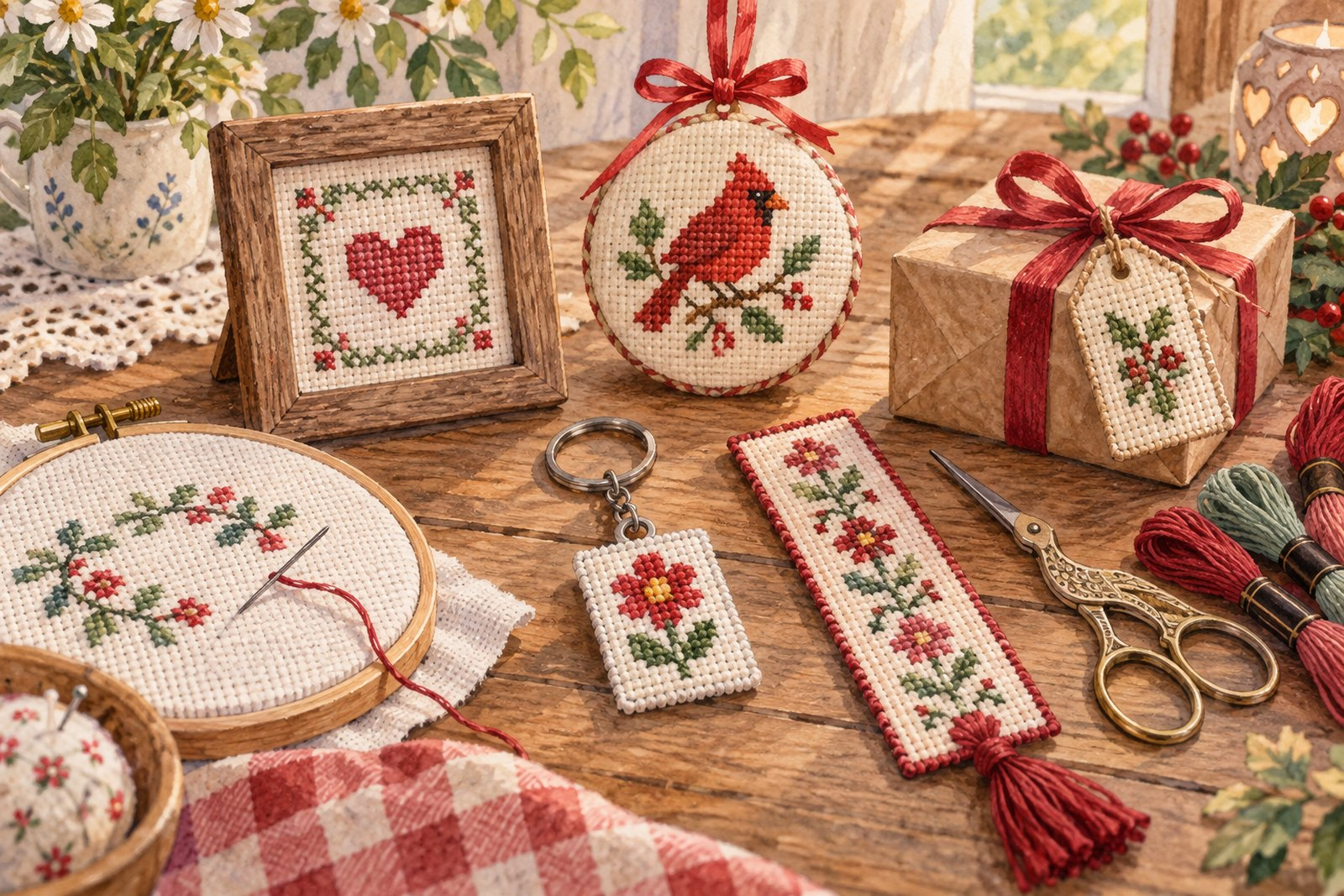
A good cross stitch gift is small, personal, and finished in a way the person will actually use. The pattern matters less than the match: their interests, their home, and the occasion. This guide covers the gift formats that work, from ornaments and bookmarks to framed samplers, how to pick the right one for each person, how to personalize with names, dates, and photos, and how to plan your stitching time so the gift is done before the day, not after.
Pick a small design under about 40x40 stitches, choose a finish that fits how the person lives (an ornament for the sentimental, a keychain for the practical, a framed piece for the decorator), and work backward from the date: stitching time plus a finishing day plus a buffer week. A finished small gift always beats an ambitious one that is still on the frame when the occasion arrives.
Pick the right person first
Cross stitch takes hours of your life, and your time is worth something. Before choosing a pattern, be honest about the recipient. The best candidates are people who understand handmade work: fellow crafters who know what the hours mean, and sentimental people who will treasure something made just for them. A gift that also fits their taste and decor ends up displayed; one that does not ends up in a closet.
If you are unsure how someone will receive a handmade gift, test the water with something small. A keychain or ornament costs you a few evenings, not a month, and their reaction tells you whether they are worth a bigger piece next year. And keep one thing in mind through all of this: you are allowed to stitch gifts for yourself too.
Match the gift to the person
Almost any pattern can be a gift, which is exactly the problem. Narrow the endless options with three questions. What are they into? Pets, a game or show they love, gardening, a sport, a new baby. Where will it live? Someone with bare walls and a minimal style wants a different piece than someone with a crowded gallery wall. And what is the occasion? Birthdays and holidays suit playful motifs; weddings, babies, graduations, and anniversaries call for names, dates, and their colors.
The occasion pieces deserve extra care. A wedding or birth sampler with the wrong spelling or the wrong wedding colors is a heartbreak, so confirm names letter by letter and ask about the nursery or ceremony palette before you buy floss. These gifts are judged on the details, because the details are the point.
Ornaments and small hangings
The most forgiving gift format. A small seasonal motif becomes a tree ornament with a ribbon hanger, and ornaments come out every year, which means your work is seen every year. Flat ornaments are the simplest finish: back the stitching with felt or a second fabric, stuff lightly or not at all, and add a hanging loop. A biscornu, two stitched squares sewn into a puffed octagon, works as an ornament and doubles as a pincushion for a stitcher friend. A flatfold stands on a shelf, which suits people without tree space or wall space.
Small designs under about 50x50 stitches finish fast enough that you can make several in the weeks before a holiday. That makes ornaments the answer for teachers, coworkers, and the long list of people you like but cannot spend a month on.
Cards and bookmarks
For families that keep cards, a stitched card is two gifts in one: the greeting and a small piece they can frame later. The simple route is mounting the stitching on a blank card front with a light, acid-free adhesive the recipient can peel away. Cards with pre-cut insert openings are neater still: the stitching slides in and can be removed and reframed. Perforated paper lets you stitch directly on the card itself. One honest note: most card finishes show the back of your work. Let it be seen. Backs are allowed to be messy.
Bookmarks suit readers and students. Stitch on a strip of aida or evenweave and back it with felt, or use perforated paper or plastic canvas for a stiffer finish. Keep the design tall and narrow, and skip beads or thick embellishments that would dent a book's pages.
Keychains, magnets, and trinkets
Plastic canvas is the workhorse here. It is stiff, cheap, and needs no finishing beyond trimming and backing, and small stitched shapes become keychains, magnets, pins, earrings, and bag charms. These are ideal stocking stuffers and ideal tests for the maybe-appreciative, because each one takes a few hours at most.
For gamers, tiny sprite motifs are perfect at this scale, and pixel art converts to cross stitch one stitch per pixel with no simplification at all. The pixel art guide covers where to find sprites, how to size them, and the copyright line between personal gifts and selling. Stitching a character for a friend is fine; just keep it personal.
Coasters and mug rugs
Acrylic coaster blanks with an insert slot turn a small square of stitching into something genuinely useful, and several pattern shops design specifically for those coaster dimensions. A mug rug, an oversized coaster with room for a cup and a cookie, is the sewn version: your stitched panel, batting, backing fabric, and simple quilting. If the household has kids, pets, or a record of spilled coffee, consider a layer of clear vinyl over the stitching or pick a different format entirely. Fabric gifts in splash zones have a short life.
Wearables and bags
Aida is fabric, and fabric can become anything a sewing pattern can make: zippered pouches, project bags, tote panels, patch pockets. You do not need a sewing machine for small items; aida's grid works as a stitching guide for hand-sewn seams, even for setting a zipper. A stitched panel on a pouch makes a gift that gets used daily, which is the highest compliment a handmade thing can get.
To stitch directly onto clothing, use waste canvas or water-soluble canvas: baste the gridded canvas onto the shirt, apron, or cap, stitch through both layers, then remove the canvas threads or dissolve them. A small motif on a cook's apron or a gardener's overalls is personal in a way no store-bought gift can match. Bring a thimble for thick fabrics like denim.
Framed pieces and hoop art
The classic cross stitch gift is wall art: a framed piece, a hoop finish, or stitching stretched over a canvas frame. Framing is the most formal and the most protective; a hoop finish keeps the handmade warmth and skips the frame shop entirely. The finishing and framing guide covers washing, mounting, and assembly in detail. Whichever you choose, keep their decor in mind. The goal is a piece that goes up on the wall, not one that visits the closet.
Three wall-art categories consistently land. Pet portraits: simplify a general breed design to match their animal, or chart their actual pet from a photo. Fandom pieces: their favorite game, show, or book, either as an obvious character piece or as a subtle reference only fans would catch. And event samplers for weddings, babies, and graduations, built around names and dates in their colors.
Make it personal
Personalization is what separates a stitched gift from a stitched object. Names, initials, dates, and short quotes turn any design into their design. Alphabet charts make this easy: add a name and date beneath a motif, or build the whole gift around a monogram in their favorite colors. The alphabet guide covers lettering layout and spacing. Inside jokes, song lyrics, and coordinates of a meaningful place all chart beautifully in a few lines of backstitch or small letters.
The most personal source image is your own photo. Threaded's pattern maker turns a photo into a stitchable chart matched to real thread codes: their pet, the couple on their wedding day, the house they grew up in, the grandkid. Upload, set a stitch count you can actually finish, and preview the crop live. The pet photo guide walks through turning an animal photo into a gift-worthy chart, and the size calculator keeps the finished piece honest for your deadline.
Give a kit instead
For the person who keeps saying they want to try, gift the hobby itself. A small kit with everything included, fabric, floss, needle, chart, is low-pressure for them and zero stitching for you. Keep it small so they are not discouraged; a mini ornament kit is a better first taste than a giant sampler. You can also build a custom kit around something you know they love, which makes finishing far more likely.
This is also the graceful answer for someone you suspect will not value a hand-stitched gift: let them discover what the hours feel like first-hand. Offer to help or even finish it for them if they stall, with no guilt attached. If they catch the bug, point them at the beginner's guide.
Time and planning
Handmade gifts fail on logistics, not effort. Most people stitch somewhere around 100 to 200 stitches an hour, faster in big color blocks, slower in confetti. Work backward from the date, and remember the gift is not done when the stitching is done: washing, drying, mounting, or framing adds at least a day, and a frame shop adds weeks.
| Gift | Typical size | Stitching time | Order by |
|---|---|---|---|
| Keychain or magnet | Under 25x25 | 2-4 hours | 1 week before |
| Ornament or bookmark | 25x25 to 50x50 | 4-12 hours | 2-3 weeks before |
| Coaster or small hoop | 50x50 to 70x70 | 10-20 hours | 3-4 weeks before |
| Framed sampler | 80x80 to 120x120 | 30-70 hours | 2-3 months before |
| Large wall piece | 150x150 and up | 100+ hours | 4-6 months before |
Add a buffer week to every row. Life happens, and a gift finished early is peace of mind, while a gift finished late is an IOU card. If the deadline is already close, drop down a row in the table rather than gambling on your fastest stitching.
Questions
What is a good cross stitch gift for a beginner to make?
An ornament, bookmark, or keychain under about 50x50 stitches. These finish in days, teach you the whole pipeline from stitching to finishing, and a small finished gift beats a large abandoned one every time.
How do I personalize a cross stitch gift?
Add names, initials, dates, or a short quote with an alphabet chart, choose their favorite colors, or chart a photo of something meaningful to them, like a pet or a home. The personal details are what make a stitched gift irreplaceable.
Is cross stitch a good wedding gift?
Yes, if you plan ahead. A wedding sampler with the couple's names and date in their wedding colors is a keepsake, but confirm every spelling and start two to three months early, especially if you are framing professionally.
What can I make quickly as a last-minute gift?
A plastic canvas keychain or magnet in an evening or two, or a small ornament in a weekend. Skip framing and choose hoop or flat finishes. And a small kit for them to stitch themselves needs no lead time at all.
Can I stitch a gift from a photo?
Yes. Photo-to-pattern conversion is ideal for gifts because the result is personal by definition. Keep the stitch count modest so you finish on time, crop tight on the subject, and expect to adjust a few thread colors by eye.
What should I avoid giving as a cross stitch gift?
Avoid huge pieces for people whose reaction you do not know, fabric items for splash-prone kitchens unless protected, and anything whose colors or style clash with their home. When in doubt, go smaller and more personal.