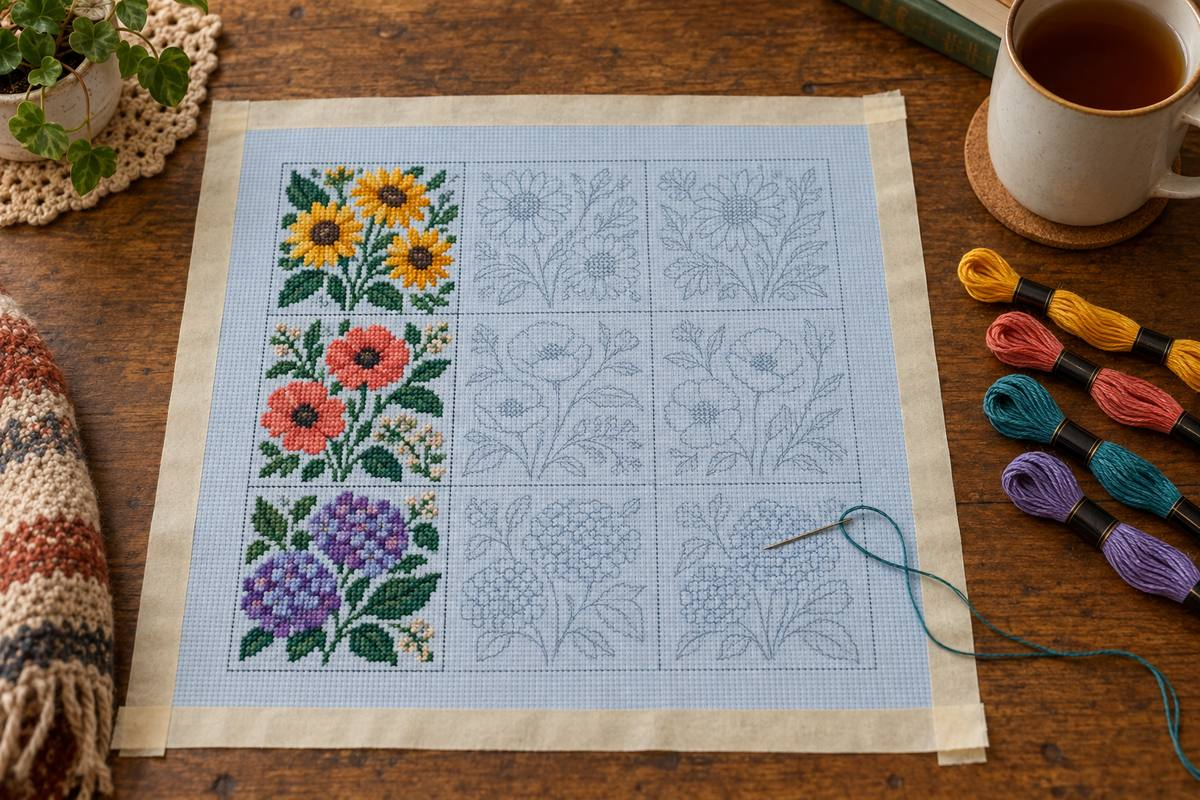
A stitch along, or SAL, is a cross stitch project stitched in consecutive parts: you receive one piece of the pattern at a time, usually weekly or monthly, and stitch it alongside hundreds of other people doing the same. It turns a solitary craft into a shared event, and for many stitchers the community ends up mattering more than the pattern. This guide covers how SALs work, what you commit to, and how to decide whether to join one. Last updated November 11, 2026.
Start here: A SAL is a pattern released in parts on a schedule, stitched at the same time as a community. Most run six months to a year with weekly or monthly releases. In a mystery SAL you never see the full design in advance, so choose by designer, not by pattern. It is not a race: falling behind is normal and catching up is easy.
What a stitch along is
XStitch Magazine's definition: a stitch along is a sequential stitch project in which an entire design is stitched in consecutive parts. You receive a new part of the pattern on a schedule and stitch along with other stitchers, usually within a set timeframe. SALs are often themed, seasonal or built around cultural references.
Lord Libidan's definition adds the social half: a single pattern broken up and given week by week, stitched separately but at the same time by a large group, with a community group somewhere that only talks about that pattern. If you spend time on cross stitch forums or Reddit in the first quarter of the year, when many SALs launch, the acronym is everywhere.
Normal vs mystery SALs
XStitch Magazine splits SALs into two types. In a normal stitch along you can see the whole design from the start; the parts are just a pacing device. In a mystery stitch along, or MSAL, the design is kept secret and revealed only as parts arrive. Mystery SALs are the more common and, for many, the more fun format: you share the voyage of discovery with everyone else, guessing what the design will become. Their Life in the Fast Lane SAL showed twelve shapes that were clearly people and cars, but the individual characters, each with a backstory, a star sign and a favorite song, emerged only month by month.
The practical consequence: in a mystery SAL you are buying a designer, not a pattern. Pick a designer whose style you already like, because you will not see what you are stitching until it arrives.
How a SAL works
Lord Libidan's walkthrough: SALs are advertised through pattern designers' mailing lists, social media and cross stitch groups, usually with about a month's notice and a sign-up. Some are free; others charge the full pattern price up front, and a few sell a complete kit of supplies, also up front. You then receive parts of the pattern week by week or month by month, plus a way to talk with everyone else stitching, most often a dedicated Facebook group.
Because most SALs are fairly large patterns, they run long: six months to a year is typical, though a few last under two months. You generally need to join within a few weeks of the start, though some SALs let you join at any time. And you should not rush to finish each part before the next lands; the schedule is a shared rhythm, not a deadline.
What you get up front
Even a mystery SAL should tell you how to prepare. XStitch Magazine lists what joining instructions should include: the project's dimensions on different fabric counts, the full thread or floss list, and a simple tutorial for new stitchers. That is enough to buy materials, pick fabric (our Aida count guide helps) and get excited while waiting for part one.
Good organizers also make the parts easy to stitch from. XStitch's own SALs ship charts in four formats: color blocks with symbols and symbols-only, each for both the whole design so far and just the latest piece, so you can stitch the distracted or the focused version as you prefer. If you are new to charts in general, our chart reading guide covers symbols and legends.
Why people join
The community. Lord Libidan calls this the biggest thing about a SAL. Whole subreddits, flosstube channels and groups spring up around a single pattern, and the talk ranges from the design to stitching life in general. It is not about who stitches fastest or guesses the design first; it is about being together. For someone unsure about joining a big community, a SAL is a gentle door in.
Access to the designer. Designers are usually active in their SAL groups: answering questions, explaining decisions, sharing the ideas behind the pattern and dropping hints about future projects. That kind of one-on-one insight is rare outside a SAL.
Weekly satisfaction. A normal pattern is page after page with one payoff at the end. A SAL gives you a small, achievable chunk and a feeling of completion every single week. It is easy to stay motivated, easy to catch up after a busy week, and you can still stitch other projects on the side.
The surprise. With the sheer number of patterns online, choosing what to stitch can be its own paralysis. A mystery SAL removes the choice: pick a designer you like and let the design arrive. SAL patterns are also often exclusive, available only to participants or only during the run.
SALs for beginners
XStitch Magazine's take: a beginner should not find most SALs too confusing. A good SAL pattern shows the elements to stitch in each part plus the larger pattern for context, and careful counting does the rest. Their 12 Days of Xmas SAL was a good first project precisely because it used only five colors and had plenty of empty space, which kept both cost and pace manageable. If you are brand new, our beginner guide covers the first stitches; a small, low-color SAL is a fine second project.
The one real beginner caution is commitment shape. A SAL is a long project by design, so pick one whose release size you can keep up with at your real pace. Our stitching time guide helps you estimate hours from stitch counts before you sign up for a year of weekly parts.
Costs and how to join
Money is the first practical question, and the answer depends on the organizer. Lord Libidan notes that SALs can be free or can charge the full pattern price up front, and that some designers also sell a kit of every supply you need, again paid in advance. Neither source quotes typical prices, because they vary by designer and project size, so treat a SAL like buying a large pattern: look at the total before you sign up.
Joining is usually simple. In a reply on his post, Lord Libidan says that once you find a SAL you like the look of, you can contact the website owner directly. In practice you join either through a Facebook group, which is the usual route for free SALs, or by buying a specific item in the designer's online shop that grants access. Another commenter's advice is that Facebook is a good place to start looking.
XStitch Magazine adds one convenience worth looking for: its XStitchAlong patterns contain interactive links so you can buy the threads each part needs as you go. Whether a SAL gives you a full thread list on day one or part by part, ask before you buy, because a long mystery project with a color count that keeps rising can change your budget. XStitch describes its CanCan SAL as a Pop Art stash buster for exactly this reason: each part added colors without revealing much of the design.
Staying on track
Both sources say the schedule is a rhythm, not a deadline, and both describe the same habits that keep people comfortable with it. Parts are small by design, so a missed week is easy to recover; Lord Libidan points out that smaller chunks make catching up simple and let you keep stitching other projects alongside. You do not need to finish each part before the next one arrives.
The chart format matters more than people expect. If you like to mark progress on the whole picture, a symbols-only chart of the design so far is the easiest to track. If you like to focus, the latest-piece-only version removes distraction. Check which formats an organizer provides before you join, and print the one that suits how you stitch.
Community is the other thing that helps. XStitch notes that some SALs, including the Steotch-Alongs, actively encourage stitchers to make friends and stitch in groups, even with international teams. Lord Libidan describes the same effect in whole subreddits and flosstube channels. If you are shy, that is the easiest way in: read along for a week, then post your first progress photo.
When a SAL ends
What happens to the pattern after the final part varies. XStitch Magazine makes the whole design available as a standalone pattern once a SAL ends, while still offering the parts for anyone who wants the sequential experience. Some organizers do the opposite: the SAL pattern is a limited edition and stops being available to new stitchers when the project finishes, which makes it an exclusive challenge. Climbing Goat Designs' science-themed SALs take a middle path, releasing the complete design in one file after the challenge so finishers can stitch at their own pace.
Where sources disagree
Whether you see the pattern. Lord Libidan presents not seeing the pattern as close to defining: 'with a SAL, you don't see the pattern'. XStitch Magazine explicitly describes two types, including normal SALs where the full design is visible from the start. In practice the mystery format dominates the big community SALs, but a visible-design SAL exists precisely for stitchers who hate surprises.
Joining windows. Lord Libidan says you usually must join within a few weeks of the start, with some exceptions. XStitch Magazine emphasizes post-run availability, with finished SALs sold as standalone patterns. Both are true for different organizers: if a specific SAL matters to you, check its sign-up and archive rules before assuming you can come back later.
What the schedule means. Both sources insist it is not a race, but for different reasons. Lord Libidan notes the patterns are large enough that rushing is pointless. XStitch frames it as fun first: the weekly or monthly rhythm is there to share, not to enforce.
FAQ
What does SAL stand for? Stitch-a-long: a cross stitch project a group stitches at the same time, with the pattern released in small parts at regular intervals instead of all at once. The mystery version is often shortened to MSAL.
Where do I find SALs to join? Follow cross stitch designers you like on Instagram or their mailing lists, watch cross stitch forums and subreddits, and check Facebook groups. Many SALs launch in the first quarter of the year.
Do I need special supplies? No. SALs use standard cross stitch materials, and the organizer provides the full thread and fabric list before part one so you can kit up in time.
How long does a SAL last? Typically six months to a year with weekly or monthly parts, though some run under two months. You stitch each part at your own pace; the schedule is a shared rhythm, not a deadline.
Can I join a SAL late or after it ends? Depends on the organizer. Some allow late joins, some close sign-ups a few weeks in, and some make the full pattern available afterward while others retire it as a limited edition. Check the specific SAL's rules.
Sources
This guide draws on the following sources, and where their descriptions differ it says so above rather than blending them.
- XStitch Magazine, cross stitch magazine and pattern publisher: What Is A Stitch Along?, xstitchmag.com. Source for the SAL definition, the normal vs mystery split, the up-front materials list, the four chart formats, the beginner guidance, the end-of-run availability models, and the XSAL examples. XStitch sells its own stitch alongs; its explanations of the format stand on their own.
- Lord Libidan, cross stitch blog: What Is A SAL (Stitch-A-Long) and Should You Join One?, lordlibidan.com. Source for the sign-up mechanics and costs, the six-month-to-a-year durations, the community, designer access, weekly-satisfaction and surprise reasons to join, and the finding-a-SAL advice.