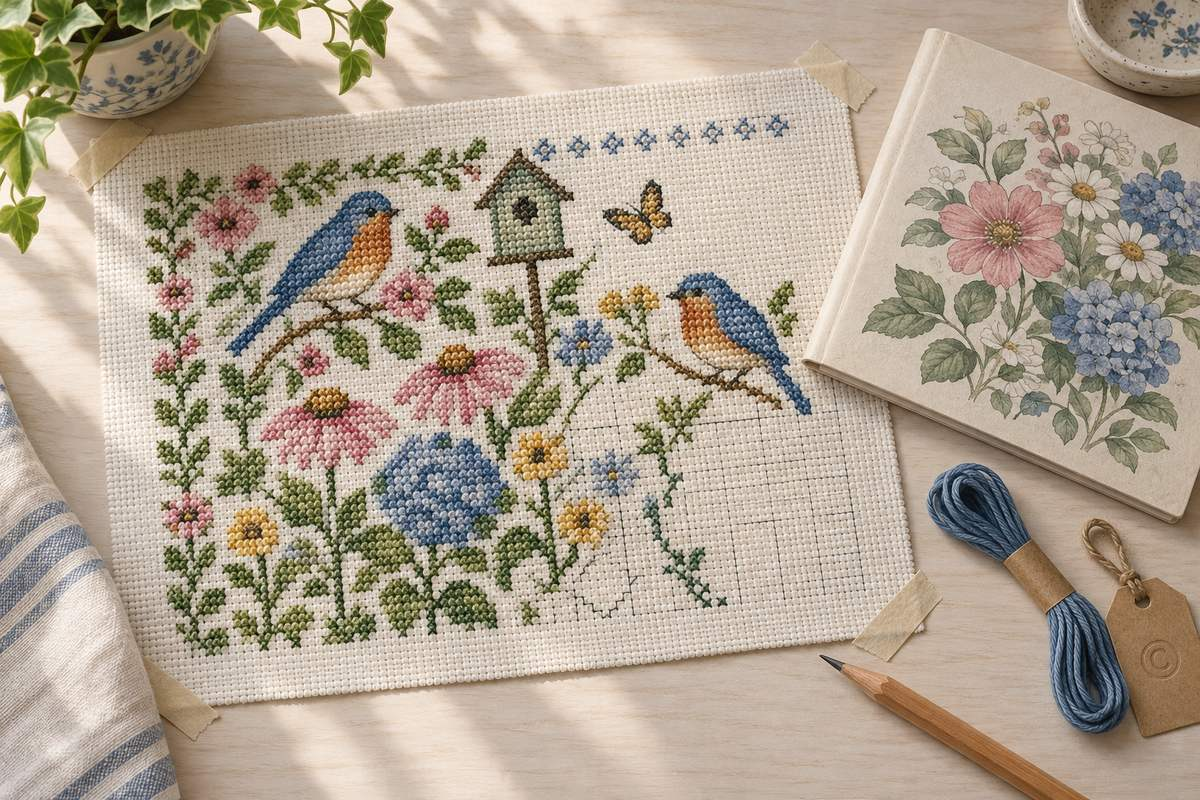
Cross stitch copyright decides three everyday questions: whether you may copy a chart, whether you may sell what you stitched from it, and what you may share online. The answers are steadier than forum arguments suggest, but they come from general copyright principles and from each designer's own terms, not from one needlework rulebook. This guide lays out what the sources agree on, where designers differ, and the habits that keep you safe. It is general information, not legal advice; for a specific dispute, consult a qualified intellectual property lawyer. Last updated November 10, 2026.
Start here: Treat every chart as owned by its designer from the moment it was made. Buying a pattern buys a license to stitch it, not the design. Never photocopy, scan or share the chart itself. Before selling a finished piece, read the pattern's terms of use; if there are none and you cannot ask the designer, keep it to personal use and gifts.
Who owns a pattern
The designer owns the copyright from the moment of creation. The Stitchery Corner, a pattern seller, stresses that there is no registration requirement in most countries, and YarnTree, a needlework publisher, adds that the owner holds the same exclusive rights whether or not the printed work says anything about copyright. A missing copyright notice means nothing.
Those exclusive rights, as YarnTree lists them, cover reproducing the work in copies, preparing derivative works, distributing copies by sale or other transfer, and displaying the work publicly. The owner can grant any of these to anyone on any terms, and can say yes to one person and no to the next.
What you buy is a license, not the design. The Stitchery Corner puts it plainly: whether the pattern arrives as a PDF, a booklet or part of a kit, you are purchasing a license to use it for personal stitching, and you acquire no ownership of the design itself. The chart, the color key and the image cannot be copied, shared, redistributed or resold without permission.
The UK Intellectual Property Office's copyright notice for knitting and sewing patterns, which it says is relevant to comparable crafts such as cross-stitch, frames the same boundary from the other side: copyright lets the owner control copying of the whole work or a substantial part of it, and copying includes reproduction by hand, photocopying or scanning. It also cautions that only a court can give a conclusive view, which is worth remembering whenever a forum thread sounds certain.
Copying a pattern
YarnTree is blunt: legally you cannot ever make a copy without the copyright owner's permission. The form does not matter - photocopy, electronic copy or photograph - and neither does the money. Selling copies and giving them away are both copying. This extends to out-of-print patterns and magazine designs; a designer who stops offering a chart keeps every right to it.
Sharing a purchased file is copying too. The Stitchery Corner names the common cases directly: sending a PDF to a friend, posting it in a Facebook group, or selling spare physical patterns are all infringements. Maurer-Stroh's designer FAQ answers the kind version of the same question - sharing a free download with a friend who has no internet - with a general no, while noting most designers will say yes if asked. Asking is the whole system.
Working copies are the gray zone every stitcher asks about. YarnTree says there is no legal right to enlarge or duplicate a chart for convenience without permission, but reports knowing of no designer who would refuse an enlargement needed because the printed chart is unusable, and that many tolerate a personal working copy of a pattern you bought. Maurer-Stroh's FAQ lands in the same place: working copies or enlargements are not allowed but tolerated by most designers for personal use only.
Tolerated is not licensed. YarnTree raises the social cost: other stitchers seeing a photocopied chart in use can read it as permission, which is exactly what designers want to prevent. If you make a working copy, keep it personal, keep it with the purchased original, and destroy it when the project is done.
Selling finished pieces
A needlework chart is unusual among copyrighted works because its purpose is to become a stitched piece - a derivative work. YarnTree reasons that this grants an implied permission to stitch the design for your own enjoyment or as a gift, but not to produce items for sale or any other commercial reason without the designer's permission.
In practice, the designer's terms decide. The Stitchery Corner sorts the market into three camps: designers who allow unlimited sale of finished pieces, which it says covers most independent designers; designers who allow limited sale, such as craft fairs and small-scale selling but not mass production; and designers who prohibit commercial use entirely, particularly larger companies. Licensed character patterns - it names Disney and Harry Potter - almost universally prohibit selling finished pieces because the character rights are licensed separately.
Individual designers write their own numbers into those camps. Maurer-Stroh's FAQ, for EMS Designs' own patterns, allows selling finished pieces only in small quantities of no more than three, ideally for charity or as gifts. The Stitchery Corner's own terms allow personal use plus small-scale selling at craft fairs, markets and online, while forbidding redistribution of the files. Two sellers, two different answers, both within their rights.
The safe routine has three steps. Find the terms of use that came with the pattern. If they permit your planned scale of selling, keep a copy of them. If they say nothing and the designer cannot be reached, The Stitchery Corner's advice is to treat the design as personal use only. Our gift guide stays on the always-safe side of this line: gifts are the use every source accepts.
Free patterns and old magazines
Free means free of charge, not free of copyright. Maurer-Stroh's first FAQ answer says it directly: a free chart is still copyrighted and remains the sole property of the designer, and copyright law applies to free charts in all points. A freebie can be stitched and shared as a link; it cannot be re-hosted, bundled or passed around as a file.
Age works the same way. The Stitchery Corner notes that copyright lasts for the designer's lifetime plus 70 years in most countries, so a pattern from a 1985 magazine is almost certainly still protected. YarnTree's out-of-print point completes the picture: a design being unavailable does not open it for copying.
Used originals are the exception that proves the rule. Maurer-Stroh allows selling, trading or donating an original used pattern, so long as no copy is kept - trading a copy while keeping the original is not allowed. That tracks the first-sale principle YarnTree describes: the owner of a particular legally produced copy may sell or dispose of that item. The physical chart can change hands; the design cannot multiply.
Photos, social media and credit
Posting your finished piece is generally welcomed. The Stitchery Corner says sharing photos of completed work on social media is accepted and even encouraged by most designers - it is free marketing for the pattern - and recommends crediting the designer and pattern name, plus any tag or hashtag the designer requests.
Watch the direction of travel. A photo of your stitching going out is fine; the chart itself going out is not. Screenshots of the pattern, close-ups that reveal the chart, or scans bundled into a blog post all copy the protected work rather than display your piece.
Making patterns from images you do not own runs the same risk in reverse. The Stitchery Corner warns that converting a photograph you found online into a cross stitch chart is a copyright issue even if the finished piece looks different, because photos are automatically protected. Its safe options: use your own photos or images under a Creative Commons license with the appropriate terms. Our photo to pattern guide starts from your own pictures for exactly this reason.
Changing a pattern
Swapping colors, adding a name or leaving out a motif are everyday stitching decisions, and Maurer-Stroh's FAQ permits changes to its patterns for personal purposes only. The same answer draws the boundary: changed patterns may not be published in any way, nor claimed as your own design, and the designer takes no responsibility for altered versions.
The distinction is between adapting for your own hoop and deriving for distribution. Stitching a favorite chart in different colors for your wall is personal use. Publishing the recolored chart, selling it, or entering it as an original design crosses into derivative-work territory that belongs to the designer.
When a project genuinely starts from your own idea, our design your own pattern guide is the clean route: an original chart carries none of these questions.
Where sources disagree
The sources agree on the chart itself - no copying, no sharing, no reselling - and diverge on the stitched piece. YarnTree frames selling finished items as needing the designer's permission in every case, a strict reading rooted in US derivative-work law. The Stitchery Corner describes a market where most independent designers do allow it, some with limits, and points to first-sale-style principles in many jurisdictions. Maurer-Stroh shows what designer-by-designer terms look like in practice with its three-piece cap. The UK Intellectual Property Office notice, meanwhile, declines to settle individual cases at all.
Working copies are the second fault line: not allowed as a right, tolerated by most designers for personal use, in both sources that address them. Where sources give a range like this, the safe move is the same each time - find the specific designer's terms, and let the strictest applicable statement govern.
FAQ
Can I sell a cross stitch piece I made from a purchased pattern?
Only within the pattern's terms of use. Many independent designers allow small-scale selling; some cap quantities, as EMS Designs does at three pieces; licensed character patterns almost universally prohibit it. No stated terms and no way to ask means personal use only.
Can I share a free pattern with a friend?
Share the link, not the file. A free chart is still fully copyrighted, and sending the file itself is copying. Most designers will grant permission if you ask.
Is a pattern from an old magazine out of copyright?
Almost certainly not. Copyright generally runs for the designer's lifetime plus 70 years, and out-of-print designs keep all their protection.
Can I make a working copy of a chart I bought?
There is no legal right to copy without permission, but most designers tolerate an enlargement or working copy for your own use alongside the purchased original. Keep it personal and destroy it when finished.
Sources
- YarnTree: Copyright Basics For Cross Stitch And Needlework, US-focused publisher's summary of exclusive rights, copying limits, working copies and implied permission to stitch for personal use and gifts.
- The Stitchery Corner: Cross Stitch Copyright: Can You Sell Stitched Pieces?, pattern seller's guide to ownership, designer terms for selling finished pieces, social sharing and old patterns.
- Maurer-Stroh: Copyright FAQ, designer FAQ with concrete house terms for EMS Designs patterns, including free charts, used originals and a three-piece selling cap.
- UK Intellectual Property Office: Copyright notice on knitting and sewing patterns, official UK notice noting relevance to cross-stitch, on what copyright controls and the limits of general guidance.