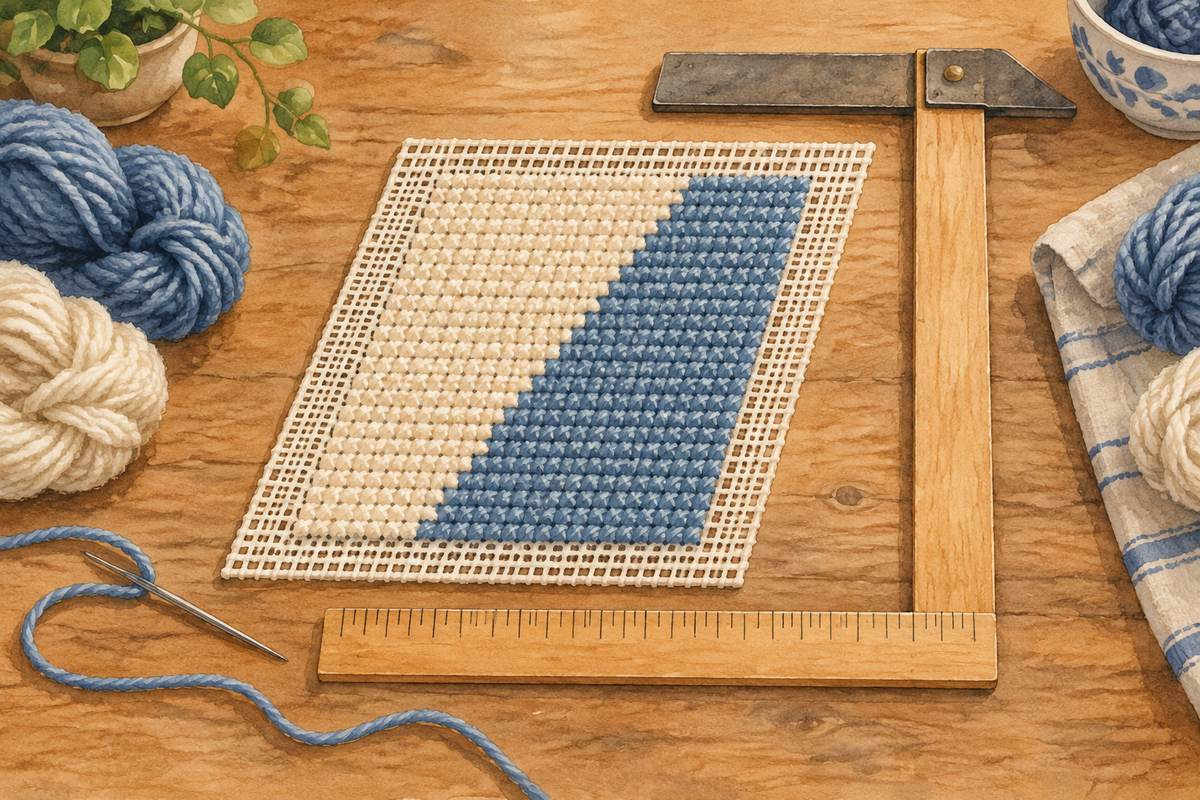
You unmount a finished piece and the rectangle has become a parallelogram. The edges no longer meet at right angles, and blocking suddenly looks like a wrestling match. This skew is not bad luck or a flawed canvas: it is the accumulated pull of your stitches, and writers who have studied it say it is mostly preventable with the right frame, stitch choices and tension. This guide covers why canvas shears, how to keep it square while you stitch, and what fixing can and cannot do at the end. Last updated October 29, 2026.
Start here: Every tent-style stitch pulls the canvas slightly along its diagonal, and thousands of pulls in one direction shear the weave. The most effective preventions are a drum-tight frame mounted with the threads running true, even and moderate tension, and basketweave stitch for large areas. Blocking at the end squares the last few degrees; it does not reverse a parallelogram.
Why needlepoint canvas skews
Mike at mikeismakingstuff, who has written a series of technical articles on canvas distortion, explains the mechanism plainly: each continental stitch is a diagonal, with the needle going down through one hole and up through the diagonally adjacent one, pulling thread across the canvas intersection at an angle. One stitch's sideways pull is negligible, but thousands of stitches pulling the same diagonal direction add up, dragging the warp and weft threads progressively off square. Because the pull is directional and predictable, he says experienced stitchers can often tell which stitch was used just by looking at the distorted canvas.
The same author's penelope article adds that skew is cumulative and largely invisible while you work: it reveals itself when you unmount the piece and the edges no longer meet at right angles. The Spruce Crafts describes the mirror-image case from the other side, noting that basketweave's staggered alternating diagonal rows create a woven pattern on the back that holds the mesh threads in place, virtually guaranteeing the canvas keeps its original shape.
Which stitches and canvases skew most
On stitches, the sources agree. Unwind Studio, a seller, says some stitches, such as the continental tent stitch, tend to create more distortion and tension in the canvas, so the design starts to lose its original shape. Spellbound Stitchery, a shop blog, says continental and half-cross stitches are far more likely to warp the canvas than basketweave, resulting in more blocking time at the end. Mike at mikeismakingstuff puts a scale on it: distortion is proportional to area, so a large background stitched entirely in continental in one direction is the worst case, while small continental details stay manageable. Our tent stitch comparison and basketweave guide cover the stitches themselves.
On canvases, Mike's mono canvas article says mono's single-thread plain weave has relatively little structural resistance to shear, so the threads slide against each other and distort more readily than stiffer grounds. His penelope article says penelope's paired threads make counting easy but leave the weave open and mobile compared with a tight mono. In an r/Needlepoint thread about a warped first project, one commenter offered a contrary data point from experience: Unwind Studio kits use interlock canvas, which the commenter found more flexible and therefore more warp-prone than mono (community opinion, not tested).
Prevention at the frame
Mike's penelope article calls a proper frame the single most effective prevention: stitching in hand, letting the canvas flex and flop, guarantees some skew on any piece larger than a coaster. His setup advice is specific: mount on stretcher bars or a scroll frame and tension the canvas until it rings when tapped, and sight along the warp threads to make sure they run parallel to the frame's edge before fastening, because a canvas mounted crooked will stitch crooked and no amount of blocking fully corrects a piece that was skewed from the first stitch. Spellbound Stitchery agrees on the frame but adds a fallback: if you prefer to hold the canvas in hand, basketweave is a must.
Tension matters as much as equipment. Mike's weft distortion article says even, moderate tension is more effective than most stitchers expect, because much distortion comes not from the stitch's geometry but from overtight stitches compounding the diagonal pull; a continental stitch worked with a light, even hand distorts far less than the same stitch yanked tight. Our tension guide has the hands-on techniques.
Catch it early
Both mikeismakingstuff articles say to check for skew periodically rather than at the end. The penelope article suggests laying a ruler along the canvas threads every few sessions and comparing against the frame edges; the mono article gives two other tells: check the corners against a right angle, and watch the design itself, because straight vertical or horizontal lines in the pattern start to slant as distortion builds. Catching it early matters, the mono article says, because mild distortion blocks out easily while severe distortion may never fully correct.
If you catch drift early, the penelope article lists in-progress corrections: add counter-directional stitches in the affected area or switch the problem section to basketweave, keep the canvas tension even across the frame because a loose corner lets that quadrant shear, and, a trick it attributes to some stitchers, rotate the frame 180 degrees halfway through a large background so the second half's pull opposes the first.
Fixing a skewed piece
Every source treats blocking as the end-of-project fix, and most treat it as having limits. DMC, the thread manufacturer, describes the standard method: dampen the whole canvas with warm water and let it rest five minutes so the fibers relax, then hold the canvas and stretch it in the direction opposite to the distortion, noting that most stitched canvases lean toward the right, before pinning to a blocking board with the threads kept vertical and horizontal. DMC adds two practical rules: never cut the canvas before blocking, because the selvage strips hold the pins, and a local needlework shop can block the canvas professionally if you prefer. Our blocking guide walks through the full process.
The mikeismakingstuff articles are more cautious about what blocking can achieve. The weft article says mild distortion responds well, but severe distortion resists: threads sheared that far spring back toward skew with handling, and aggressive blocking can pop stitches or break threads. Its honest rule: blocking finishes the job prevention started; it squares the last few degrees, it does not reverse a parallelogram. For penelope with significant skew, the penelope article recommends blocking in stages: pull partway true, let it dry, then dampen and pull the rest, because forcing a badly skewed piece square in one session stresses the stitches and distorts the design.
If a new canvas arrives crooked
A different problem: the canvas is skewed before you stitch a thing. In a June 2026 r/Needlepoint thread about exactly that, commenters split between diagnosis and action. Several said some canvases come off the roll that way or are cut slightly crooked rather than warped, and one suggested laying a T-square on the canvas and following the threads, because wonky bias tape at the edge can make a square canvas look crooked; if the canvas itself is out of square, that commenter would ask for a replacement. Others said to mount it on stretcher bars, stitch normally and block at the end, and a shop worker noted that new canvases are sometimes skewed by about an eighth of an inch even when trimmed along the thread line, and that final blocking handles it. All community opinion, but consistent with the teachers: a small out-of-square start is a blocking job, a large one is a return.
Where sources disagree
How much blocking can fix. In the r/Needlepoint threads, commenters are broadly optimistic: wet blocking when the piece is finished will fix a skewed canvas, and several report needing a couple of rounds but ending fine. Mike at mikeismakingstuff explicitly pushes back on "it will block out no matter what", saying blocking cannot perform miracles on a badly skewed canvas and that overstretching to force squareness distorts the stitching itself. The practical read: mild to moderate skew blocks out; severe skew is a prevention failure, not a blocking job.
Block mid-project or wait. In an August 2025 thread, a stitcher whose continental-stitched areas had warped the canvas asked whether to block before starting the background. Most commenters said wait until the piece is complete, since it will need blocking again anyway; one said they sometimes block mid-project and doubt it matters. Commenters also noted that professional finishers will block for you, some charging extra if they must block more than once.
Is stitching in hand ever fine? Mike's penelope article is absolute: in-hand stitching guarantees some skew on anything larger than a coaster. Spellbound Stitchery, which also recommends stretcher bars, softens it: if you prefer holding the canvas, basketweave makes it workable. And in the community threads, plenty of stitchers report in-hand projects that blocked out fine.
Common mistakes
- Stitching a large background entirely in continental in one direction, the worst case for accumulated pull (mikeismakingstuff, Unwind Studio).
- Mounting the canvas crooked on the frame; a skewed start cannot be fully blocked out later (mikeismakingstuff).
- Pulling every stitch tight; overtight stitches compound the diagonal pull (mikeismakingstuff).
- Checking squareness only at the end instead of every few sessions (mikeismakingstuff).
- Trimming the canvas before blocking, which removes the selvage the pins need (DMC).
- Forcing a badly skewed piece square in one blocking session, which can pop stitches (mikeismakingstuff).
FAQ
Why does needlepoint canvas skew?
Tent-style stitches each pull the canvas slightly along their diagonal, and thousands of pulls in one direction shear the weave into a parallelogram. Mike at mikeismakingstuff says the effect is cumulative, mostly invisible while you work, and worst in large areas of one-directional continental stitch.
Which stitch prevents skewing?
Basketweave. The Spruce Crafts says its alternating diagonal rows hold the mesh threads in place, Spellbound Stitchery says continental and half-cross warp canvas far more, and mikeismakingstuff calls basketweave the traditional solution for large backgrounds because the opposing pulls cancel out.
Will blocking fix a skewed canvas?
Mild to moderate skew, yes: DMC describes dampening and stretching the piece square, and community threads agree. Mike at mikeismakingstuff says severe skew may never fully correct, so block in stages and do not force it.
Do I have to use a frame?
Mike's penelope article says a drum-tight frame is the single most effective prevention and in-hand stitching guarantees some skew beyond coaster size. Spellbound Stitchery says if you do stitch in hand, use basketweave. Our frame guide covers the options.
My new canvas looks crooked. Should I stitch it?
Community advice: check with a T-square along the threads first, since crooked edge tape can fool the eye. Slightly out of square, stitch and block normally; clearly out of square, ask the shop for a replacement.
Can I block a project before it is finished?
r/Needlepoint commenters mostly say wait, because the piece will need blocking again at the end, though one blocks mid-project and doubts it matters. Finishers will block for you, sometimes charging extra for a second round.
Sources
- mikeismakingstuff - Preventing Diagonal Warp Skewing on Penelope Canvas (a stitcher's technical resource article, October 2026)
- mikeismakingstuff - Mono Canvas Mesh Distortion Under Continental Stitches (a stitcher's technical resource article, October 2026)
- mikeismakingstuff - Mono Canvas Weft Distortion Under Continental Stitches (a stitcher's technical resource article, October 2026)
- Spellbound Stitchery - Why I Want You To Learn the Basketweave Stitch (a shop blog, July 29, 2024)
- The Spruce Crafts - How to Do a Basketweave Tent Needlepoint Stitch (a craft reference site, by Althea DeBrule)
- Unwind Studio - Complete Guide to Needlepoint Finishing: Your Top FAQs (a seller, May 6, 2024; blocking and distortion notes)
- DMC - How and Why to Block Finished Tapestry and Needlepoint Pieces (a thread manufacturer; the blocking method and rules)
- Reddit r/Needlepoint - Skewed/warped canvas? (a community thread, June 2026, so opinion)
- Reddit r/Needlepoint - Warped canvas - worth blocking mid project or wait till complete? (a community thread, August 2025, so opinion)