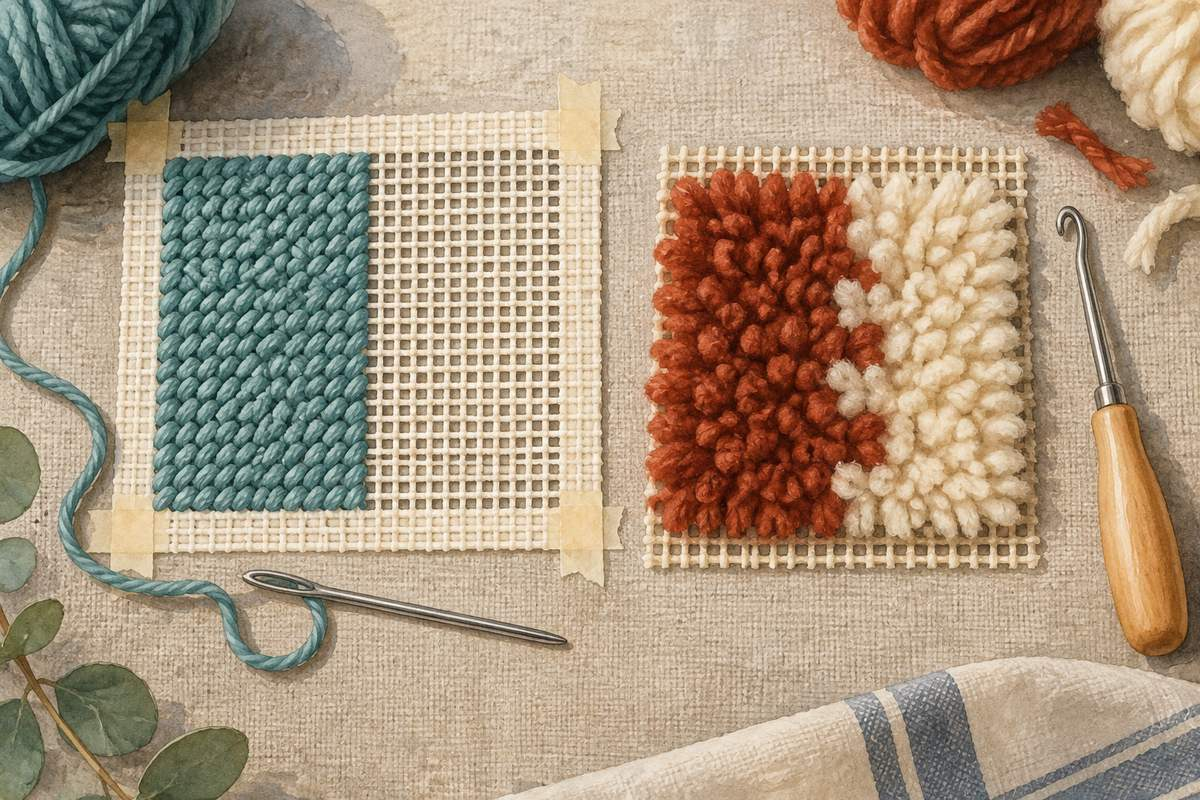
Needlepoint and latch hook both build a design on a grid, which is why the finished pieces can look similar from across the room. They are not the same craft. Needlepoint pulls a continuous thread through open canvas with a blunt tapestry needle and creates a flat woven surface. Latch hook knots short pieces of yarn onto a coarse rug canvas with a hinged hook and creates a cut pile. The grid, the tool and the structure all differ. Last updated November 4, 2026.
Start here: Choose needlepoint for fine detail, smooth tailoring and pieces that need to wear like fabric. Choose latch hook for a plush rug or wall hanging, fast progress and a simple knot repeated hundreds of times. You cannot swap one craft's canvas or tool for the other.
Why they get confused
Both crafts are counted, colorful and often sold as beginner kits. DMC describes tapestry and needlepoint as counted embroidery stitched through stiff open-weave canvas, usually with the design painted or printed on. Needlepointers.com describes latch hooking on a wide woven backing that also works like a grid of holes. On a product listing, both can appear as a square of canvas plus yarn.
The resemblance ends once the first stitch is made. Needlepoint fills the canvas with connected stitches. Latch hook attaches one separate piece of yarn to each cell. Needlepoint's image sits in the stitches themselves; latch hook's image is a map of thousands of tiny knots.
Two different motions
Needlepoint uses a blunt tapestry needle and a continuous length of wool, cotton, silk or another thread. DMC explains that the blunt tip passes through the holes without piercing the canvas fibers. Needlepointers.com names the three basic tent stitches: continental, basketweave and half-cross. You bring the thread up through one hole, take it down through another, and build the design stitch by stitch from the front.
Latch hook uses no threaded needle. Needlepointers.com describes wrapping a precut piece of yarn around the middle of a latch hook, pushing it into a cell of the backing, catching both ends and pulling them back through so the yarn forms a lark's head knot. Hands Occupied shows the same action: fold the yarn under the latch, insert the hook under a horizontal bar of rug canvas, wrap the tails, and pull until the latch closes and the knot forms. Each yarn piece is complete before the next begins.
Canvas, thread and tools
Needlepoint canvas is a stiff open weave in mono, interlock or Penelope constructions. DMC explains that mono uses single threads and has some give, interlock locks the crossings for stability, and Penelope uses durable double threads. The canvas count is the number of holes per inch; a higher count gives smaller stitches and finer detail. Thread weight follows the mesh, from tapestry wool on lower counts to finer cotton or silk on higher counts. Our canvas types guide compares those constructions.
Latch hook starts with rug canvas, not needlepoint canvas. The Oxford Company describes the backing as mesh with 1/4-inch square holes, and Needlepointers.com calls it a wide woven fabric made of stiff cotton. Yarn comes precut or is cut to length. Hands Occupied's formula is pile height times two, plus 1/4 inch for the knot: for a 2-inch pile, cut yarn 4 1/4 inches long. The tool is a handled hook with a small hinged latch that closes over the yarn as it is pulled through.
Flat fabric vs knotted pile
Needlepoint makes a flat, dense surface that behaves like woven fabric. DMC notes that most designs cover the canvas completely, which is why needlepoint works for pillows, ornaments, belts and upholstery. The stitch surface can be smooth or textured, but the canvas is still covered by connected stitches.
Latch hook makes a shaggy cut pile. The Oxford Company says each precut yarn piece is knotted into one square of the mesh, with both ends standing up to form a pile about 1 1/4 inches tall from standard 2 1/2-inch rug yarn. It emphasizes that latch hook is knotted and cut-pile, unlike punch needle's running stitch of uncut loops. Needlepointers.com likewise describes the result as a low pile suited to pillows, rugs and textured wall hangings.
Detail, speed and fixing
Needlepoint wins on detail. Its mesh counts can be much finer, each stitch is small, and color changes can happen one stitch at a time. That makes faces, lettering and shaded images possible. Latch hook's cells are larger and each knot carries a tuft, so edges are softer and curves become stepped. The right subject is bold: blocks of color, simple motifs, checkerboards, stripes and graphic rugs.
Latch hook usually feels faster. Each knot is a complete unit, and Hands Occupied presents it as a beginner-friendly way to make wall hangings, pillows and rugs from yarn scraps. Needlepoint is slower because the continuous thread must enter and exit the canvas cleanly, but it gives more control. Fixing differs too: a latch-hook knot can be removed and replaced as a unit, while needlepoint has to be unpicked stitch by stitch, as our mistakes guide shows.
Which one should you choose
Choose needlepoint if you want a durable, tailored surface and care about small details. It is the right fit for a portrait, belt, ornament, glasses case or pillow front that needs crisp edges. It also has more stitch variety: tent stitches can carry an entire design, or decorative stitches can change the texture. Needlepointers.com notes that the three tent stitches are only the start; combination stitches expand the vocabulary.
Choose latch hook if you want a plush surface, a large graphic design or a relaxing repetitive motion. Needlepointers.com calls it simple, relaxing and kid-friendly, and notes that it can be worked without a frame on a table or lap. It is also a good use for yarn scraps when you cut your own lengths. If the piece will be stepped on, latch hook's rug canvas and pile are designed for that world; if it will be sat on as upholstery, needlepoint has the flatter, more stable structure.
Where sources disagree
Is latch hook a kind of needlepoint? No. DMC defines needlepoint as counted embroidery stitched through canvas with a tapestry needle. Needlepointers.com defines latch hooking by its hinged tool and knotted precut yarn. They share a gridded base and yarn, not the mechanism.
Is latch hook the same as rug hooking?Needlepointers.com says no: rug hooking usually uses a frame and pulls loops through burlap or hessian, while latch hooking knots yarn onto coarse open mesh. The Oxford Company adds that latch hook is not technically considered rug hooking because it forms knots rather than a running loop stitch. A latch-hook rug is a rug, but the process is distinct.
Which is easier? Needlepointers.com calls latch hook simple and kid-friendly, while needlepoint has three basic tent stitches to learn before broader stitch choices. That makes latch hook easier for a first finished object. Needlepoint is not harder mechanically, but it asks for more patience and counting.
FAQ
What is the main difference between needlepoint and latch hook? Needlepoint uses a threaded tapestry needle and continuous thread to make connected stitches. Latch hook uses a hinged hook to knot individual pieces of yarn onto rug canvas.
Can you latch hook on needlepoint canvas? No. Latch hook needs coarse rug canvas with large openings, commonly described by The Oxford Company as 1/4-inch square holes. Needlepoint canvas is built for smaller stitched coverage.
Which lasts longer? Both can last when finished properly. Needlepoint makes a flat, dense fabric suited to pillows and upholstery; latch hook makes a knotted pile suited to rugs and wall hangings. Choose the structure for the use, not a generic durability claim.
Which is better for beginners? Latch hook has the shorter first lesson because one knot repeats. Needlepoint is still beginner-friendly, but you need to learn thread handling and at least one tent stitch. DMC calls tapestry and needlepoint relaxing and beginner-friendly once the canvas and needle are matched.
Can you make detailed pictures with latch hook?Yes, but at a larger scale and softer resolution. Each knot is one pixel with a tuft. Needlepoint resolves finer detail because each stitch is smaller and lies flat.
How is punch needle different? The Oxford Company says punch needle forms a running stitch of uncut loops with no knots, while latch hook forms a knotted cut pile. Our needlepoint vs punch needle guide covers that comparison.
Sources
- DMC - What Canvas Do I Need for Tapestry or Needlepoint? (a thread manufacturer reference; canvas constructions, counts, threads and tapestry needles)
- Needlepointers.com - Learn How to Needlepoint (a needlework reference site, updated September 2025; needlepoint definition and the three basic tent stitches)
- Needlepointers.com - Latch Hooking (a needlework reference site, updated August 2025; latch-hook knots, backing, uses and the rug-hooking distinction)
- Hands Occupied - Latch Hook Basics (a craft teaching blog, June 2018; yarn-length math, lark's head knots and project finishing context)
- The Oxford Company - Punch Needle vs Traditional and Latch Hook FAQ (a rug-hooking tool maker and school; 1/4-inch latch-hook mesh, 2 1/2-inch yarn, cut pile and knot structure)