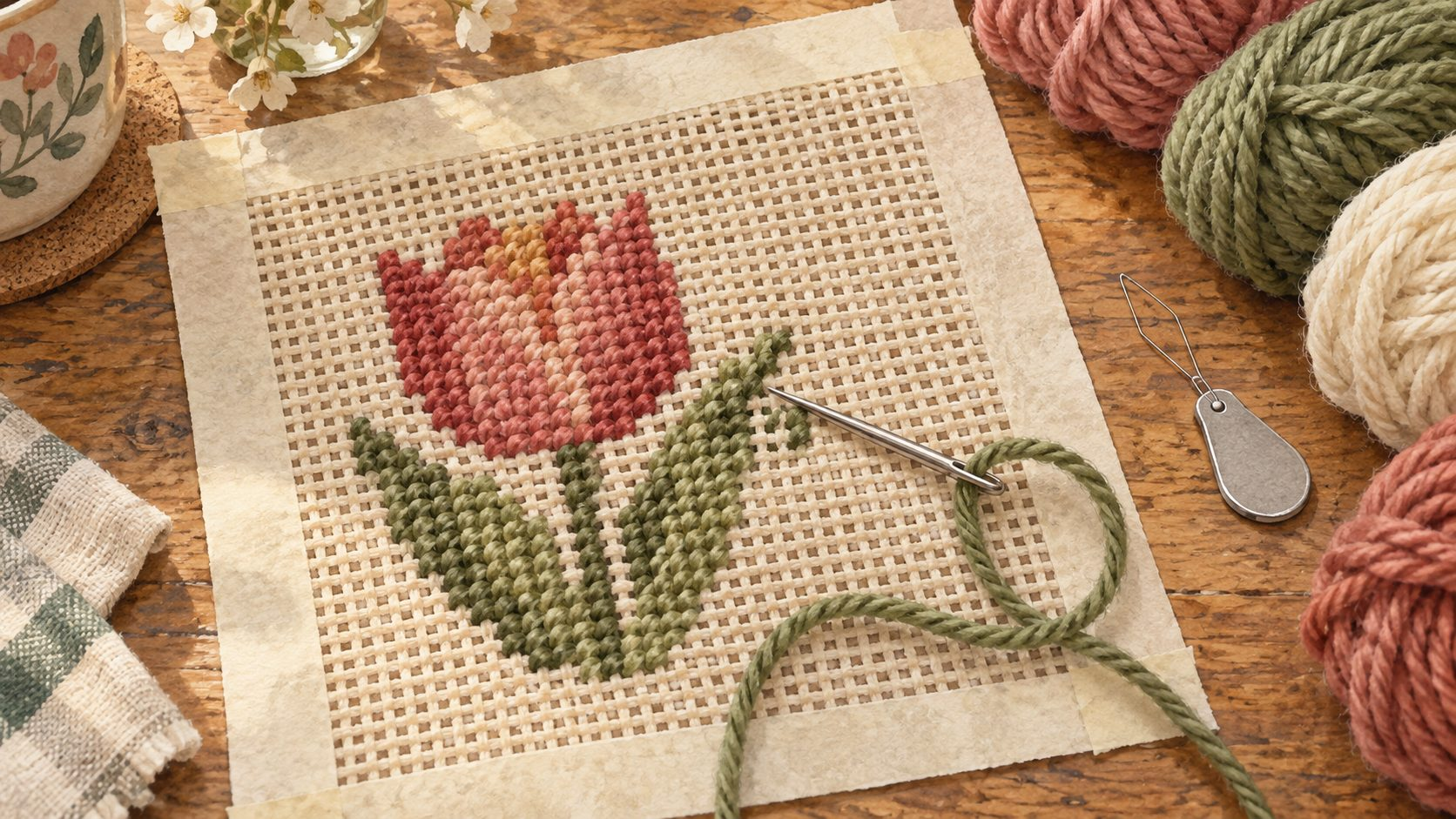
Fuzzy wool is the hard part of needlepoint threading. A tapestry needle has a big eye, but yarn splays at the end and slides off before it gets through. This guide pulls together eight sources on three ways to thread a needlepoint needle, how to pick a needle that makes it easier, and where the advice splits.
Use a tapestry needle with a large eye and cut about 18 inches of yarn (NeedlepointTeacher, Unwind Studio). Fold the yarn over the needle, squeeze the fold flat between thumb and finger, pull the needle out and push the folded crease through the eye (NeedlepointTeacher, Unwind Studio). If that fights you, use a needle threader.
Start with the right needle
Penny Linn says the key to threading is using the right needle first. Needlepoint is usually stitched with tapestry needles, which have larger eyes and blunt points. Unwind Studio makes the same point for thick tapestry wool: pick a tapestry needle with a larger eye so threading is easier and the yarn frays less.
Penny Linn gives this rule of thumb and calls needle size a personal preference:
| Canvas mesh | Needle size (Penny Linn) |
|---|---|
| 8 to 10 | 16 |
| 10 to 12 | 18 |
| 12 to 14 | 20 |
| 14 to 18 | 22 |
Klaer International adds that thread and needle sizes must be compatible, and that you should pick a larger needle if the thread is too big for the eye. See our needle choice guide and thread by mesh count for how that fits together.
Method 1: fold or wrap the yarn
NeedlepointTeacher uses about 18 inches of yarn and gives these steps for fuzzy or bulky thread:
- Hold the yarn in your left hand and the needle in your right, if you are right handed. Wrap the yarn once around the eye of the needle.
- Pinch the crease with your thumb and index finger.
- Pull the needle out of the crease while holding the yarn tight. The needle eye slides between your thumb and finger.
- Keep sliding until the crease goes through the eye.
The same source gives two rules. Do not look at the crease once you have made it. When sliding the yarn through, the needle moves and the yarn does not. If it still fails, turn the needle over and thread from the other side.
Unwind Studio calls its version pinch and fold, and says it is the quickest way for tapestry wool. Fold the thread around the head of the needle, slide it down while keeping the fold under pressure, then hold the fold between your fingers and push it through the eye. Pull until the loop slips through.
Method 2: a needle threader
Unwind Studio calls the threader the most reliable method, and a help for shaky hands or weak eyesight. The standard wire loop version works like this (Unwind Studio, Klaer International): push the wire loop through the needle eye, put the thread through the loop, then pull the wire back out and the thread comes with it.
Needlepoint yarn is thick, so check the tool:
- Needlework threader. Klaer International sells a needlework threader for long-eyed hand needles such as tapestry, chenille and yarn darner needles. It takes thread, floss, yarn or a decorative strand. The steps are the same: wire through the eye, thread through the loop, pull back straight.
- Hook style. AllFreeSewing describes a 3-in-1 threader with a thin wire for thread, a small hook for embroidery thread or light to medium yarn, and a larger hook for medium to heavy yarn. You push the eye of the needle over the hook, lay the yarn over the hook and pull the needle off.
- Kit threaders. Modern Mesh packs one in its intro kits and says it works with a variety of needle sizes, so you can use either end. Hook the thread around the hook, rest the needle in the notch, and gently pull the needle off. Elizabeth Bradley Design describes a similar tool with a large curved end for its tapestry wool.
- Brand notes from one blogger. Peacock and Fig says a generic threader is cheap but the fine wire comes out easily, Clover and LoRan are sturdy and good for tapestry needles, LoRan does not work with smaller needles and its hooks bend, and a looped Dritz threader keeps the thread from falling out. Peacock and Fig links to Amazon with affiliate links, so read the picks with that in mind.
Klaer International also describes a cutting blade on some threaders so you can cut the thread at the handle. Penny Linn says if you need help, your needle threader is there for you.
Method 3: a paper fold
Unwind Studio gives a hack for when you do not have a threader. Fold a small piece of paper in half, tuck the thread into the fold with a small tail out, push the folded end through the eye, and pull the paper off. The thread stays in the needle. The source presents it for general stitching, not tested on thick wool, and we would expect a paper strip to work best with thinner strands (our guess).
Tips that help
- See the eye. Klaer International says to hold the needle over a white background, use good lighting and use a magnifier or readers if needed. Peacock and Fig also says a magnifier or magnifying light helps. See our lighting guide.
- Cut clean. Peacock and Fig suggests sharp scissors for a clean end if threading by hand. Our scissors guide covers the tool.
- Length. NeedlepointTeacher uses about 18 inches. Modern Mesh says fingertips to elbow, which keeps the thread long enough to make progress and short enough not to tangle. Our starting and ending thread guide covers the next step, and our Persian yarn guide covers splitting strands.
- Park the needle. A needle minder keeps a threaded needle out of the couch.
- Use a lubricant if the end shreds. Peacock and Fig suggests thread lubricant such as Thread Magic or beeswax for floss. That advice is about floss, not wool.
Where sources disagree
- Wetting the thread. NeedlepointTeacher says licking the end and aiming at the eye will never work with fuzzy or bulky thread. Penny Linn says she used to dampen the end and stopped. Peacock and Fig lists licking as a method but warns that wetting floss can rust needle eyes, making floss shred and knot more.
- Do you need a threader? Unwind Studio calls the threader the most reliable option. NeedlepointTeacher and Unwind Studio both teach hand methods for tapestry wool, and AllFreeSewing says a large eye may not need a threader. Our read is that wool on a tapestry needle can be threaded by hand once you learn the fold, and a threader helps when you cannot.
- Which tool fits. Modern Mesh says its threader works with a variety of sizes. Peacock and Fig says one brand does not work with smaller needles and a generic one loses its wire. Both are sellers or affiliates, so check that a threader fits your needle before relying on it.
- Which side to thread from. NeedlepointTeacher says to flip the needle if it will not go. Peacock and Fig says sewing needles often have a groove on one side and you should thread from that side. That tip is about sewing needles, and tapestry needles do not have the same issue as far as these sources say.
Questions
How do I thread yarn through a needlepoint needle?
Wrap or fold the yarn over the needle, pinch the crease flat, pull the needle out and push the crease through the eye (NeedlepointTeacher, Unwind Studio).
What size needle do I need?
Penny Linn pairs a size 16 needle with 8 to 10 mesh, 18 with 10 to 12, 20 with 12 to 14, and 22 with 14 to 18. She calls it personal preference.
Can I use a regular sewing needle threader on wool?
The wire loop on a standard threader is thin for tiny eyes. For yarn, AllFreeSewing and Klaer International point to larger hook or needlework threaders.
Should I lick the end of the yarn?
NeedlepointTeacher says it will not work with fuzzy thread, and Peacock and Fig warns that wetting floss can rust the eye.
How long should the strand be?
About 18 inches (NeedlepointTeacher) or fingertips to elbow (Modern Mesh).
Sources
- NeedlepointTeacher, How to Thread a Needle
- Penny Linn, How To: Threading a Needle
- Elizabeth Bradley Design, How to Use a Needle Threader
- Peacock and Fig, What needle threader is best for you?
- Modern Mesh, Beginner's Guide to Needlepoint
- Klaer International, How to use the Threaders
- AllFreeSewing, How to Use a Needle Threader
- Unwind Studio, 3 Easy Ways to Thread the Needle