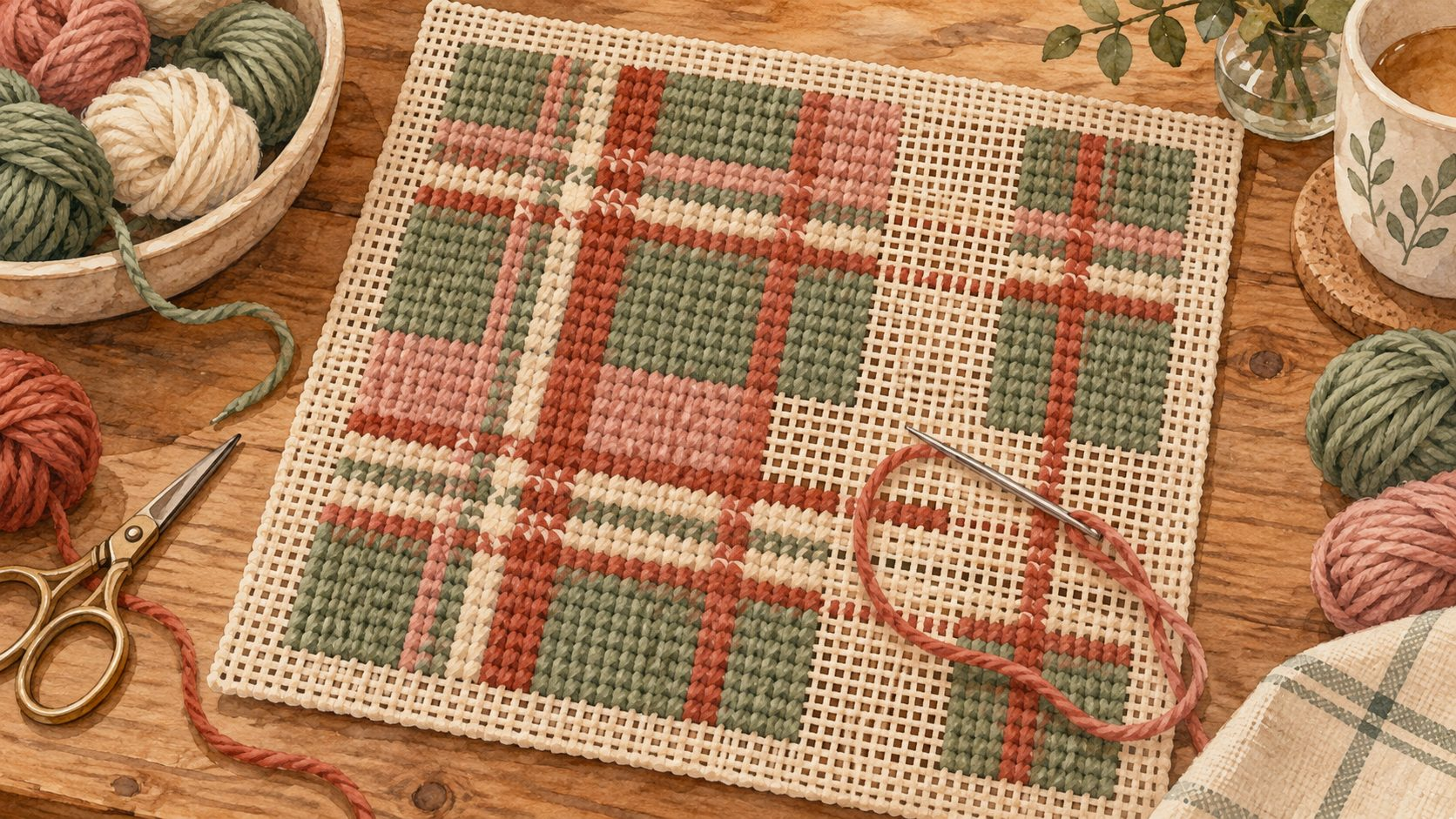
A needlepoint plaid is just two sets of stripes crossing at right angles: one set stitched vertically, one horizontally, with the over-and-under pattern doing the rest. The stitch that makes it easy is skip tent - tent stitch worked on every other intersection in a checkerboard, so the second set of stripes has open holes waiting for it. Plaids look impressive and stitch fast once the repeat is set.
The core recipe (Janet Perry, Nuts about Needlepoint): stitch your stripes in one direction in skip tent, then fill the open intersections with the stripes running the other direction, worked in straight continental rows. Know your color sequence and stripe widths, and the plaid emerges on its own. If you can do tent stitch, you can do this - see stitches for beginners first if tent stitch is new.
What a needlepoint plaid is
Plaids are two sets of stripes, one vertical and one horizontal, and stitching one is relaxing because once you know the pattern it just repeats (Nuts about Needlepoint). Where two stripes of the same color cross, you get a solid block; where different colors cross, the stitches mix. If the color sequence and stripe widths match in both directions the plaid is symmetrical, like a tartan, and the solid blocks are squares. If they differ - as in a birthday plaid - the blocks are rectangles and the plaid is asymmetrical.
Skip tent: the engine of plaid stitching
Skip tent is tent stitch on every other intersection, producing a checkerboard of stitched and bare holes with half the stitching of full coverage (Floss Field). Work it on the diagonal like basketweave with every other row left out, so the thread passes evenly behind the skipped holes. On its own it makes a light, lace-like texture that lets painted canvas show through, popular for skies and backgrounds. For plaids it does something cleverer: it leaves every other intersection open, ready for the crossing stripes.
Two practical notes from Floss Field: because canvas shows between stitches, thread ends are harder to hide, so anchor them behind neighboring full-coverage areas or in the margin; and decide at the start whether your stitches sit on the horizontal or vertical canvas threads, then stay there for the whole area. At edges, partial stitches use compensation - see compensation stitches.
The basic plaid method
Janet Perry's method: stitch the first direction as stripes in skip tent (diagonal rows are fine here), then stitch the second direction in straight rows, continental style, filling the open intersections. Do not work the second direction in diagonal skip tent rows, she warns - you will get ridges. Expect the second direction to use slightly more thread, because those stitches pass over the backs of stitches already worked rather than open canvas. The plaid appears as the second direction fills in.
Chilly Hollow describes the same structure with a canvas turn: cover the area in skip tent with your color sequence (her example: 7 rows blue, 1 black, 7 orange, 1 black, repeated), then turn the canvas 90 degrees and fill the empty canvas threads in the same sequence. Turning the canvas is simply another way to keep the second direction's stitch slant matching the first.
Chottie's Plaid: the reversible version
Chottie's Plaid, designed by the American canvaswork teacher Charlotte "Chottie" Alderson, is a spaced-diagonal stitch that produces the same checked pattern identically on both sides of the canvas (Royal School of Needlework StitchBank). Horizontal stripes are worked as spaced diagonal stitches first, then vertical stripes fill the gaps, and because nothing is hidden, the front and back match. The RSN notes it suits anything whose reverse will show - coasters, bookmarks, handbag flaps, ties - and that with a binding stitch at the edge you can conceal the thread ends. The same stitch family scales to related checks by changing the row counts: gingham is 3 rows of alternating colors, houndstooth 2 rows, and tweed effects come from single rows of several colors (RSN, NeedlepointTeacher).
Designing your own plaid
From a real tartan. NeedlepointTeacher's scaling method: find a fabric sample of the tartan, count the woven threads in each color block of one repeat, and divide by two to shrink it to canvas scale (rounding an odd count up first). If the plaid reads the same in both directions, you only count one direction.
Birthday plaids. Chilly Hollow's recipe: pick 4 or 5 colors, take a number sequence - a birthdate, phone number, or zip code - and let the digits set the stripe widths. For 72180, work 7 rows of color one, 2 of color two, 1 of color three, 8 of color four (drop zeros, or treat them as 10). You will not know exactly what you have until the second direction goes in, which is half the fun. Her design advice: limit the palette to 4 or 5 colors and alternate wide bands with narrow ones for a coherent result.
Keep track. Lake Shore Needlepoint calls the plaid stitch beginner-friendly - it is just tent stitches - with the real difficulty being the repeating color pattern. Follow a written sequence and work one color at a time.
Common mistakes
Ridges in the second direction. Caused by working both directions as diagonal skip tent; the fix is straight continental rows for the crossing stripes (Nuts about Needlepoint). She offers two more ridge-free options for two-color skip tent work: stitch the second color in solid backstitch rows slanting the opposite way, or work everything in horizontal rows from the start.
Losing the checkerboard after an interruption. When part of the design breaks a row, find your place by the canvas threads, not by counting stitches: if your stitches have been sitting on the horizontal canvas threads, the next one does too (Floss Field).
Exposed thread ends. Open work gives ends nowhere to hide. Anchor behind full-coverage neighbors, trail along edges, or use a binding finish (Floss Field, RSN).
Where sources disagree
Second direction: turn the canvas or change the stitch? Chilly Hollow turns the canvas 90 degrees and keeps working skip tent in the same sequence; Janet Perry keeps the canvas put and switches the second direction to continental straight rows, explicitly warning against diagonal rows there. Both aim at the same result - crossing stripes with a consistent slant and no ridges - so pick the one your hands prefer.
Is skip tent "half the work"? Floss Field calls skip tent half the stitching of full coverage and quicker for large areas. In a plaid, though, the open intersections get filled by the second direction, so a plaid is closer to full coverage in time; the speed claim holds for skip tent used as open background, not for plaid.
Common questions
What is skip tent stitch?
Tent stitch worked on every other canvas intersection in a checkerboard, leaving half the holes bare (Floss Field). It is also called skipped tent stitch or basketweave twill, and it is worked on the diagonal like basketweave with every other row left out.
What is the difference between skip tent and Chottie's Plaid?
Skip tent is an open stitch where the bare intersections stay bare. Chottie's Plaid is a specific two-pass pattern of spaced diagonal stitches designed so the second pass fills the gaps and the finished piece looks identical front and back (RSN). A basic tent plaid sits between the two: fully covered like Chottie's, but not reversible.
Can beginners stitch a plaid?
Yes - it is all tent stitch. Lake Shore Needlepoint rates the plaid stitch beginner-friendly; the only real skill is following the color sequence. Chilly Hollow suggests plastic canvas for a quick kid-friendly version (see plastic canvas guide).
Gingham, tartan, houndstooth: what changes?
Only the row counts and colors. Gingham is 3 rows of each alternating color, houndstooth is 2, tartans follow the sett of the real fabric (scale it by counting threads and dividing by two), and tweed effects use single rows of several colors (RSN, NeedlepointTeacher).
What is a birthday plaid?
An asymmetrical plaid whose stripe widths come from the digits of a date, phone number, or zip code, in 4 or 5 chosen colors. Every birthday plaid is unique to its number (Chilly Hollow).
What can I make with a stitched plaid?
Coasters, ornaments, bookmarks, bag flaps, belts, pillows, and backgrounds. Where the back shows, choose Chottie's Plaid for its reversible finish (RSN); where it will be backed or framed, the basic tent plaid is faster to learn. Plaids also make strong backgrounds and borders.
Sources
- Floss Field, Skip tent stitch in needlepoint: how to work it
- Nuts about Needlepoint, Let's Talk Plaids!
- Nuts about Needlepoint, Stitching Skip Tent in One or Two Colors
- Chilly Hollow Needlepoint Adventure, Creating Needlepoint Plaids
- Royal School of Needlework StitchBank, Chottie's Plaid
- NeedlepointTeacher, How to Create a Plaid
- Lake Shore Needlepoint, Needlepoint Plaid Stitch Chart