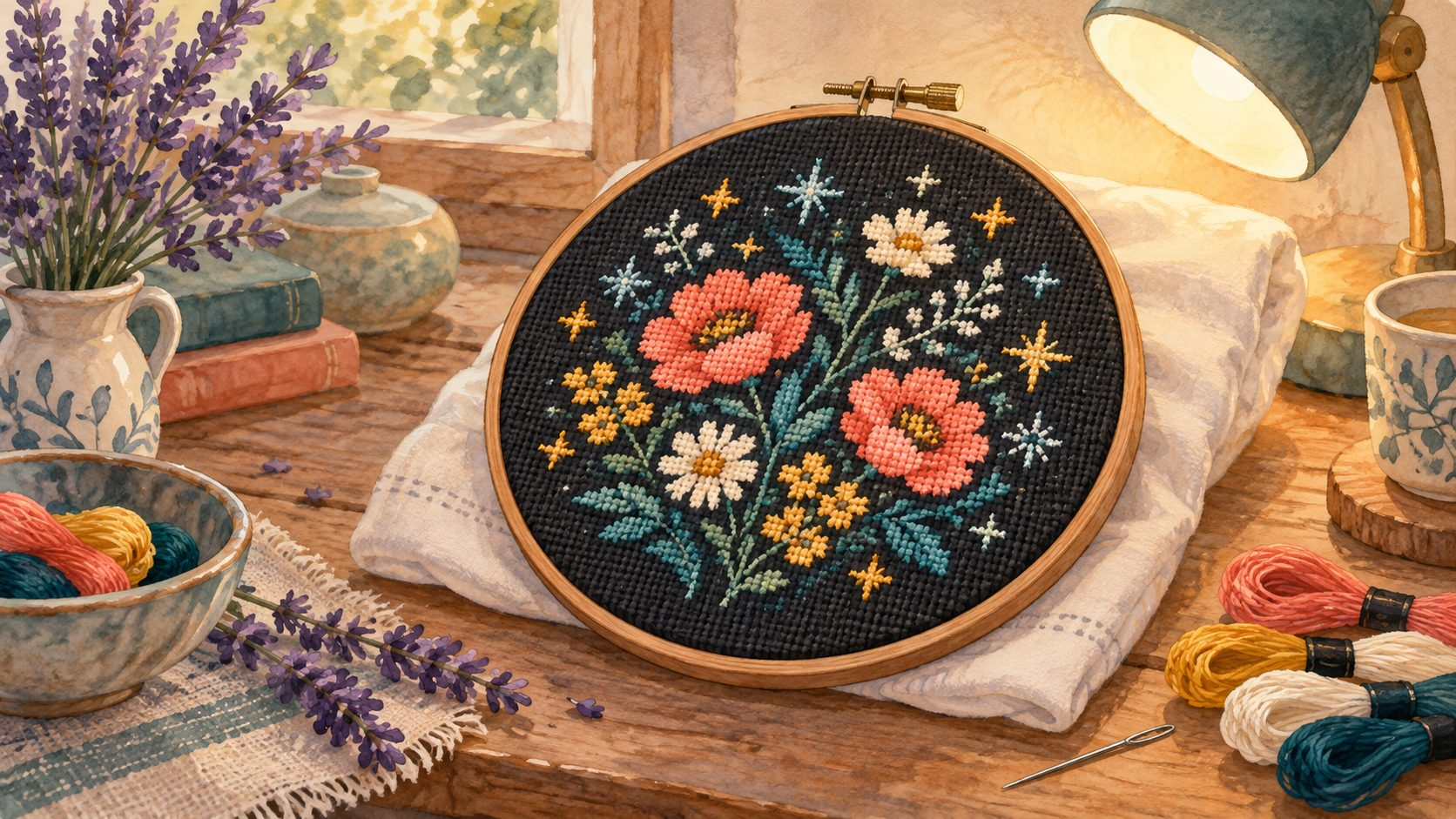
Black and navy fabric makes bright floss glow, and it saves you from stitching thousands of background squares. It also hides the holes you need to find. The good news is that nearly every problem with dark fabric comes down to seeing the weave, and a handful of cheap changes fix most of it. This guide pulls together the advice from six stitching teachers on light, fabric, tension, technique, and thread.
Use 14 count aida for your first dark project, pick a pattern with bright colors, stitch in strong daylight or under a daylight lamp, put something white under the fabric, and keep the fabric tight in a hoop or frame. Work in short sessions and take eye breaks. Everything below expands on those points.
Why use dark fabric
Stitch Squad lists the situations where dark fabric earns its trouble. The design has a dark background, so the fabric does the work of thousands of stitches and saves thread and time. Light and bright colors look more vibrant on dark than on white. Designs with negative space, such as night skies, galaxies, and silhouettes, let the fabric become part of the image. Dark fabric also avoids the white border effect that unstitched margins can give on light fabric.
Sirious Stitches adds that vibrant colors pop on dark backgrounds, and that you can do an entire design with white thread on black fabric.
What makes it hard
Stitch Squad describes the main problem well. On white aida, each hole is a tiny shadow against a bright background. On black fabric the holes nearly disappear, and you are looking for dark holes with a dark thread. The challenge is not that dark fabric is only for experts. It is that you need a setup that makes the holes visible.
The second problem is coverage. Stitch Squad notes that on dark fabric every small gap between stitches shows the dark background underneath, which can make stitching look less full, especially in white, yellow, and pastel threads.
Lighting
Every source puts light first. Sirious Stitches says lighting is crucial on dark fabric, and Catkin and Lillie says that if you do nothing else, get strong light, either good daylight or an overhead daylight LED lamp. You can never have too much light.
- Daylight. Little Lion Stitchery likes natural daylight because colors show accurately and the holes are easier to tell apart. Stitching beside a window is the easy version.
- Daylight lamps. Little Lion Stitchery says anything at 5,000 K or above gives a cool light that is good for stitching. Stitch Squad suggests 5,000 to 6,500 K and at least 1,000 lumens, positioned above and slightly to the side so each hole casts a tiny shadow.
- Flexible lamps and ring lights. Sirious Stitches likes a slim lamp that bends between you and the stitch, and a dimmable one. A ring light also works because you can look through it. She keeps the color mode on white so thread colors do not look off.
- Portable options. Fiberlicious Yummy Fibers suggests a neck light or a headlamp, with or without a magnifier, to put light where you need it.
White underneath and light behind
Stitched Modern calls a white background the most important step after good lighting, and the sources agree. Drape a white pillowcase, towel, or sheet of paper over your lap under the work. Little Lion Stitchery says any light surface works, because it is all about contrast. Catkin and Lillie suggests holding the work over your printed pattern.
The next step is light from behind. Little Lion Stitchery notes that backlighting makes the holes easy to find because light passes through the fabric. Stitch Squad calls a light pad the single most impactful tool for dark fabric. A thin LED tracing pad, even an A5 size, turns each hole into a bright point. You only need light behind the section you are working on, and some stitchers use a tablet showing a white screen in a pinch. Stitched Modern suggests a small lamp on the floor pointing up, with indirect light so it does not shine in your eyes. Sirious Stitches lined the edge of her desk with LED strips, with the frame leaning against it.
Choosing fabric
- Aida over linen. Five of the six sources say aida is easier on dark colors because its holes are more prominent. If you are choosing between them, our evenweave versus aida guide covers the differences.
- Lower count. Fabric with fewer holes per inch has bigger holes. Sirious Stitches says to stick to 14 count until you are comfortable, because higher counts make the struggle worse. Our aida count guide explains what the numbers mean.
- Weave tightness varies by brand. Little Lion Stitchery points out that two fabrics with the same count can differ. Her example is 28 count Monaco evenweave from Charles Craft, which is thicker and heavier with holes harder to see than 28 count Lugana from Zweigart.
Hoops and tension
Tight fabric opens the holes, so light passes through more easily. Little Lion Stitchery says stitching on black can be the one exception for people who normally stitch in hand, and Sirious Stitches agrees that this is not the time for in-hand stitching. Stitched Modern puts fabric in a snap frame and pulls the edges gently until tight, without pulling so hard that the weave distorts. Our guide to choosing a hoop or frame compares the options. A stand, which Stitch Squad and Fiberlicious Yummy Fibers both mention, frees both hands and helps when you cannot see as well.
Stitching technique
- Feel for the hole. Stitched Modern and Catkin and Lillie both describe dragging the needle tip slowly and lightly over the fabric. It dips slightly at a hole, and you push through there. It takes some practice, and Catkin and Lillie notes a ball tip needle can help.
- A sharper or larger needle. Fiberlicious Yummy Fibers suggests a tapestry size 24 or 26 to find the holes more easily.
- Railroad the strands. Stitch Squad says to separate the strands with the needle so they lie side by side instead of twisting, which spreads the thread across the square and helps coverage.
- Work simple first. Catkin and Lillie recommends a small, simple first pattern without fractional stitches. Sirious Stitches suggests choosing a pattern designed for dark fabric, because stitching black on black is painful.
- Stitch from the back, maybe. One tip from Fiberlicious Yummy Fibers is that some people find the weave easier to see from the back. She says to test it on a small area first.
Thread, coverage, and color
Stitch Squad suggests moving from two strands to three on 14 count aida, especially for light colors where gaps are most obvious. Catkin and Lillie agrees, and notes that lower count fabrics show more of the dark fabric through the stitches, so test your coverage before committing to a full piece.
Color behaves differently too. Sirious Stitches warns that dark threads such as 939 and 3371 are as bad as 310 on black. Stitch Squad says to stitch a small test swatch on a scrap of your fabric, because threads can surprise you compared with how they look in the skein. She lists white and very light colors as the highest contrast, and metallic threads in gold, silver, and copper as striking on dark. Sirious Stitches suggests variegated, glow-in-the-dark, and metallic threads to mix things up, while admitting that specialty threads come with their own annoyances.
If you wash the finished piece, check that the dark fabric and the floss are colorfast first. Little Lion Stitchery suggests a color catcher sheet as a precaution, and our washing guide shows the full process.
Marking the fabric
Gridding helps on any color, and the sources say it helps more on dark fabric. The sources differ on how to do it:
- White or light thread. Stitch Squad suggests a single strand of white or neon guideline thread. Fiberlicious Yummy Fibers also suggests high-contrast thread for gridding.
- Chalk. Little Lion Stitchery suggests dusting chalk over the fabric to brighten it while you stitch, then washing it off.
- Erasable markers. A water-soluble or erasable pen can mark a light grid. Stitch Squad says white or silver pencils can work but should be tested thoroughly first.
For the basic method, see our guide to gridding fabric.
Eye care
All the sources mention eye strain. Stitched Modern and Catkin and Lillie suggest short sessions and alternating with a second project on lighter fabric. Catkin and Lillie says even stitching in 10 or 15 minute chunks will get you to the finish. Sirious Stitches recommends taking breaks and stitching with something else in between. Stitched Modern suggests inexpensive reading glasses, and brings a scrap of fabric to the drugstore to pick the right strength. Fiberlicious Yummy Fibers suggests the 20-20-20 habit: every 20 minutes, look at something 20 feet away for 20 seconds.
Where sources disagree
| Question | What the sources say |
|---|---|
| Do you need a hoop? | Most say yes for dark fabric. Catkin and Lillie jokes that even dark fabric cannot talk her into using one, though she still says extra fabric tension helps you see the holes. |
| How to mark a grid | White thread (Stitch Squad), chalk (Little Lion Stitchery), or erasable pens (Fiberlicious Yummy Fibers). Stitch Squad warns to test pencils. |
| Light temperature | Little Lion Stitchery says 5,000 K and up. Stitch Squad says 5,000 to 6,500 K. Sirious Stitches keeps her lamp on white so colors are not distorted. |
| Coverage | Stitch Squad and Catkin and Lillie suggest three strands on 14 count. The other sources do not give a number, so test on a scrap. |
Questions
Is black aida harder than white?
Yes, mainly because of visibility, according to every source here. The fixes are light, a white backing, tight fabric, and short sessions.
What count should I use?
Sirious Stitches, Stitch Squad, and Little Lion Stitchery suggest 14 count aida for a first dark project. Higher counts make the holes smaller and harder to find.
Do I need a light pad?
It is not required. A white pillowcase on your lap helps a lot. Stitch Squad says a light pad is the most impactful tool if you stitch dark fabric often.
Which colors work best?
Bright and light colors, plus metallics. Dark colors close to the fabric disappear.
Should I use more strands?
Maybe. Stitch Squad and Catkin and Lillie suggest three strands on 14 count if gaps show, particularly in light colors. Stitch a test swatch first.
Can I wash dark fabric after stitching?
Yes, if the fabric and floss are colorfast. Test first, and rinse in cool water.
Sources
- Little Lion Stitchery: daylight and lamp temperature, backlighting, fabric brands, and chalk.
- Sirious Stitches: 14 count aida, bright patterns, white backing, and specialty threads.
- Stitched Modern: white background, tight frame, reading glasses, and feeling for holes.
- Stitch Squad: why use dark fabric, light pads, strands, railroading, and color swatches.
- Catkin and Lillie: daylight lamps, white backing, needle feel, and short sessions.
- Fiberlicious Yummy Fibers: needles, stands, gridding, eye care, and stitching from the back.