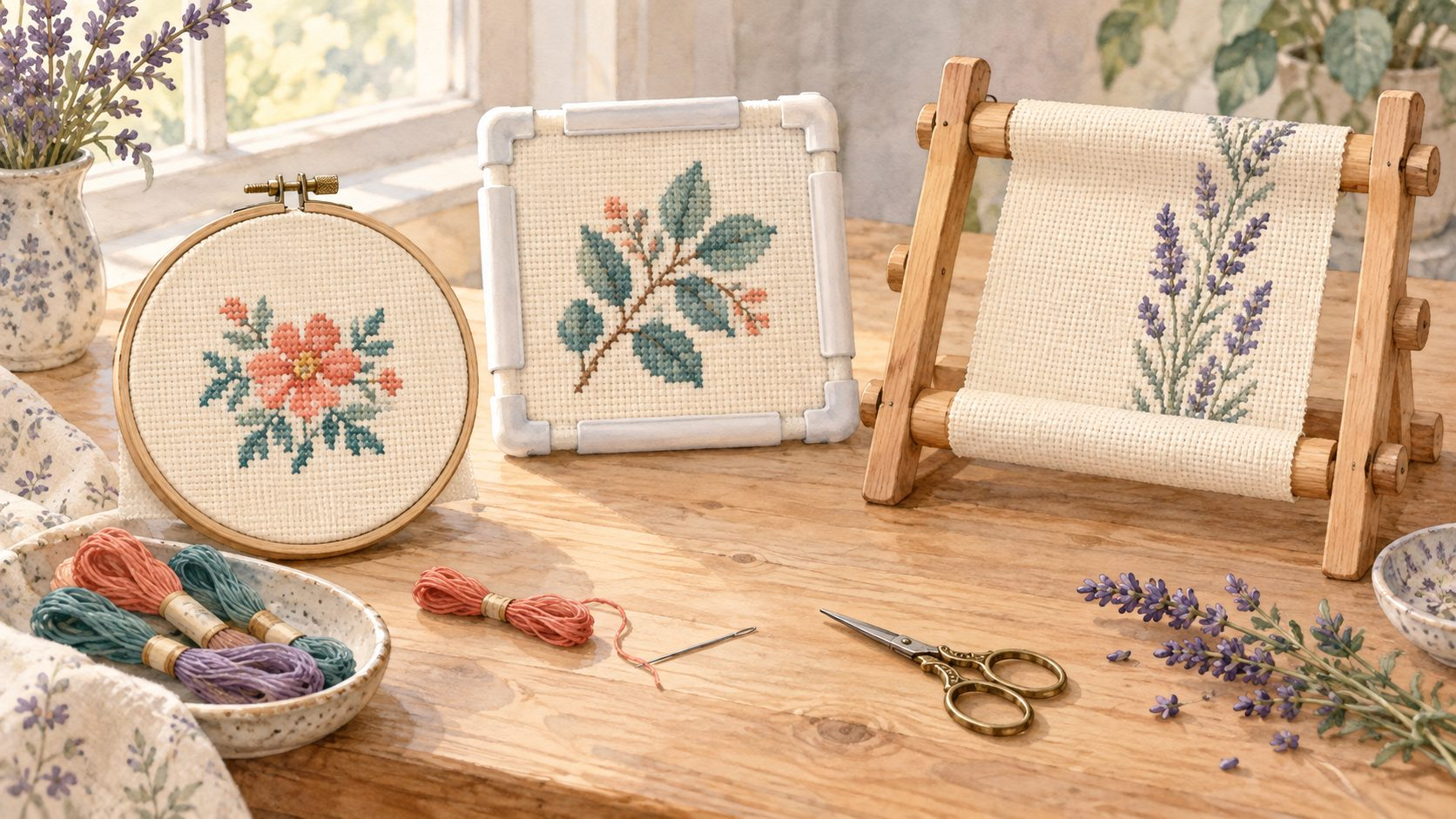
Every cross stitcher ends up with an opinion about hoops, snap frames, and scroll frames, and the opinions disagree. That is because the right tool depends on the size of your project, how your hands feel after an hour, and how much storage space you have. This guide explains how each option works, what stitchers who use them say about the good and bad parts, and how to pick one without buying all of them.
For a small or medium project, a wooden screw-tension hoop is the cheapest and simplest place to start. For a large pattern, or if hoops hurt your hands or leave stubborn rings, look at a scroll frame or a snap frame. Whichever you try, stitching in hand with no tool at all is also fine. Nothing here is required.
Do you need anything at all?
Sirious Stitches makes a point that gets lost in beginner advice: there is no wrong way to stitch, and holding the fabric in your hand is a legitimate method. Many new stitchers believe they must buy a hoop first, but if you are still working out whether you like the craft, there is no need to spend money. Notorious Needle agrees that you can cross stitch without a hoop, although she recommends one for beginners.
The reason stitchers suggest a holder is tension. Taut fabric helps keep your stitches even in size and stops the fabric puckering under uneven stitches. You can keep tension yourself by keeping the area you are working on taut and by not pulling the thread too tight. Sirious Stitches also notes that stitching in hand is the only choice on materials like plastic canvas, perforated paper, and vinyl aida, which cannot go in a hoop or frame.
A tool is worth trying if your hand cramps when you hold the fabric. Notorious Needle and Luv 4 Cross Stitch both describe that as a reason they use a holder.
The four options side by side
| Option | Best for | Main strengths | Main drawbacks |
|---|---|---|---|
| In hand | Small pieces, non-fabric canvases, trying the craft | Free, portable, no marks on the fabric | You supply the tension, and hands can cramp |
| Hoop | Small to medium projects, stitching on the go | Cheap, light, easy to hold, many sizes, can double as the frame | Can leave rings, screw can loosen, awkward on very large pieces |
| Snap frame (Q-Snap style) | Medium to large projects, people who find hoops hard to grip | Tension from four sides, adjustable sizes, fewer hard creases | Thicker and heavier, clamps can be fiddly, fabric can stretch if clamped badly |
| Scroll frame | Large or long projects | Large view of the pattern, rolling instead of clamping, works well on a stand | Takes practice to load, sides can sag, less portable |
Hoops
Sirious Stitches describes the classic hoop as two concentric rings with a screw that tightens the outer ring over the fabric, and says hoops were patented in 1903. Hoops come in wood, plastic, and, in older versions, metal. Notorious Needle covers the types in more detail:
- Screw-tension hoops. The most common type. Easy to find and use, and the wooden round ones are inexpensive. She uses these most often for stitching.
- Flexi hoops. A stretchy vinyl outer ring over a hard plastic inner ring. Great for framing a finished piece, but she finds it hard to place the fabric well and does not recommend them for stitching.
- Spring-tension hoops. Small ones hold fabric very taut and large ones feel looser. She does not recommend them for hand embroidery.
- Metal hoops. Usually vintage. They can work well, but if the metal rusts it can stain the fabric.
- Plastic hoops. Pretty for framing. She says to avoid smooth plastic rings for stitching because the fabric slips and sags, and to look for ridges or a groove if you do use plastic.
The benefits stitchers mention are consistent. Hoops are thin, light, and easy to hold, they come in many sizes, and they are cheaper than other options. Blooming Daisies Crafts adds that hoops take up little room when not in use. Lizzy B points out they are portable and versatile for small and medium projects. A finished piece can also be left in the hoop and hung, which our guide to finishing and framing cross stitch covers in more depth.
The complaints are also consistent. Sirious Stitches finds tension gets loose as she works with cheap hoops, and recommends a well-known brand if you commit. Lizzy B says hoops can give limited tension on large projects, and that many people wrap the inner ring in twill tape to help the fabric grip. And hoops can leave rings, covered below.
Snap frames
Q-Snap is one brand of snap frame, and the name is used loosely for the whole type. Little Lion Stitchery describes them as rectangular plastic frames with C-shaped plastic clamps that hold the fabric taut. The inside of each clamp is ribbed to grip better. Sirious Stitches describes the frame as square plastic pipes with clamps, in sizes from 6 by 6 inches up to 24 by 36.
What stitchers like about them:
- Four-sided tension. Little Lion Stitchery contrasts this with scroll frames, which grip only at the top and bottom. A fabric held on all four sides stays tight.
- Customizable size. Pieces can be mixed, so two sides from an 8 by 8 and two from an 11 by 11 make an 8 by 11. Extension kits add length.
- Easy to hold. Notorious Needle and Sirious Stitches both say the thicker frame is easier to grip than a hoop, which helps if hoops are uncomfortable.
- Fewer hard creases. Luv 4 Cross Stitch suggests putting a scrap of felt or wax paper under the clamp to protect the fabric and make removal easier.
The downsides: Notorious Needle notes the frames are heavier than a hoop, and accessories such as lap or table stands exist to help. Little Lion Stitchery warns not to pull clamps off. Slide them off the end instead. Blooming Daisies Crafts relays a stitcher whose fabric was stretched out of proportion when clipped in, and another who found them tiring to hold. Both are personal experiences, not rules.
Scroll frames
Sirious Stitches says scroll frames were patented in 1994 and describes how modern ones work: two rods are split so you slide the fabric between them, roll it, and secure it with clamps. Some come with a fabric strip you sew your cloth to first. Lizzy B notes the rolling means you get even tension across the width and no clamp creases.
They suit large projects. Blooming Daisies Crafts rests hers on the arms of a chair and does not have to hold it up. Luv 4 Cross Stitch says they are easiest with a floor or lap stand.
The common problems are loading and the sides. Sirious Stitches says fabric loaded crookedly can bubble and throw off tension, and that the loose sides can sag, which elastic clips fix. Lizzy B adds that you need a frame slightly wider than your fabric, because folding the sides in loses tension. Newer frames with an added bar or PVC piece help hold the design tauter, according to Blooming Daisies Crafts.
How to choose
- Start with the size of the finished design. Under about 6 or 8 inches, a hoop or in-hand stitching is usually plenty. Large patterns point toward a scroll frame, or a large snap frame on a stand. If you have not worked out your size yet, our size calculator guide helps.
- Think about your hands. If you get cramps, try a thicker snap frame, or a hoop on a stand.
- Think about where you stitch. Hoops travel well. Scroll frames work best at home.
- Think about storage and budget. Hoops are the cheapest. Snap frame pieces store flat, and scroll frames take room.
- Try before you commit. Luv 4 Cross Stitch ends her post by saying that if you try one and do not like it, try another.
Many experienced stitchers own more than one and match the tool to the project. Lizzy B says as much, and Blooming Daisies Crafts reports that people in her community use all three.
Sizing
Notorious Needle recommends a hoop about two inches bigger than the pattern, leaving roughly an inch of fabric space on every side. Little Lion Stitchery's rule for snap frames is to work out your project size and add two to four inches. A frame that is too big gets hard to use without a stand.
You do not need the whole design to fit. When you finish a section you can move the frame, as you would with a hoop. Cut your fabric with enough margin to be held at all; our gridding guide pairs well with this step.
Avoiding hoop marks and creases
- Take the work out between sessions. Luv 4 Cross Stitch says this is the best way to avoid creases. Lizzy B admits that most people, including her, do not.
- Use a bigger hoop. Sirious Stitches notes that a hoop large enough to frame the whole piece avoids ring marks inside the design.
- Pad the clamp with felt or wax paper on snap frames.
- Wash and press when done. Sirious Stitches says hoops make washing and ironing close to a necessity. Our guide to washing and caring for finished cross stitch shows how.
Where sources disagree
| Question | What the sources say |
|---|---|
| Do hoops hold tension? | Notorious Needle says hoops make it easier to keep tension even. Sirious Stitches and Lizzy B report loosening or limited tension on cheap hoops and large projects. Hoop quality and size appear to decide it. |
| Do scroll frames avoid creases? | Sirious Stitches and Lizzy B say rolling avoids creases. Lizzy B adds the sides need care or tension is lost. |
| Are snap frames easier on the hands? | Sirious Stitches and Notorious Needle say the thicker frame is easier to hold. Blooming Daisies Crafts reports a stitcher who got cramps from them and found hoops thinner and easier. |
| Remove the project from the hoop after each session? | Luv 4 Cross Stitch recommends it. Lizzy B says it is advised but rarely done. |
| How much bigger than the pattern? | Two inches for a hoop (Notorious Needle), two to four inches for a snap frame (Little Lion Stitchery). |
Questions
What is the best frame for a beginner?
Notorious Needle suggests a hoop, because it is cheap, light, and easy. Sirious Stitches suggests trying a few methods, including stitching in hand, before spending much.
Is a Q-Snap the same as a snap frame?
Q-Snap is one brand. Little Lion Stitchery says it is the original and that other brands use different joints, so parts cannot be mixed between brands.
Can I use a hoop as the final frame?
Yes. Hoops double as frames for finished pieces, which Sirious Stitches and Notorious Needle both mention. A wooden or plain hoop is easiest to paint or decorate.
Why does my fabric slip in the hoop?
Smooth plastic rings are a common cause, per Notorious Needle. A ridged hoop, or a wooden one, grips better. Lizzy B adds that wrapping the inner ring in twill tape helps.
Do I need a stand?
Not required. Several stitchers say stands help with larger frames, especially scroll frames and big snap frames, because they free up your hands.
Can I use a hoop on any fabric?
Not on every material. Plastic canvas, perforated paper, and vinyl aida cannot go in a hoop or frame, according to Sirious Stitches. If you are still choosing fabric, see our beginner guide.
Sources
- Sirious Stitches: in-hand stitching, hoop, scroll frame, and snap frame pros and cons.
- Notorious Needle: hoop types, materials, sizing, and when to avoid a hoop.
- Little Lion Stitchery: snap frame sizes, brands, assembly, and sizing rule.
- Lizzy B: hoops versus scroll frames, creases, tension, and twill tape.
- Luv 4 Cross Stitch: hoops, snap frames, scroll rods, and padding clamps.
- Blooming Daisies Crafts: stitcher experiences with all three formats.