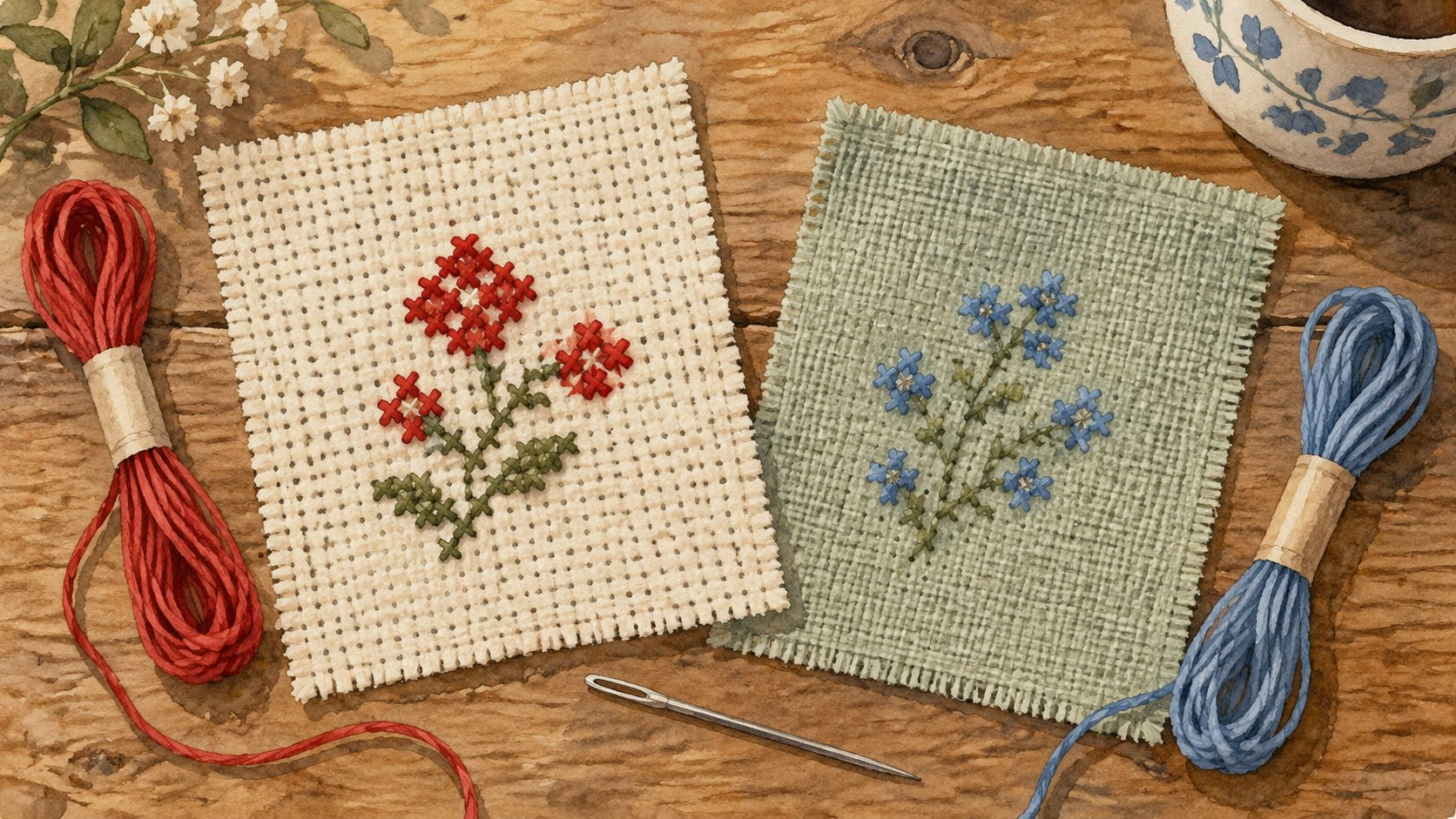
Aida and evenweave are the two fabrics cross stitch patterns are written for, and they behave differently enough that the choice changes how stitching feels and how the finished piece looks. Aida is the stiff, hole-punched cotton almost everyone learns on. Evenweave is the smooth fabric most stitchers graduate to. Neither is better in general, but one is usually better for the project in front of you. This guide covers what each fabric actually is, how their counts convert, and when each one earns its place.
The short version: 14 count aida and 28 count evenweave produce stitches the same size. Aida gives you visible holes arranged in ready-made squares. Evenweave gives you a smooth surface and you stitch over two threads at a time. Stitching your first piece? Choose 14 count aida. Comfortable stitching and want a finer, softer finish? Try 28 count evenweave.
What aida is
Aida is a cotton fabric woven with its threads grouped into blocks. Each block is one ready-made square with a clear hole at each corner, so one cross stitch fills exactly one square: the needle comes up through one corner hole and goes down through the diagonally opposite one. You never have to measure or count threads, because the grid is built into the weave itself.
Aida comes in counts from about 6 up to 22, where the count is the number of squares per inch. 14 count is the standard: most kits, books, and beginner patterns are written for it, and its holes are easy to see. 16 and 18 count give a finer, more detailed look. Lower counts like 11 make big, quick stitches that suit children and bold designs.
Aida is also stiff. It holds its shape in a hoop or Q-snap without stretching, and small pieces can be stitched with no frame at all. That stiffness is why ornaments, cards, and hooped wall pieces work so well on it.
The one real frustration is fractional stitches. Quarter and three-quarter stitches land in the middle of a block, where there is no hole. You have to push the needle straight through the fibers of the block center, which takes a sharp needle and some force. On patterns with lots of fractionals, this gets old fast.
What evenweave is
Evenweave is woven from single threads of even thickness crossing at right angles, one thread over one thread, with no blocks. The surface is smooth and uniform, and the holes are small and evenly spaced. It is usually cotton or a cotton and modal blend, and it is noticeably softer than aida, with a drape closer to ordinary clothing fabric.
Because there are no pre-made squares, you decide how many fabric threads each stitch spans. Almost everyone stitches over two: each cross covers two threads in each direction, so a stitch sits on a 2 by 2 square of threads and behaves exactly like one aida square. The common evenweave counts are 25, 28, and 32 threads per inch, and they are chosen so that over-two stitching lands on the same sizes aida stitchers already know.
Fractional stitches are the reason many stitchers switch. A quarter stitch lands in the middle of the 2 by 2 square, and because the threads there cross singly, there is a genuine hole right where the needle needs to go. No piercing fibers, no sharp needle, no fight. Backstitch flows over the smooth surface the same way.
Evenweave has two honest downsides. It frays more than aida, so the cut edges want binding before you start. And the finer weave is harder on the eyes: good light is a must at 28 count, and many stitchers add a magnifier at 32 count.
Aida vs evenweave, side by side
| Aida | Evenweave | |
|---|---|---|
| Weave | Threads grouped into blocks | Single threads, no blocks |
| Stitching unit | One block per cross | Two threads per cross, over two |
| Common counts | 11, 14, 16, 18 | 25, 28, 32 |
| Feel | Stiff, holds its shape | Softer, drapes like clothing fabric |
| Fractional stitches | Needle forced through block center | Real hole in the middle of the stitch square |
| Edge fraying | Modest | Frays more; tape or bind edges |
| Ease on eyes | Large visible holes | Fine weave; wants good light, maybe a magnifier |
| Best for | Beginners, kits, ornaments, bold full-coverage pieces | Fractionals, finer finishes, heirlooms, anything that drapes |
How the counts convert
A fabric count is threads (or blocks) per inch. Stitched over two, an evenweave behaves like a fabric of half its count, and that is the whole conversion:
| Evenweave count | Stitched over two | Aida equivalent |
|---|---|---|
| 25 count | 12.5 stitches per inch | Between 11 and 14 count |
| 28 count | 14 stitches per inch | 14 count aida |
| 32 count | 16 stitches per inch | 16 count aida |
The practical consequence: a pattern written for 14 count aida comes out the identical size on 28 count evenweave stitched over two. Same finished dimensions, same floss amounts, same strand counts. If you want a smaller result from the same chart, 32 count over two gives you a 16 count finish, about 12 percent smaller in each dimension than 14 count.
You can also stitch over one thread, where each cross spans a single thread. That doubles the density: 28 count over one gives 28 stitches per inch, which is miniature territory used for faces and fine detail, usually with a single strand of floss. Unless a pattern says otherwise, it assumes over two on evenweave.
Finished size still follows the same rule as on aida: stitch count of the design ÷ effective fabric count. The cross stitch size calculator walks through the math, and the aida count guide covers what count changes about the look, strands, and needles.
When to choose aida
Your first projects. The visible grid does the counting for you, mistakes are easy to spot and undo, and nearly every learn-to-stitch resource assumes it. The beginner's guide starts on 14 count aida for exactly this reason.
Kits and patterns with no fractionals. Most kits are designed around aida's strengths: whole crosses and backstitch on a grid. If the chart has no quarter stitches, aida's one weakness never comes up.
Anything that benefits from stiffness. Ornaments, greeting cards, bookmarks, and small hooped pieces all hold their shape better on aida without extra finishing.
Stitching with kids. 11 or even 6 count aida has holes big enough for small hands and blunt needles.
When to choose evenweave
Patterns full of fractional stitches. Detailed faces, flowing lettering, and confetti-heavy designs all use quarter stitches, and each one is painless on evenweave and annoying on aida. This alone settles the question for many stitchers.
A finer, softer finish. Even without changing effective count, evenweave's single threads disappear under the stitches more completely than aida blocks, so coverage looks smoother and more woven. Pieces meant to be handled, like cushions, table runners, and clothing, also drape far better.
Squeezing a design into a smaller space. 32 count over two shrinks a 14 count pattern by about 12 percent with no chart changes, and over one goes much further.
Heirloom work. Samplers and wedding or birth pieces traditionally live on evenweave or linen, and the fabric's softness suits work meant to last decades.
Evenweave goes by many names
Shopping for evenweave is confusing because the bolt rarely says evenweave. The common brand names, all stitching the same over-two way:
Lugana is Zweigart's 25 count evenweave, a soft blend of about 52 percent cotton and 48 percent modal with a slight sheen and clear hole definition. It is the most popular first evenweave and comes in a huge color range. You may see the same fabric sold as Brittney.
Jobelan is a 28 count cotton and modal blend (roughly 51/49) from a different maker, known for resisting wrinkles and taking dye well, which is why so many hand-dyed and variegated evenweaves are Jobelan.
Murano is the 32 count member of the same Zweigart family as Lugana, for when you want a 16 count finish over two.
Linen deserves its own mention. It is evenweave spun from flax rather than cotton, usually 28 to 36 count, stitched over two the same way. Linen costs more and its natural thick-and-thin slubs are part of the look rather than flaws. It is the traditional heirloom fabric and ages beautifully, so samplers and keepsake pieces often land here. The counting math is identical to any other evenweave.
Switching a pattern from aida to evenweave
For a pattern written for 14 count aida, buy 28 count evenweave and stitch over two. The chart, the finished size, the floss list, and the strand counts all carry over unchanged. Work backstitch over two threads so it matches the scale of the crosses, and buy the same cut size the pattern recommends, adding the usual framing margin.
Two habits make the switch smooth. Bind the cut edges with masking tape, a zigzag stitch, or fray check before the first stitch, because evenweave frays more than aida. And grid your fabric if the pattern is large: marking every tenth thread with a water-soluble pen or a running thread keeps counting honest when there are no blocks to lean on. The pattern reading guide covers how chart grids map to fabric.
Threaded's cross stitch pattern maker turns a photo into a stitchable chart with a matched DMC thread list, and you set the finished size before you convert, so you can plan for evenweave by choosing its aida equivalent: pick 14 count when you intend to stitch 28 count evenweave over two, and the size, strand counts, and floss list all come out right. The size calculator pairs well with it for the fabric math.
Questions
Is evenweave harder to stitch than aida?
A little, at first. Without obvious squares you count threads instead of blocks, and most people need a few hours before they trust their counting. Good light helps at 28 count and a magnifier is common at 32 count. Most stitchers adapt within a project or two, and many never go back to aida except for kits.
Can I stitch over one thread on evenweave?
Yes. Over one doubles the stitch density, so 28 count fabric gives 28 stitches per inch. It is used for miniature work and fine detail like faces, usually with a single strand of floss. Unless a pattern says otherwise, assume it was written for over two.
Does evenweave really fray more than aida?
Yes, noticeably. The loose single threads at a cut edge work free as you handle the fabric. Two minutes with masking tape or a zigzag stitch before you start is worth it on anything bigger than a card.
What is the difference between evenweave and linen?
Only the fiber. Evenweave is the weave: single, even threads crossing at right angles. Linen is that same weave spun from flax instead of cotton. It counts, stitches, and converts exactly like cotton evenweave, with a crisp hand and natural slubs that many stitchers love for heirloom pieces.