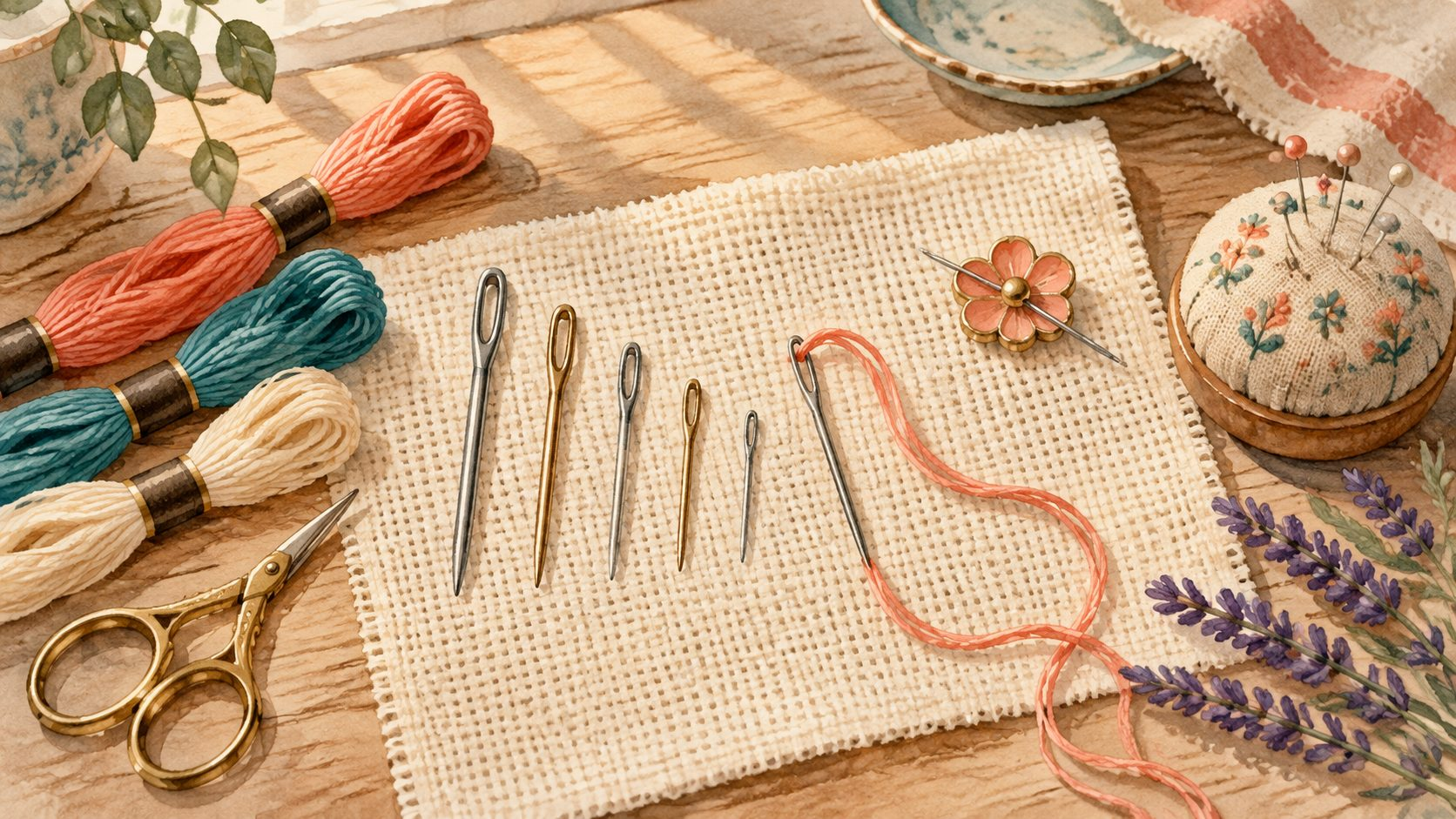
Most people grab whatever needle came in the kit. That often works, and it also explains a lot of frayed thread and uneven stitches. The right needle for cross stitch is a blunt tapestry needle, and the size follows your fabric count. This guide covers why the tip is blunt, how to read the size numbers, which size to use on each fabric, and what to do when your thread frays or your holes stretch.
Use a blunt tapestry needle. For 14 count aida, start with size 24 (or 26 if you prefer a finer needle). For 16 count, use 26. For 18 count, use 28. Remember that a higher number means a smaller needle. If your thread frays or the holes look stretched, try the next size up or down.
Why cross stitch needles are blunt
Stitch Wit explains the logic. When you cross stitch you should be parting the threads of the fabric and not piercing them, so you use a tapestry needle, which has a blunt tip. Stitcher.co.uk adds that because the holes already exist, the needle does not need to pierce the fabric, and the blunt point helps it find the right hole without splitting the fabric threads.
Better Cross Stitch Patterns makes a practical point from her own experience. Sharp needles pierce the fabric so easily that she keeps stitching without noticing the mistake, and finds it only when she stitches the next area. The blunt tip helps avoid that, and it helps you find the hole by feel. If you are working on dark fabric, where that skill matters most, see our guide to cross stitching on black fabric.
The large eye matters too. Stitched Modern says it holds cotton embroidery floss, pearl cotton, and specialty fibers, and keeps the thread from rubbing against the fabric as you stitch, which reduces wear.
How needle sizes work
Needle sizes run backward from what many people expect. Stitched Modern notes that with tapestry needles, the larger the number, the smaller the needle. A size 28 is finer than a size 24. The general rule is that the larger the holes in your fabric, which means the lower the count, the larger the needle you need.
The needle has one job, which is to open the weave so the thread passes through easily. Better Cross Stitch Patterns says if the needle is too small, the floss frays a little more each time it is pulled through. If it is too large, it can distort the small holes in even weave fabric such as aida over 18 count. Stitched Modern says the same thing from the other side: a needle that is too big pushes the fabric threads apart and makes a hole the stitching thread may not fill, while one that is too small wears the thread.
Needle size chart
Stitcher.co.uk and Stitched Modern publish the same pairing, which is also the one in the My Stitch World size guide. Treat it as a starting point.
| Aida count | Evenweave or linen over two threads | Tapestry needle |
|---|---|---|
| 6 | - | 18 |
| 8 | - | 20 |
| 11 | 22 to 27 | 22 |
| 14 | 28 | 24 |
| 16 | 32 | 26 |
| 18 | 36 | 28 |
Stitcher.co.uk says these are recommendations, not rules. The number of strands, the type of thread, and your own comfort can all push you a size finer or larger. If you are not sure what the counts mean, our aida count guide explains them.
Evenweave and linen
Evenweave and linen are often stitched over two fabric threads. Stitcher.co.uk says to pair the needle with the effective count, so 28 count evenweave over two threads behaves like 14 count. Waldev says a size 26 works well there, slightly finer than the 24 you would use on 14 count aida because the individual threads are finer. Stitching over one thread creates a much finer result and may need a finer needle than the chart suggests. Our evenweave versus aida guide covers the fabric differences.
Strands, thread type, and size
Better Cross Stitch Patterns uses size 26 almost exclusively, because she works mostly on 11 to 18 count fabric and finds it the most versatile. She keeps a few size 24 needles for when there are too many strands to thread through a 26, and for metallics or blending filament. Stitched Modern says the eye also needs to suit the thread, and Waldev points out that the needle, the fabric count, and the number of strands all work together.
Specialty threads are the usual reason to go a size up. If a thread will not slide through the eye easily, or it frays at the eye, change to a larger needle rather than forcing it. For ending threads neatly, see our guide to starting and ending thread.
Other needle types
- Tapestry needle. Blunt, large eye. The standard for counted cross stitch on aida, evenweave, and linen.
- Ball-tip tapestry needle. Stitch Wit calls these a personal game changer, because they seem to find the holes more easily than traditional tapestry needles. It is a matter of preference.
- Chenille needle. Same sizes as tapestry but sharp. Better Cross Stitch Patterns keeps a couple of size 24 and 26 chenille needles for stitching on top of stitching, such as a backstitch outline or a French knot for an eye, because a blunt tip can struggle to pierce dense stitching. Our guides to backstitch and French knots cover those stitches.
- Crewel or embroidery needle. Sharp with a large eye. Stitcher.co.uk says use one when a design is printed on tightly woven cotton or linen and the needle must pierce the fabric. The right needle depends on the fabric, not simply on whether the design is printed.
- Beading needle. Slim with a small eye, for adding beads. My Stitch World lists these as the choice for seed beads.
- Plain sewing needle. Better Cross Stitch Patterns says to walk past them. They have smaller eyes and are not designed for floss.
Signs of the wrong needle
Waldev describes how to read the signals. A needle that is too thin for the fabric does not open the hole enough, so the thread drags and frays and the needle feels fiddly in the large hole. A needle that is too thick stretches the holes and can distort the grid. Stitcher.co.uk lists uneven stitches despite consistent tension as another sign, and says that trying the next size finer or larger can make a surprising difference. Waldev adds that thread that is too long is another common cause of fraying, so check that before changing needles.
A correct needle passes through smoothly with gentle resistance, opens the hole just enough, and feels secure in your hand.
Caring for needles
- Replace rough needles. Stitch Wit says to get rid of old needles with marks or rough areas, because they damage floss and fabric. Stitcher.co.uk says to replace a needle when it becomes rough or tarnished or begins catching on the thread.
- Do not park a needle in the fabric. Both Stitch Wit and Stitcher.co.uk say it can leave a mark, especially a nickel-plated one, and make the needle hard to find safely.
- Use a needle minder. Stitch Wit suggests a magnetic minder that holds the needle on the fabric when you pause.
- Consider gold-plated needles if you have a nickel allergy. Stitched Modern notes that most needles are nickel-plated. Stitcher.co.uk says the coating wears with use.
- Expect to lose a few. Better Cross Stitch Patterns says buy a few, since needles go missing in every room.
Where sources disagree
| Question | What the sources say |
|---|---|
| Best size for 14 count | Stitcher.co.uk and Stitched Modern give 24, and Stitcher.co.uk adds 26 as a finer option. Better Cross Stitch Patterns uses 26 almost exclusively, from 11 to 18 count. Try both. |
| Package labels | Better Cross Stitch Patterns says to ignore a combo pack note such as "for 18 and 22 count fabric" and settle on the size you like. |
| Ball tips | Stitch Wit loves them. Other sources do not mention them, so treat them as optional. |
| Sharp or blunt | Blunt on open fabric, say all sources. Stitcher.co.uk adds sharp for tightly woven printed fabric, and Better Cross Stitch Patterns for working over dense stitches. |
Questions
What size needle for 14 count aida?
Size 24 is the standard starting point per Stitcher.co.uk, and 26 works too if you like a finer needle.
Is a cross stitch needle the same as a tapestry needle?
Usually yes. Stitcher.co.uk says needles sold for counted cross stitch are normally blunt tapestry needles with a large eye.
Why does my thread fray?
The needle may be too small for the fabric, or the thread may be too long, per Waldev. Try a size larger first.
Can I use a sharp needle on aida?
It will pierce the fabric threads instead of passing through the holes. Better Cross Stitch Patterns says that makes mistakes easy to miss.
Do I need different needles for different projects?
Most stitchers get by with two sizes, such as 24 and 26, and add a finer or sharper needle for special cases.
Does the number of strands matter?
Yes. More strands or specialty thread may need a size larger so the thread passes through the eye without wear.
Sources
- Stitcher.co.uk: size chart, why blunt, sharp needles for printed fabric, and signs of the wrong needle.
- Stitch Wit: pairing needles with fabric, ball tips, and needle care.
- Better Cross Stitch Patterns: tapestry, chenille and crewel needles, and size 24 and 26 advice.
- Stitched Modern: how sizes work, why the eye matters, and the size table.
- My Stitch World: needle size guide and needle types.
- Waldev: evenweave pairing, strands and coverage, and signs of a wrong needle.