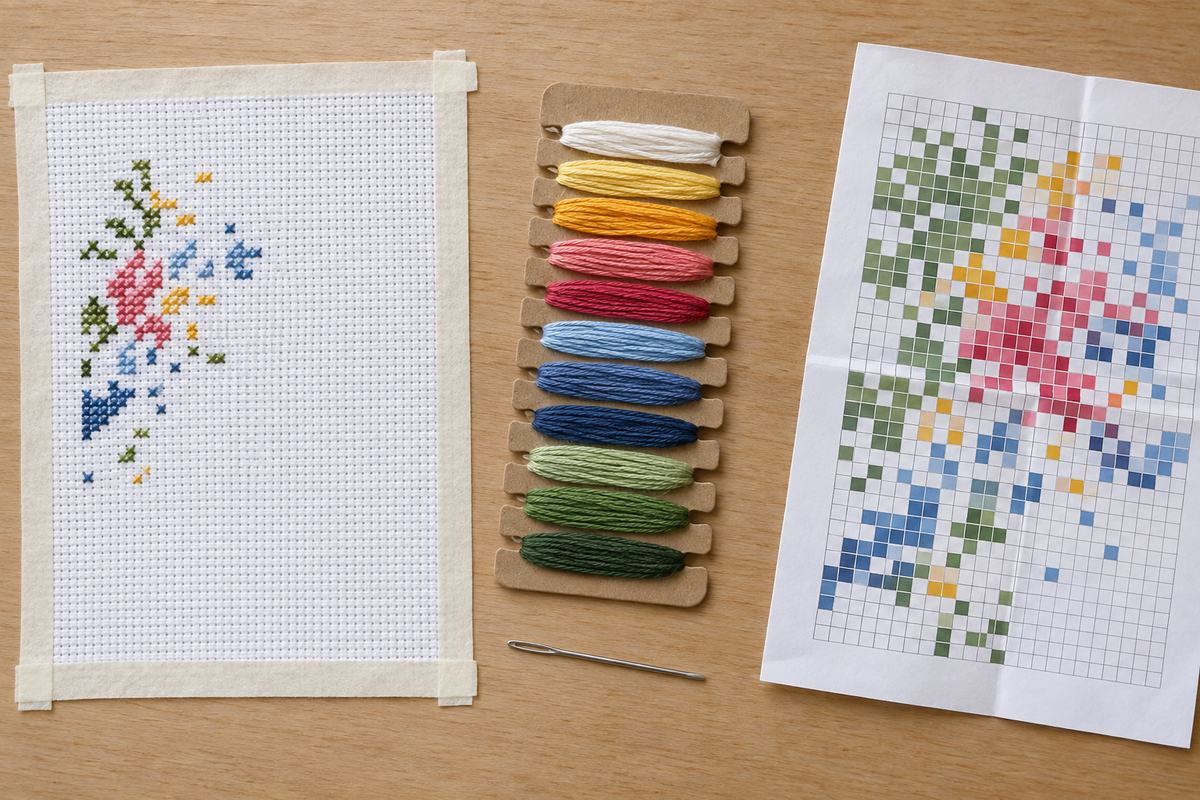
A cross stitch kit is a whole project in one box: fabric, threads, a needle, a chart and instructions, chosen to work together. For a first project that bundle is worth real money, because the kit removes the exact decisions that stop beginners before they make a stitch. But the word beginner on the box is marketing, not a guarantee. This guide covers what a good kit contains, how to read a listing before you buy, and how to pick a first design you will actually finish. Last updated November 14, 2026.
Start here: Judge a kit by what the listing tells you, not by the picture. Before you buy, you should be able to confirm the fabric count, whether the design is counted or stamped, the needle and strand instructions, and that the chart key maps every symbol to a thread. If any of those are missing, ask the seller or pick another kit.
What a cross stitch kit includes
Cross Stitch Academy, a teaching site, defines the standard bundle: the pattern, the threads, the fabric, the needles and sometimes the hoop, all in one package. The point of a kit for a beginner is economic as much as convenient: you do not have to buy every color of floss before you know whether you like the craft.
Caterpillar Cross Stitch, a UK kit maker, describes what a well-made beginner kit looks like from the inside: pre-sorted DMC threads on a card holder, Zweigart Aida already cut to size for the project, the right needle for that fabric, a color printed pattern and step-by-step instructions. Pisgah Needleworks, a US needlework shop, adds that most of its starter kits also include a hoop, so you can be stitching within minutes of opening the box.
Check the contents list before buying. Cross Stitch Academy warns that some kits skip items, and vendors normally list exactly what is in the package. A kit missing its needle or chart is not a bargain at any price.
Counted or stamped: know which you are buying
Every kit is one of two types, and the difference shapes your whole first project. In a counted kit, you start with blank fabric and a separate chart, find the center, and count squares to place each stitch. In a stamped kit, also called printed, the design is printed on the fabric and you stitch over the printing, like paint by numbers with thread.
Caterpillar Cross Stitch's verdict is that both are genuinely beginner friendly, with different strengths: stamped feels reassuring because you can see where every stitch goes, while counted gives a cleaner finished piece, a reusable chart and the counting habit every future pattern will need. Stitch by Count, a cross stitch education site, is stricter: never infer the method from the finished picture, and do not buy at all if the listing does not say which method the kit uses, because that uncertainty affects the entire project.
Our stamped vs counted guide goes deeper on the choice.
Read the listing like a checklist
Stitch by Count's approach is the most rigorous: a beginner label proves nothing, and you should verify a short list of facts before committing.
- Fabric type and count. "Fabric included" is not enough. The count is the number of stitches per inch: 14-count Aida has 14 blocks per inch, and Pisgah Needleworks notes that a higher count like 18 means more detail but more stitches and more time.
- Chart and key. For counted kits, every symbol on the chart should map to a thread color in the key, and similar symbols should be easy to tell apart. A floss list alone is not enough if you cannot connect it to the chart.
- Needle and strands. The kit should include a needle or name one, and say how many of the six floss strands to use. Caterpillar Cross Stitch specifies a blunt-tipped tapestry needle, size 24 for 14-count Aida; the blunt tip slides between fabric threads instead of piercing them.
- Finishing space. Compare the design dimensions with the supplied fabric dimensions. Stitch by Count's rule: the fabric must extend beyond the design far enough for your intended finish, and if the listing gives only the design size, ask for the fabric size.
Pick a design you will finish
Caterpillar Cross Stitch's design advice for a first kit is concrete. Keep it small: a design that fits a 4 to 6 inch hoop, roughly under 50 by 50 stitches, finishes in a sitting or two and still feels satisfying. Watch the color count: three to seven colors keeps stitching manageable, because every extra shade is more thread swapping. Stick to full cross stitches only; fractional stitches and French knots can wait for your second or third piece. And pick a subject you love, because motivation is what actually gets a first project finished.
Fourteen-count Aida is the standard beginner fabric for a reason: the holes are easy to see, the grid is easy to count, and white or cream gives the clearest contrast. Lower counts like 6 or 8 suit children because the squares are bigger. Our Aida count guide and evenweave vs Aida guide cover fabric in more depth.
Kit or separate supplies
For a first project, the kit wins. Caterpillar Cross Stitch's reasoning is that sourcing fabric, threads and a needle separately is exactly where beginners get overwhelmed and quit, while a kit guarantees the parts work together. Pisgah Needleworks points out the alternative costs almost nothing though: their founder's first project was a piece of Aida, a cheap hoop, needles and two skeins of floss, under five dollars total, and it worked.
Once you have a few finishes behind you, buying supplies separately gives more flexibility and works out cheaper per project. That is also when a pattern maker becomes useful: our free cross stitch pattern maker guide covers generating your own charts, and cross stitch for beginners walks through the first stitches.
Where sources disagree
Stamped or counted for a first project. Caterpillar Cross Stitch says both are fine and uses counted for its own kits, arguing counted builds the habit everything else relies on. Stitch by Count says choose the method you prefer, but refuse any kit that leaves the method unclear. The shared ground: a clear stamped kit beats a vague counted one.
Is a hoop essential? Pisgah Needleworks includes a hoop in most starter kits and treats it as part of the out-of-box experience. Caterpillar Cross Stitch sells the hoop as an optional extra and says a small 4 to 6 inch hoop is worth adding but not mandatory. If your kit lacks one, stitching in hand works; a hoop just holds the fabric taut.
How small is small enough? Caterpillar Cross Stitch's rule of thumb is under 50 by 50 stitches and three to seven colors. Cross Stitch Academy simply says smaller, simpler designs with not too many colors and shades, and notes that simple does not mean unpretty. Both agree the first piece should end quickly, in a win.
FAQ
What should a beginner cross stitch kit include? Fabric, pre-sorted threads, a tapestry needle, a printed chart and clear instructions, per Caterpillar Cross Stitch's kit standard. A hoop is a common extra but not universal, so check the contents list.
What count fabric is best in a first kit? Fourteen-count Aida is the standard recommendation: visible holes, an easy grid and good detail. White or cream is easiest to count on.
How many strands of floss do I use? Follow the kit's instructions. The common setup on 14-count Aida is two strands for cross stitches and one for backstitch, separated from the six-strand skein.
Are cheap kits worth it? Check what they skimp on. Caterpillar Cross Stitch warns that flimsy fabric with an uneven grid makes counting harder from the first row, and unbranded floss tends to fray and tangle. Pre-sorted, named-brand threads are worth paying for.
Kit or supplies for a total beginner? Kit, for the first one. It guarantees the materials match. Buy supplies separately once you know what you like.
Sources
This guide draws on the following sources. Where their advice differs, it says so above rather than blending them.
- Caterpillar Cross Stitch, UK kit designer and seller: Beginner Cross Stitch Kits: How to Choose Your First Kit, caterpillarcrossstitch.com. Source for the kit contents standard, the counted vs printed comparison, the size and color rules of thumb, 14-count Aida guidance and the kit-vs-supplies verdict. This is a seller's guide and its advice stands on its own.
- Stitch by Count, cross stitch education site: How to Choose Your First Beginner Cross-Stitch Kit, stitchbycount.com. Source for the pre-purchase verification checklist: method, fabric count, chart and key, needle and strands, and finishing space.
- Cross Stitch Academy, teaching site: Cross Stitch Kits for Beginners, crossstitchacademy.com. Source for the definition of a kit, the contents-check warning and the simple-design advice.
- Pisgah Needleworks, US needlework shop: What Every Beginner Should Know Before Buying a Cross Stitch Kit, pisgahneedleworks.com. Source for the hoop inclusion, the stitch-per-inch explanation of fabric count, and the five-dollar supplies alternative.