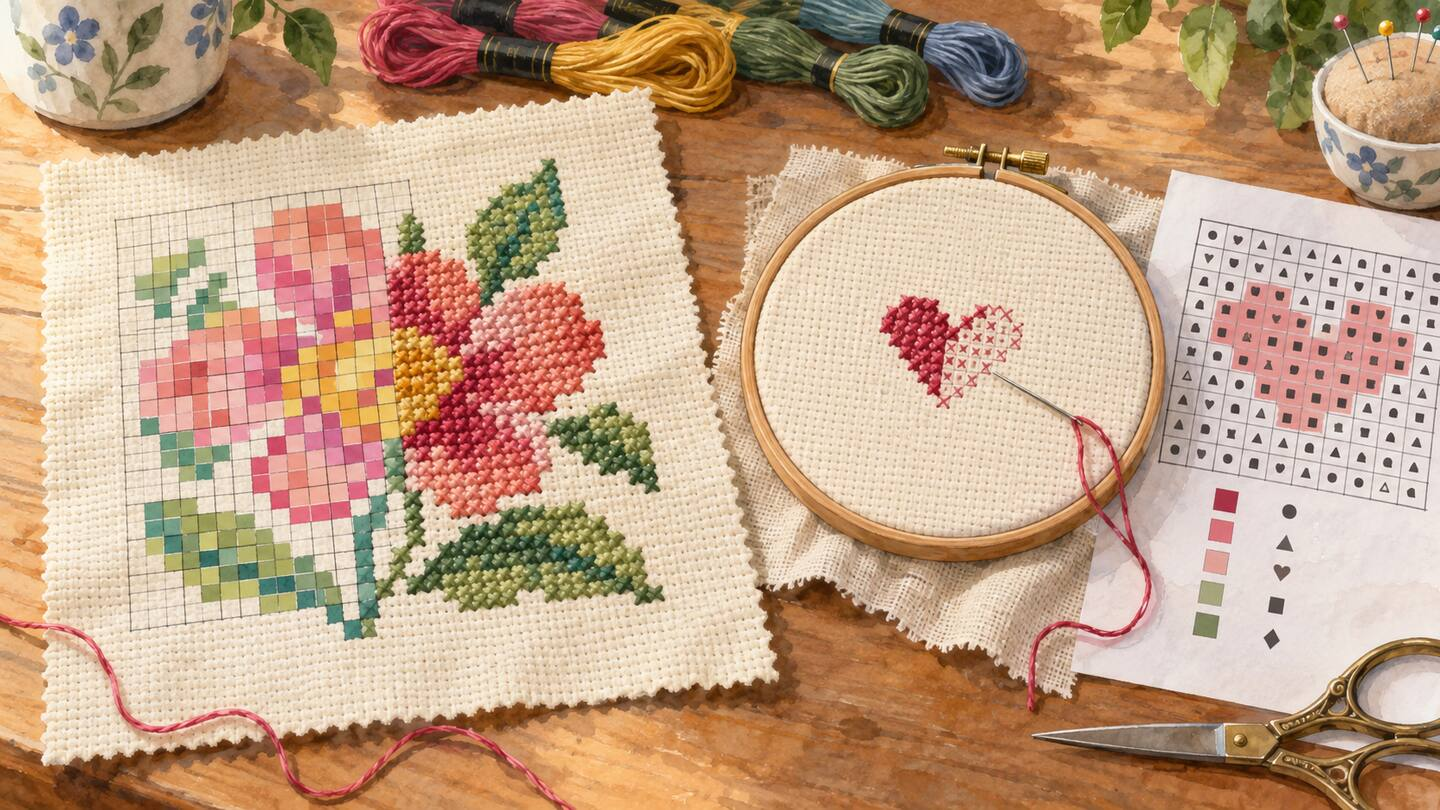
Every cross stitch kit is one of two kinds: stamped or counted. A stamped kit prints the whole design onto the fabric and you stitch over the print. A counted kit gives you blank fabric and a chart, and you count each stitch into place yourself. Neither is better in general, but one is usually better for the project and the evening in front of you. This guide covers how each method actually works, what the printed ink does in the wash, where the design libraries differ, and how to choose.
The short version: stamped is easier to start, counted is easier to love. Stamped needs no chart reading at all, so it suits total beginners, kids, gifts on a deadline, and stitching in front of the TV. Counted has a steeper first hour, then opens up the entire world of modern patterns, including anything you make yourself. If you plan to stitch for years, learn counted. If you want to be stitching five minutes from now, start stamped.
What stamped cross stitch is
In a stamped kit, the fabric arrives with the full design already printed on it. Modern kits print a dense pixel grid onto aida: every stitch position is a small block of bright, high-contrast color with a tiny letter or number inside it. That symbol maps to a floss code in the kit legend, so you match the symbol on the cloth to the matching skein, stitch over the printed cell, and move on. There is no chart to read and nothing to count. You are effectively stitching on top of a chart that was printed straight onto the fabric.
The printing is deliberately brighter than the real floss colors. That is not a mistake: the vivid ink makes cell boundaries easy to see in any light and keeps the symbols legible over a project that might run twenty thousand stitches. The ink is engineered to wash out completely once you finish, which is why the fabric must stay dry until the last stitch is in.
One note on vocabulary: older and vintage stamped goods, like printed table linens and classic embroidery kits, work a little differently. There the design is stamped as outlines you cover with stitches rather than wash away. The modern washable pixel-grid kit is what you will meet in almost every online shop today, and it is what this guide means by stamped unless it says otherwise.
What counted cross stitch is
In a counted kit, the fabric is completely blank. You get a separate chart, on paper or as a PDF, where every square of a grid holds a symbol that stands for one cross stitch in one color. You find the center of the chart and the center of the fabric, count squares outward, and place each stitch where the chart says it belongs. Nothing is printed on the fabric, so when you finish, there is nothing to wash away.
Counted is the format the modern craft runs on. Nearly every independent designer publishes counted patterns, because a chart can encode anything: fractional stitches, blended threads, subtle shading, backstitch detail. A printed cell grid cannot carry that information. It is also the format any pattern-making tool produces, including charts made from your own photos.
The first counted project asks for twenty to thirty minutes of patience up front: learning the legend, finding the center, and trusting your counting. After one or two projects the chart reading goes automatic, and most stitchers stop noticing it entirely.
Stamped vs counted, side by side
| Stamped | Counted | |
|---|---|---|
| Fabric | Design pre-printed as a colored pixel grid | Blank; only the weave shows |
| What you follow | The print on the cloth | A separate chart |
| Time to first stitch | About five minutes | Twenty to thirty minutes the first time |
| Mistakes | A missed cell is obvious against the print | A miscount can shift a whole section |
| Design library | Narrower; skews traditional florals, cartoons, licensed characters | Vast; nearly every modern designer |
| Stitch types | Full crosses only, almost always | Fractionals, backstitch, blends, anything |
| Finishing | Needs a wash to remove the ink | Optional gentle wash for handling marks |
| Price | Usually $15 to $40 for a beginner kit | About the same at entry level |
| Best mood | Passive, podcast-and-TV stitching | Focused, puzzle-like flow |
The wash: what happens to the print
The most common worry about stamped kits is that the bright printed grid will show through the finished piece. With modern kits it does not, as long as you follow the kit's washing instructions. The standard routine is a long soak in cool water: around 30 degrees Celsius (86 degrees Fahrenheit) for about three hours is the usual guidance, with a drop of mild detergent if you like, then a gentle rinse and flat dry. Some kit makers say thirty minutes in lukewarm water is enough. Either way, the ink lifts out completely, leaving only your stitches on clean fabric.
Three rules make the wash work. Keep the piece dry until you are finished stitching, because the ink dissolves on contact with water, including sweaty hands over long sessions if your kit uses a very soluble ink. Keep the soak water cool, since hot water can set some printed inks instead of releasing them. And never scrub or wring: press the water out gently and lay the piece flat on a towel.
A properly washed stamped piece frames as cleanly as a counted one. The transformation from the busy printed canvas you have held for weeks to a clean finished piece is, for many stitchers, the most satisfying moment of the project.
Design selection is the real fork
Ease differences fade after a project or two. What never fades is the design library. The modern cross stitch renaissance, the independent studios filling Etsy and online shops with contemporary patterns, publishes almost entirely in counted format. The reason is technical: a chart can specify quarter stitches, three-quarter stitches, backstitch lines, and blended colors, and none of that prints cleanly as colored cells on cloth.
Stamped kits come mostly from mass-market manufacturers and budget imports, so the catalog leans toward traditional florals, sentimental quotes, cartoon animals, and licensed children's characters. There is a small but growing wave of independent stamped designers improving things. Still, if you have ever seen a stitched piece online and thought that is exactly what I want to make, it was almost certainly a counted pattern.
Making your own designs is counted territory too. A photo converted to a stitchable chart is, by definition, a counted pattern: blank fabric plus a chart with a floss list. The free pattern maker guide shows what that looks like in practice.
When to choose stamped
Your very first project, especially with kids. There is no chart skill to learn, and a stitch cannot land in the wrong square because the square is printed in front of you. Children under about ten do noticeably better with stamped; chart reading frustrates young stitchers before the stitching itself does.
Pure relaxation stitching. If the goal is to keep your hands moving through a movie, an audiobook, or a conversation, stamped removes the last bit of mental bookkeeping. Many experienced stitchers keep a stamped project on the side for exactly these evenings.
Low light and tired eyes. With no chart to glance at, you can stitch in dimmer conditions, and the bold printed cells are easier to track than symbols on paper.
A quick gift on a deadline. When finishing fast matters more than design range, a stamped kit gets a beginner to a completed piece with the least friction.
When to choose counted
You want the modern design world. Independent designers, trending patterns, and anything subtle or detailed live in counted format. So do fractionals and backstitch, which are what give detailed pieces their character.
You like a puzzle. Counted stitching engages the same part of the mind that enjoys sudoku or knitting from a written pattern. If that sounds like rest rather than work, counted will feel richer within a few sessions.
You want to stitch your own photos. Any custom pattern starts as a chart. Threaded's pattern maker turns a photo into a counted chart with a matched DMC floss list, and you set the finished size before converting.
You care about the framed result. Counted pieces have no ink to manage at all, and the full stitch vocabulary gives cleaner detail. Both methods frame well after a proper wash, but counted skips the wash question entirely.
If you are new and genuinely torn, start with a small counted kit: under three thousand stitches, fewer than ten colors, on 14 count aida. The beginner's guide walks through the whole first project, and the aida count guide explains fabric choice. Learn the harder method first and stamped will feel effortless if you add it later.
What 11CT, 14CT, and 16CT mean
Kit listings, especially stamped ones, label fabric with a CT number. CT is short for count: the number of fabric squares per inch. It sets the size of every stitch and therefore the size and detail of the finished piece.
| Fabric | Squares per inch | Look | Usual strands |
|---|---|---|---|
| 11CT | 11 | Bold, chunky, classic pixel look; fastest to finish | 3 strands |
| 14CT | 14 | The standard balance of detail and ease; best for beginners | 2 strands |
| 16CT | 16 | Finer, more detailed, smaller result from the same design | 2 strands |
The same design comes out physically larger on 11CT than on 16CT, because each stitch covers more fabric. Strand counts in the table are the kit norms for full coverage. Count applies to both methods: stamped kits are usually printed on 11CT or 14CT aida, and counted stitchers choose counts the same way. The size calculator does the finished-size math for any count, and evenweave vs aida covers the other big fabric choice.
Can you switch between the two?
From counted to stamped, not practically. Modern stamped kits are printed on industrial equipment that lays a dense, washable pixel grid onto fabric. A home printer cannot reproduce that on aida, so converting a counted chart into a stamped canvas costs more than buying a stamped kit.
From stamped to counted, you already have everything you need: the printed grid on a stamped kit is itself a chart, so a stitcher who later learns counted technique will find the skill transfers immediately. That is another reason stamped makes a gentle on-ramp. The one skill stamped never teaches is reading a separate chart, and the pattern reading guide covers exactly that when you are ready.
Threaded's cross stitch pattern maker turns any photo into a counted chart with a matched DMC thread list, and you set the finished size before you convert, so the chart comes out at exactly the scale you want to stitch. If you have only ever done stamped kits, a small custom counted pattern is the most rewarding way to try the other side.
Questions
Is stamped cross stitch easier than counted?
In the first hour, clearly yes: no chart, no counting, no center finding, and you can be stitching within five minutes of opening the kit. After a project or two the difference mostly disappears, because chart reading becomes automatic. What remains is a style difference: stamped for passive, low-light, TV-friendly stitching, counted for a focused, puzzle-like session and a far bigger design library.
Will the printed pattern show on my finished stamped piece?
Not with a modern kit washed correctly. The print is water-soluble and lifts out in a cool soak, around 30 degrees Celsius for up to three hours or per your kit's instructions. Keep the fabric dry while stitching, keep the wash water cool, and never wring or scrub. Older vintage stamped linens are different: their printed outlines were meant to be covered by stitches, not washed away.
Can children do counted cross stitch?
Under about ten, stamped kits work better because chart reading frustrates young stitchers. From around ten up, kids who enjoy puzzles often take to counted faster than adults. Start either age on 11CT or 14CT fabric so the holes are easy to see.
Do stamped and counted kits cost the same?
At entry level, yes: both typically run $15 to $40 for a small beginner kit with fabric, floss, needle, and instructions. Premium counted patterns from independent designers can cost more because of design licensing, but the floor is the same for both methods.