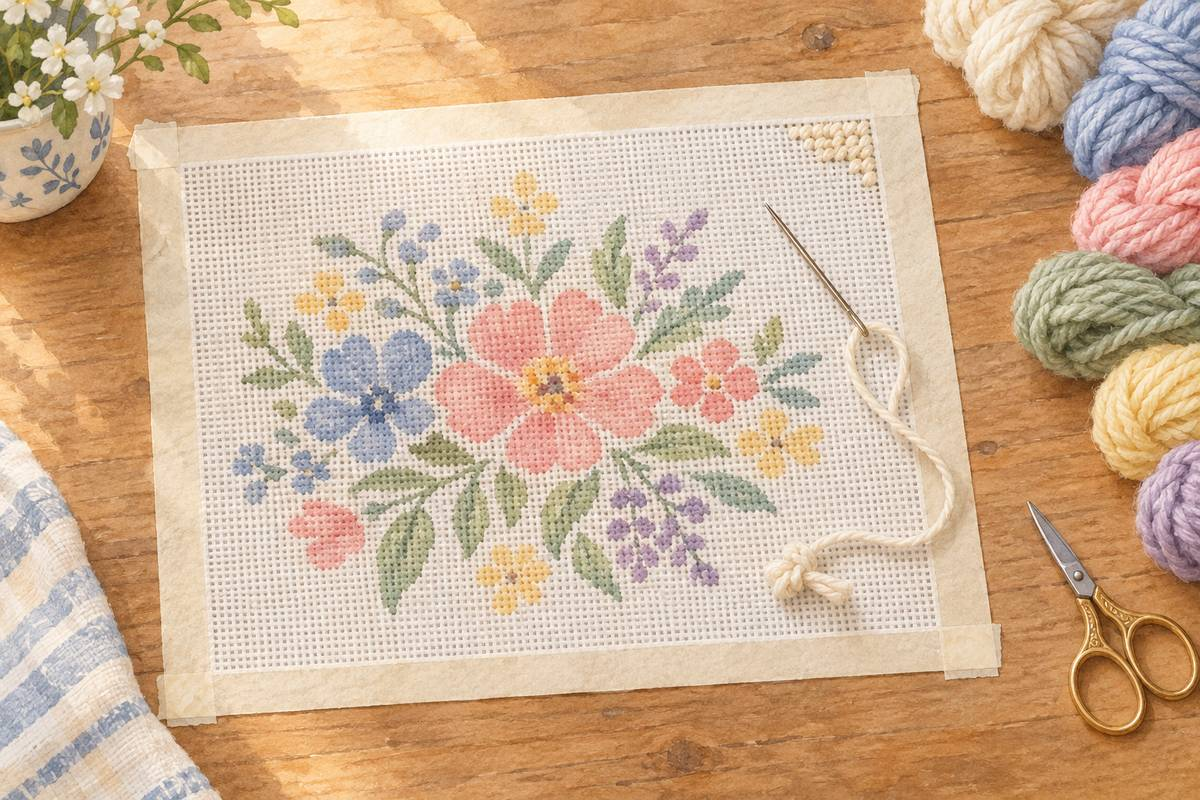
The canvas is taped, the thread is cut, and then the question every beginner hits: where does the first stitch actually go? Teachers and kit makers give three different answers - a corner, the center, or wherever the biggest block of color sits - and each answer has a reason behind it. This guide lays out who says what, when each starting point makes sense, and how the answer changes for a charted design on blank canvas. Last updated October 29, 2026.
Start here: On a painted canvas, most kit makers say to start in the upper right corner of a large area of color (upper left if you are left-handed, by one account) and work from there; it barely matters where, as long as you start. On a charted design worked on blank canvas, find and mark the center first and count out from it. Stitch a large, light-colored area first to build confidence and keep dark lint off pale threads.
The short answer
Poppy Monk, a kit seller, reassures beginners that it does not really matter where you begin a needlepoint canvas, especially on a first project, as long as you make a start, though it calls the top right corner of the design a generally good option. Needlepoint.com, also a seller, gives the standard version of that advice: after securing a waste knot, you can start stitching anywhere you like, but it recommends the upper right-hand corner of a large area of color. Modern Mesh, a kit seller, ties the corner to handedness: if you are right-handed and using the continental stitch, start in the upper right-hand corner of the canvas or of the color you are stitching; left-handed stitchers start in the upper left instead. Floss Field's starting guide describes the same geometry from the row's point of view: start at the right-hand end of the first row and work it from right to left, coming up at the lower left of each intersection and down at the upper right.
Why the upper right? Starting there and working right to left keeps each new stitch out from under your working hand and matches the natural diagonal of the tent stitch, which every one of these guides teaches as lower-left-to-upper-right. The corner advice assumes a painted or printed canvas, where the design is already in place and positioning is not in question.
Which color to stitch first
Two practical rules recur across the sources. First, pick a large area of color: Needlepoint.com and Poppy Monk both steer beginners to a big block, and Unwind Studio, a seller, suggests starting right in the center of the design or picking a large, solid block of color to build confidence. Well Whisk adds a strategy note: if the design has a large background, some stitchers prefer to start there rather than in the main motif, because it works as a comfortable warm-up zone before the detailed areas. (Once you are past your first piece, the order of background versus foreground becomes its own decision - our background first or last guide covers it.)
Second, stitch light colors before dark. Modern Mesh recommends starting with the lighter colors in the design because they are less likely to pick up lint or dye from darker threads as you handle the canvas. It also suggests cutting thread about fingertip-to-elbow length, long enough to make progress but short enough to resist tangling.
When to start in the center
A rival school starts in the middle. Unwind Studio's beginner stitch guide says it always recommends starting right in the center of the design and working your way out, or picking that large solid block of color. Designer Abigail Cecile explains the center start's real purpose in her charted-pattern tutorial: starting in the center of the design ensures the stitching ends up centered on the canvas without measuring and positioning the first stitch. She also sequences within a design: on her monogram patterns, she stitches the letter itself before the floral and decorative elements around it.
Well Whisk notes one tool that matters more for center starts: a laying tool keeps background threads flat and even when you begin in the middle of things, and it suggests a stitch guide - the plan showing the full design in color - is a worthwhile beginner investment for deciding which sections to stitch in which order. Our laying tool guide explains how to use one.
Charted canvas: mark the center first
On a painted canvas the starting place is a preference; on a charted design stitched on blank canvas it is structural. Floss Field's guide is explicit: a chart on blank canvas is counted out from a starting place, and the center is one such place. Its method: mark the center before the canvas goes on a frame, when marking is much easier (it credits one designer for that timing). If the chart's center falls on a hole, thread a needle with a short length of thread, tie a big knot in the end and take the needle down through that hole so the knot sits on top; if the center falls on threads, make a small stitch over the intersection. Leave the marking thread in until the first real stitches are made, then remove it. From there, count out from the marked center to the right-hand end of the first row and begin. Well Whisk likewise says chart work starts by finding the center of the chart and the center of the canvas. Our chart reading guide covers how to find the center your chart calls for.
Anchoring that first thread
Wherever the first stitch lands, the thread behind it needs securing. Woolfloss, a shop blog, teaches the waste knot placed to the left of where you will start: the knot sits on the front of the canvas, you stitch toward it over the tail on the back, then pull up and cut it once secure. The Detroit Institute of Arts' Stitch Club Detroit instructions for its museum canvas teach the same waste knot anchor, snipping the knot once the stitches have locked the tail. Well Whisk places its waste knot about an inch from where the first stitches will land. Modern Mesh skips the knot entirely: it has you hold a short tail against the back with a finger while the first few stitches pass over it and anchor it. Our thread starts and ends guide compares all the anchoring methods and when each fits.
Where sources disagree
Corner or center. Unwind Studio always recommends the center, Abigail Cecile starts centered designs in the middle, and chart work generally counts from the center (Floss Field, Well Whisk). But Needlepoint.com, Poppy Monk and Modern Mesh all steer painted-canvas beginners to a top corner of a large color area. The two camps are answering slightly different questions: the center camp cares about placement and balance of the design on the canvas, the corner camp cares about an easy, consistent first row. On a painted canvas either works.
Where left-handers start. Modern Mesh says left-handed stitchers start in the upper left-hand corner. Well Whisk reports an official instruction set that puts left-handed stitchers in the lower left-hand corner instead. If you are left-handed, treat the exact corner as a suggestion; the principle is to mirror the right-handed geometry so you stitch away from your working hand.
Whether it matters at all. Poppy Monk and Needlepoint.com both say you can start anywhere, then immediately recommend the upper right corner of a large color area, while Unwind Studio says it always recommends the center. The honest summary of the sources: on a painted canvas the starting point is a confidence and convenience choice, not a correctness one; on a charted canvas it is a counting anchor and must be found, not chosen.
Common mistakes
- Starting a charted design without marking the center first, so the finished stitching drifts off position on the canvas (Floss Field, Abigail Cecile).
- Marking the center after the canvas is already on the frame, when it is much harder to do (Floss Field, crediting a designer).
- Cutting the marking thread out before the first real stitches replace it as a reference (Floss Field).
- Starting with the darkest colors and transferring lint or dye to pale areas worked later (Modern Mesh).
- Choosing a small, fiddly detail as the very first area instead of a large block of color that builds rhythm (Needlepoint.com, Unwind Studio).
- Cutting thread longer than fingertip-to-elbow, which tangles more easily (Modern Mesh).
FAQ
Where do I start stitching on a painted needlepoint canvas?
Anywhere works, say Needlepoint.com and Poppy Monk, but both suggest the upper right corner of a large area of color. Modern Mesh puts right-handed stitchers in the upper right and left-handed stitchers in the upper left.
Should I start in the center?
Unwind Studio always recommends starting in the center and working out, and Abigail Cecile starts centered designs there so the stitching lands centered on the canvas. It is a choice on painted canvas, and the norm for charted work.
How do I start a charted design on blank canvas?
Find the center of the chart and the canvas, mark the canvas center with a knotted thread or small stitch before framing, and count out to your first stitch from there (Floss Field, Well Whisk).
Which color should I stitch first?
A large block of color for an easy rhythm (Needlepoint.com, Unwind Studio), and lighter colors before dark so pale threads stay clean (Modern Mesh). Some stitchers warm up on the background first (Well Whisk).
Do I need a knot to start?
Not in the fabric. Woolfloss and the Detroit Institute of Arts instructions use a waste knot on the front that gets snipped later; Modern Mesh anchors by holding the tail under the first stitches. Either is fine.
Sources
- Needlepoint.com - Starting Your Needlepoint Journey: A Beginner's Guide (a seller; start anywhere, upper right corner of a large color area recommended)
- Poppy Monk - How to Needlepoint (a kit seller; it barely matters where you start, top right is a good option)
- Modern Mesh - Beginner's Guide to Needlepoint (a kit seller; handedness corners, light colors first, thread length)
- Unwind Studio - Basic Needlepoint Stitches for Beginners (a seller, May 17, 2023; start in the center or a large solid block)
- Well Whisk - How to Start a Needlepoint Canvas (a stitcher's blog, August 2026; corner and center guidance, background warm-up)
- Floss Field - How to Start Needlepoint (a needlework guide site; marking the center for charts, right-to-left first row)
- Abigail Cecile - How to Stitch a Charted Needlepoint Pattern (a designer's tutorial; start in the center to keep the design centered)
- Woolfloss - How to Start Needlepoint: Step-by-Step Tutorial for Beginners (a shop blog, April 2025; the waste knot placed left of the start)
- Detroit Institute of Arts - Instructions for DIA Canvas (a museum's Stitch Club Detroit instructions; the waste knot anchor)