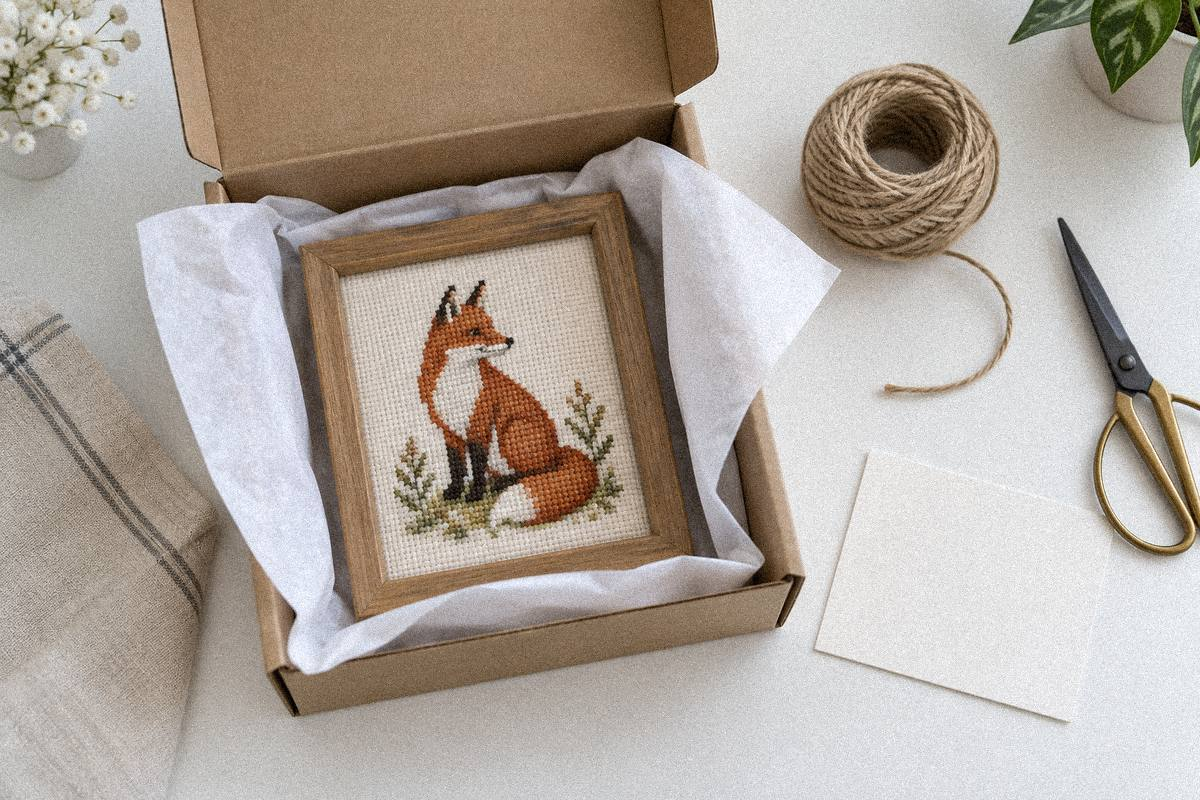
There is a real market for cross stitch on Etsy, both for finished pieces and for PDF patterns, but the sellers who do well are not simply the best stitchers. They are the ones who pick the right model for their time, stay on the right side of copyright, price with the fees in mind, and treat the listing photo as the product. This guide covers both selling models honestly, including what the money actually looks like. Last updated November 11, 2026.
Start here: Decide which model fits you. Finished pieces are slow to make and sell at craft-fair prices, so keep them small and giftable. Patterns are digital: do the work once and sell it repeatedly, but you need original designs and a catalog of ten or more before the shop looks trustworthy. Either way, never sell work based on someone else's pattern or art without a license.
Two ways to sell
Finished cross stitch means framed pieces, hoop art and custom commissions sold to people who want something handmade but do not stitch themselves. The Stitchery Corner's seller guide is blunt about the economics: the time a quality piece takes is large relative to what most buyers expect to pay for wall art, and no pricing trick makes that disappear. Finished work sells best when it is small, charming and clearly giftable.
PDF patterns are the opposite model: no shipping, no inventory, no returns. StitchLark's pattern-selling guide cites a publicly tracked experiment by Lord Libidan in which a store with ten patterns earned about $669 per year in profit, and adding one new pattern per month pushed each pattern's average sales from 4 to 8 units annually. Not quit-your-job money on day one, but a catalog business that compounds if you keep publishing.
Copyright comes first
This section decides whether your shop survives, so read it before the pricing sections. Cross stitch patterns are copyrighted works, and buying a pattern does not give you the right to sell pieces stitched from it unless the designer's terms explicitly say so. Some designers include a commercial use license; most do not. The Stitchery Corner is direct: selling finished work from a pattern without the right license is infringement whether the pattern came from a major publisher or a small independent designer. If you want to sell finished pieces, stitch your own designs or patterns with explicit commercial licenses.
For pattern sellers, StitchLark's rule is original work only. Converting someone else's photo, tracing a character, or running a copyrighted image through a pattern maker and listing the result gets shops shut down, and Etsy actively removes listings for IP violations. Patterns designed from scratch, converted from your own artwork or photographs, or built on public domain imagery are the safe paths. Our cross stitch copyright guide covers the pattern side in full detail.
What actually sells
For finished pieces, The Stitchery Corner finds the consistent winners share a clear, identifiable buyer: cats and dogs in a charming style, botanical and floral subjects, home-themed motifs, seasonal pieces, personalized names and dates, and anything with an obvious gift-giving identity like weddings and new homes. Small and medium pieces outsell large ones because buyers can imagine them in their homes, and simple designs with clear subjects consistently outperform technically complex pictorial work that impresses stitchers but has no obvious buyer.
For patterns, StitchLark's advice is to pick a niche. A shop with ten floral patterns, three game characters and a random cat gives buyers no reason to browse; ten patterns in one cohesive style is worth more than thirty in ten styles. Niches that do well include modern minimalist, pet portraits, cottagecore and botanical, original fan art, snarky sayings and seasonal collections. Keep palettes to roughly 10 to 30 colors, because more than that asks the buyer to purchase a mountain of floss before starting.
Pricing finished pieces
The honest math, per The Stitchery Corner: a small framed piece that took 15 hours to stitch, priced at a fair hourly rate plus materials and fees, lands at a price that surprises buyers used to printed art. The workable strategies are to focus on pieces you can finish in 5 to 15 hours, choose smaller formats like a 4x4 or 5x5 hoop, and use quality framing that adds perceived value at modest cost. Their observed market bands: around 20 to 60 pounds for smaller pieces, 60 to 150 for medium work, with very large and complex pieces better suited to direct commission than marketplace selling.
Pricing patterns and fees
Most cross stitch patterns on Etsy sell between $3 and $12, with large or complex designs reaching $15 to $20. StitchLark cites Lord Libidan's data suggesting that up to about $18, higher prices do not significantly reduce purchases, so pricing at $1 to $2 only signals low quality while the fees eat you alive. The 2026 fee stack per sale: a $0.20 listing fee, a 6.5 percent transaction fee, and 3 percent plus $0.25 for payment processing. On a $5 pattern that is $0.93 in fees and $4.07 kept; on a $10 pattern, $1.15 in fees and $8.85 kept. The percentage hit softens as the price rises, which is one more reason not to race to the bottom.
Listings and photos
On Etsy the photograph is the product, and both sources treat it as the single biggest sales factor. Buyers cannot touch the fabric or judge the finish in person. The Stitchery Corner's rules: indirect natural daylight, not direct sun; a clean white, cream, gray or wooden background; the piece properly framed and backed; the full piece as the primary image; detail shots that show stitch quality; and a lifestyle shot of the piece hanging in a real room, which dramatically increases click-through. A modern phone in good light beats a professional camera in bad light. Our photography guide has the full setup.
For search, both sources say the same thing: use the exact words a buyer would type. 'Cross stitch fox framed art' beats 'cute animal artwork', and a pattern title should read like 'Wildflower Bouquet Cross Stitch Pattern PDF, Botanical Floral Design, Instant Download' rather than 'Pretty Flowers Pattern #7'. Use all 13 tags, mixing broad terms with specific ones, and check Etsy's search autocomplete for what people actually type. For pattern listings, StitchLark adds that mockup templates showing the design stitched and framed are not optional: they are the difference between 2 sales and 200, and a screenshot of your charting software is the fastest way to look amateur.
What a pattern PDF needs
StitchLark lists the community's professional standards, and missing pieces turn into bad reviews that tank shop visibility. A color chart with a unique symbol per DMC color, printable at a readable size with gridlines every 10 stitches and overlap between pages. A complete floss key with DMC number, symbol, color name and the stitch count per color, because that count tells the buyer how many skeins to buy. Pattern dimensions in stitches, the recommended fabric count (14-count Aida is the safe default) and the finished size at that count. A photo or quality mockup of the finished design. And Pattern Keeper compatibility, which catches newer sellers off guard: a growing share of buyers will not purchase a pattern that does not load in the app, so test the exported PDF in it before listing. Our software comparison covers the charting tools that export clean PDFs.
One more from StitchLark's mistake list: test-stitch your own pattern, or have someone else stitch it, before selling. Symbols that look too similar, colors that blend on fabric, and dimensions that fit no standard hoop are all things you only catch with a needle.
First sales and reviews
New shops face the chicken-and-egg problem: buyers are reassured by reviews, but you need buyers to get reviews. The Stitchery Corner suggests competitive early pricing to attract first buyers, then raising prices as the review count grows, plus a friendly follow-up message a week after delivery inviting a review and offering a small repeat-buyer discount. Etsy's algorithm rewards conversion and reviews with better placement, so early sales compound.
StitchLark's launch playbook for patterns: get 3 to 5 listings up to start learning, then reach 10 within the first month, because shops under 9 products convert noticeably worse. Add at least one new pattern per month afterward, since Etsy factors freshness into ranking. To kickstart sales: share work in the cross stitch community without spamming, run a $1 to $2 per day Etsy Ads test on your top three listings for two weeks to buy keyword data, list one simple pattern free or at $1 as a loss leader, and pin everything on Pinterest, where craft patterns convert unusually well.
Where sources disagree
Early pricing. The Stitchery Corner recommends starting with competitive pricing to win early buyers, then raising prices as reviews accumulate. StitchLark warns the opposite direction: pricing at $1 to $2 signals low quality and leaves almost nothing after fees, and their cited data shows buyers tolerate higher pattern prices than sellers assume. The reconciliation is that both are talking about momentum, but the floor matters more for patterns, where a $2 listing nets about a dollar.
Which model to choose. The Stitchery Corner, writing about finished work, is honest that large complex pieces rarely pay for their hours on a marketplace and suit commissions instead. StitchLark, which sells a pattern tool, presents digital patterns as the obviously scalable path. Neither is wrong; they answer different questions. Finished pieces monetize stitching time you would spend anyway, patterns monetize design skill, and plenty of sellers run both.
Paid ads. StitchLark recommends a small Etsy Ads test as a data buy. The Stitchery Corner's guide grows shops through reviews, follow-ups and repeat buyers without mentioning ads at all. If you try ads, treat it as a two-week experiment with a strict daily cap, not a permanent spend.
FAQ
Do I need to register as a business to sell on Etsy? Etsy itself does not require formal registration, but tax obligations may. In the UK you register as self-employed once income passes the trading allowance, currently 1,000 pounds per tax year. In the US, Etsy issues a 1099-K above certain thresholds and you report the income yourself. Rules vary, so check with a tax adviser for your situation.
Can I sell pieces stitched from someone else's pattern? Generally no, unless the pattern's terms include a commercial use license. Most do not. Use your own designs or explicitly licensed patterns.
How much can a pattern shop make? The tracked example StitchLark cites earned about $669 in a year from ten patterns, with monthly additions pushing per-pattern sales from 4 to 8 units a year. Catalog size and consistency drive the number.
What sells best as finished work? Charming cats and dogs, botanicals, home motifs, seasonal pieces, personalized names and dates, and clear gift pieces, in small to medium sizes.
How many listings do I need to launch? StitchLark's guidance: list your first 3 to 5 to start learning, then reach 10 within a month, because shops with fewer than 9 products convert significantly worse.
Sources
This guide draws on the following sources, and where their advice differs it says so above rather than blending them.
- The Stitchery Corner, cross stitch pattern shop: Selling Finished Cross Stitch on Etsy: What Actually Works, thestitcherycorner.com. Source for the finished-work market bands and subjects, the photography rules, listing content, pricing strategies, packaging, reviews, and the business registration and copyright answers.
- StitchLark, cross stitch pattern tool: How to Make Cross Stitch Patterns to Sell on Etsy, stitchlark.com. Source for the pattern economics and Lord Libidan experiment numbers, originality rules, PDF standards including Pattern Keeper, niche and catalog advice, the 2026 fee breakdown, launch and ads playbook, and the common mistakes list. StitchLark sells charting software; its workflow and fee figures stand on their own and are labeled here as a seller's perspective.