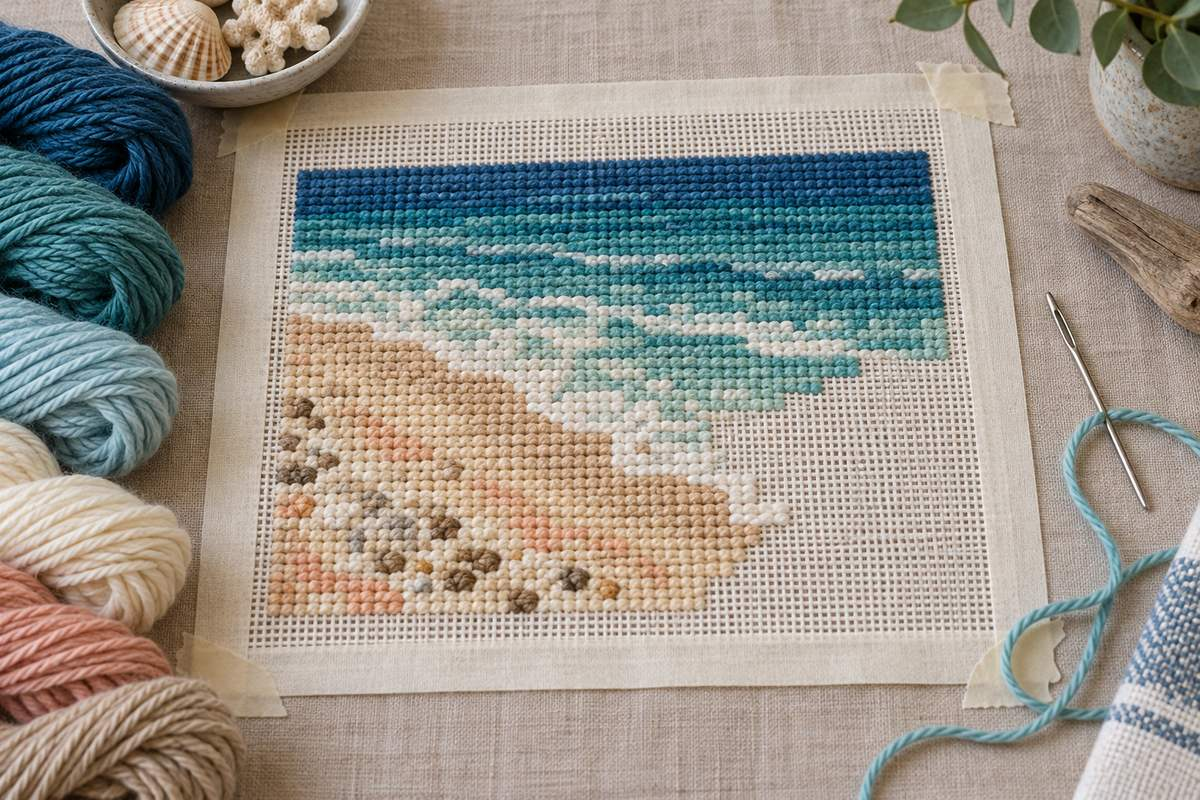
Sand is one of the hardest needlepoint textures because real sand is granular without a strong direction, while most threads are smooth and most stitches make clear lines. The answer is to mix slightly uneven thread with stitches that change direction, alternate units or encroach into one another. Smooth wet sand, dry lumpy sand and wind-shaped sand each want a different treatment. Last updated November 5, 2026.
Start here: Use tent stitch or encroached slanted Gobelin for smooth sand, Nobuko or Serendipity for broken texture, and Diagonal Victorian Step for subtle wind lines. Choose a heathery, linen, wool crepe or blended thread close to the painted sand color. Keep strong diagonals out of natural dunes unless the design deliberately shows a hard shadow.
Why sand is hard
Nuts about Needlepoint identifies the core problem: sand has uneven texture, while most needlepoint threads are smooth. It also has little direction, while many decorative stitches make obvious diagonal, horizontal or vertical lines.
That means a large area of perfect basketweave can look flat, while a bold geometric stitch can turn the beach into wallpaper. The best stitch breaks the surface without creating a repeated pattern stronger than the sand itself. Serendipity Needleworks separates smooth, wavy and lumpy beach textures; treat them as different surfaces instead of forcing one stitch across the whole canvas.
Threads that look like sand
Nuts about Needlepoint recommends a soft, slightly nubby thread. Its examples are wool crepe, Rainbow Linen and Flax n'Colors, with Rainbow Linen preferred. It also suggests slightly nubby lace- or sock-weight knitting yarns when their thickness fits the canvas.
If you cannot find a nubby thread, imitate the irregularity with color. Nuts about Needlepoint suggests hand-dyed or overdyed floss with two strands reversed, or a 50/50 blend of two similar floss colors. Our thread blending guide explains how to keep mixed strands even.
Serendipity Needleworks uses Rainbow Tweed for smooth sand. It describes that thread as a four-ply cotton, wool and acrylic blend whose uneven dye absorption gives a heathery surface. It recommends two plies on 18 mesh and all four plies on 13 or 14 mesh. Check coverage on your canvas rather than treating those numbers as universal.
Smooth sand stitches
For smooth sand near the waterline, Serendipity Needleworks chooses encroached slanted Gobelin. It is easy to work, easy to compensate and only slightly directional, so it suggests a little movement without turning the beach into stripes. Our Gobelin stitch guide covers the base stitch.
Tent stitch is the simplest option. Poppy Monk's Beach Break kit uses Tent stitch for most of the sand and offers T stitch in the top sand area. Tent stitch works when the painted canvas already carries the color changes and the sand is not the main texture. It is less successful when a large foreground needs visible grain.
Textured sand stitches
For dry, uneven sand, Nuts about Needlepoint recommends stitches that change direction, alternate stitch shapes or encroach into neighboring rows. Its direction-changing choices include Serendipity, Woven Plait and Criss-cross Hungarian. For alternating stitches, it names Double and Staggered Cross. For an encroaching texture, it calls Nobuko easy to stitch and visually effective.
Serendipity is a composite stitch. Serendipity Needleworks breaks it into left-slanting and right-slanting mosaic portions that fill one another's gaps. The finished pattern is broken enough to read as sandy texture, especially in a heathery thread. Use it when the sand area is large enough for the repeat to develop.
Nobuko is a good default for mixed dry sand because the rows encroach and break up a straight line. Our Nobuko stitch guide shows the structure. Double stitch fits smaller areas because its alternating cross units need less room to establish the pattern than Staggered Cross.
Wind lines and water edges
Wind can leave secondary lines across sand. Nuts about Needlepoint's choice for that effect is Diagonal Victorian Step because it creates subtle oblique lines. It warns against strong diagonal stitches for natural windblown sand; a hard diagonal reads more like fabric or shadow than a shifting dune.
Near the water, coordinate the sand with the water stitch rather than matching them. Poppy Monk's Beach Break model uses horizontal Hungarian for top water, horizontal Double Brick for middle water and an open woven variation for lower water. Those linear water textures leave the sand free to be quieter. Our sky and water stitch guide covers the water side in more depth.
At the shoreline, keep the wettest sand smoother and slightly darker than the dry upper beach. A change from tent or encroached slanted Gobelin near the water to Nobuko or Serendipity farther up the beach can make the transition without adding another color.
Painted lines and compensation
Many painted canvases include contour lines in the sand. Nuts about Needlepoint recommends stitching those lines in a different color of the same stitch used for the main sand. That keeps the surface unified while preserving the painted shape.
Choose a stitch that fits the spaces between the lines. If the areas are narrow, Double is easier to control than a larger Staggered Cross. When the stitch reaches a curved edge, preserve the pattern where you can and compensate only as much as the shape requires. Nuts about Needlepoint's practical advice is not to worry if the pattern gets off track: sand is supposed to look irregular. Our compensation guide covers the mechanics.
Where sources disagree
Is tent stitch enough? Poppy Monk's kit uses Tent stitch for most of its sand, with T stitch in one area. Nuts about Needlepoint favors more broken textures for sand because smooth thread and strong stitch direction work against the surface. Tent is enough when the painting supplies the texture; a decorative stitch helps when a large area needs it.
Should sand be directional? Encroached slanted Gobelin is slightly directional and Serendipity Needleworks uses that movement deliberately. Nuts about Needlepoint usually avoids a strong direction except for wind-shaped sand. Match the stitch direction to the scene: calm shoreline, dune ridge or windblown dry beach.
Do you need specialty thread? Nubby and heathery threads help, but Nuts about Needlepoint also gives a color-based workaround with reversed strands or blended floss. Thread texture is a shortcut, not a requirement.
Should compensation stay perfect? Poppy Monk warns when a compensating stitch breaks its Hungarian pattern on its model. Nuts about Needlepoint is more forgiving in sand, saying the surface is supposed to look irregular. Preserve the pattern where the repeat is visible, but do not force a full repeat into a tiny curved edge.
FAQ
What is the best needlepoint stitch for sand?Nobuko is a strong general choice for broken sand. Encroached slanted Gobelin works better for smooth sand, and Diagonal Victorian Step works for subtle wind lines.
What thread should I use for needlepoint sand?Use a soft nubby or heathery thread when one fits the canvas. Nuts about Needlepoint names wool crepe, Rainbow Linen and Flax n'Colors; Serendipity Needleworks uses Rainbow Tweed. Blended or overdyed floss is a good substitute.
Can I use tent stitch for sand? Yes. Tent stitch works when the painted canvas already shows color shifts and the sand is not the focal texture. Use a more broken stitch when a large beach area looks flat.
How do you stitch footprints or disturbed sand?Use a slightly darker shade of the same stitch for the depressed areas, or change to a smaller broken stitch such as Double. Keep the edges irregular rather than outlining every footprint in a hard line.
How do you stitch wet sand? Keep it smoother and darker than dry sand. Tent stitch or encroached slanted Gobelin works well, with the water stitch doing more of the visible texture work.
What stitch makes sand look windy? Nuts about Needlepoint recommends Diagonal Victorian Step for subtle oblique wind lines. Avoid a strong diagonal stitch unless the design calls for a hard shadow.
Sources
- Nuts about Needlepoint - Stitching Sand (a needlepoint expert and teaching site, updated April 2019; thread texture, stitch direction, Double, Nobuko and wind lines)
- Serendipity Needleworks - A Needlepoint Stitch for Sand (a needlepoint teaching site, August 2019; smooth-sand texture and encroached slanted Gobelin)
- Poppy Monk Needlepoint - Beach Break Stitch Guide (a needlepoint kit seller; its model's Tent and T stitch sand and coordinating water stitches)
- Unwind Studio - The Beach Needlepoint Kit Stitch Guide (a needlepoint kit seller; Hungarian variation, slanted Gobelin, Tent and Gobelin choices on a beach design)
- Serendipity Needleworks - To The Beach Needlepoint Stitches (a needlepoint teaching site, June 2019; Serendipity stitch structure and thread choices for sandy beaches)