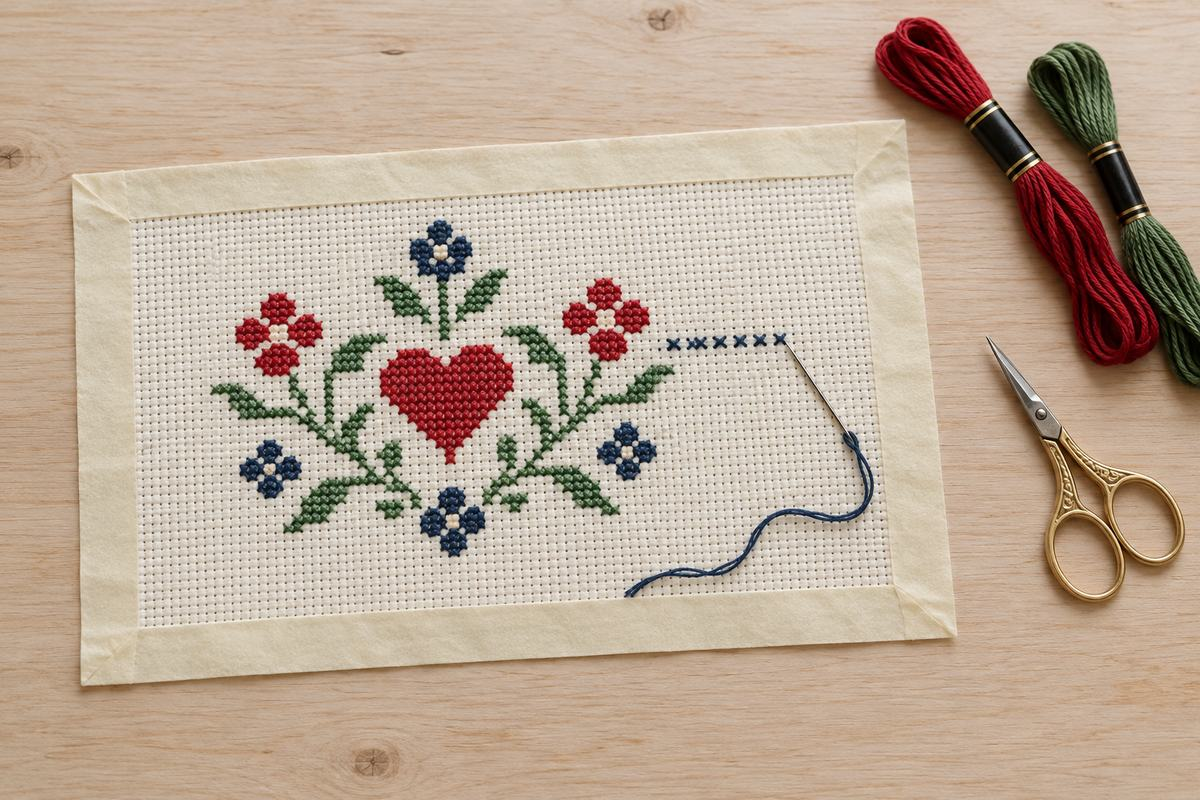
Most advice for left-handed cross stitchers says the stitch itself does not change. The cross is the same, the tools are the same and the chart is the same. What left-handers actually choose is which way to work a row, where to begin, and how to read instructions drawn for a right hand. This guide pulls together what three sources say, shows where they differ and explains the one rule they all share. Last updated November 13, 2026.
Start here: Cross stitch has one hard rule for everyone: make the top leg of every cross lean the same way across the whole piece. Which hand holds the needle, and whether you work left to right or right to left, is your choice.
Do left-handers need to stitch differently?
Often not. Floss Field, a stitching site, says the cross is the same whichever hand holds the needle, and that some left-handed stitchers follow ordinary instructions exactly as written, in rows from left to right. It adds that needles, hoops, frames, cloth and charts are the same for either hand.
Sarah White, writing on CraftGossip, reached the same view while looking into it for her left-handed daughter. She says the only difference she could see is that her daughter holds the needle in her left hand and the fabric in her right, and that her searching turned up no difference beyond how you hold the needle.
Stitch and Frog, a stitching site, makes a similar point from the other side. Its writer is right-handed but stitches the way a left-handed teacher showed her, and says what matters is being consistent.
Working a row from right to left
Floss Field gives a second way for anyone who finds the usual direction awkward. You work each row from right to left, and the finished crosses are the usual ones. It describes a row in two passes.
- First pass, the lower legs, right to left. Start at the right-hand end of the row. Bring the needle up at the top right corner of the first square and down at its bottom left. Move one square to the left and repeat to the end of the row.
- Second pass, the top legs, left to right. Come back along the row. Come up at the top left corner of the last square you stitched and go down at its bottom right. Then do the next square.
Floss Field says this is what an ordinary row looks like when the cloth and the chart are turned upside down, an adaptation often suggested to left-handed stitchers. You can turn the work and the chart, or keep them upright and stitch as it shows.
The one rule: top legs lean the same way
All three sources agree on this, in different words. Floss Field says it does not matter which leg lies on top, only that the top leg leans the same way in every stitch of the piece. Stitch and Frog says the same about the top stitches of the X. It gives its own order as an example: it starts at the lower right hole, and its last, top stitch goes from the left hole up to the right top hole.
Floss Field draws two practical points from this.
- Choose one way at the start and keep it. If you switch from the usual row to the right-to-left row partway through, check your first new cross against the ones you already made.
- Never turn the work a quarter turn. Floss Field says a half turn leaves a cross looking the same, with legs leaning as before, while a quarter turn makes the top leg lean the other way, so stitches added from there will not match.
For the basics of the stitch and the thread, see our cross stitch for beginners guide and guide to starting and ending thread.
Where to start
The sources do not give one answer. Cross stitch charts usually say to begin at the center, and Floss Field says to begin where the chart says, the same for everyone. Inside the design, it says to start a row at the end you work from. For the right-to-left row that is the right-hand end, so an area fills from the bottom up, which it describes as the usual top-down order turned half round.
CraftGossip notes that while many stitchers start from the center of a chart, left-handers might find it easier to start at the top left and work across from left to right and top to bottom. That is a suggestion, not a rule. Our guide to reading a cross stitch pattern explains how to find the center.
Reading right-handed instructions
Floss Field offers three ways to deal with diagrams and lessons drawn for the right hand.
- Turn the diagram upside down. For the cross, it says, a right-handed diagram turned upside down is a correct left-handed one, and since it is a half turn the legs lean as they should.
- Flip it. A mirror image also works for cross stitch, with one difference: the top legs will lean the opposite way from the diagram, and you read "left" for "right" in the words. A diagram copied onto clear film and turned over is a ready-made flipped copy.
- Learn face to face. If a right-handed person is teaching you, sit facing them, not beside them, because what you see is then already mirrored.
For stitches other than the cross, Floss Field points to the page for that stitch. If you also do needlepoint, our left-handed needlepoint guide covers continental and basketweave.
Hands and tools
Floss Field says that with the work on a stand, one hand stays above the cloth and one below, and that left-handed stitchers do it both ways round, so try each. It says small embroidery scissors usually suit either hand, while left-handed fabric scissors are worth having for cutting cloth. For the frame or hoop you pick, see our hoop and frame guide.
Where sources disagree
Whether anything changes at all. CraftGossip says the only difference is how you hold the needle. Floss Field agrees that nothing has to change, but it also lays out a right-to-left row and ways to turn or flip diagrams for stitchers who want them. These are options, not a contradiction.
Where to start. CraftGossip suggests the top left for left-handers. Floss Field says to start where the chart says. We found no source that tested either on a finished piece.
Turning the work. Floss Field says a half turn is safe and a quarter turn is not, and suggests turning chart and cloth upside down as one option. Stitch and Frog does not discuss turning the work. It only says to stay consistent.
Needlepoint kits. The Victorian cross stitch that Elizabeth Bradley, a needlepoint kit seller, publishes left-hand instructions for is a canvas stitch for needlepoint, not the cross stitch worked on Aida. Do not apply those diagrams to Aida.
FAQ
Do I need left-handed needles or hoops? Floss Field says needles, hoops, frames, cloth and charts are the same for either hand. It suggests left-handed fabric scissors only for cutting cloth.
Which leg should be on top? Either, per Floss Field, as long as every top leg leans the same way across the piece.
Can I stitch the whole thing upside down? Floss Field says a half turn is fine because the legs still lean as they did. Do not turn it a quarter turn.
Can I use a mirrored diagram? Floss Field says yes, but the top legs will lean the opposite way from the diagram, so check that against the rest of your piece.
Should I start at the center? Charts usually say so. CraftGossip suggests the top left may be easier for left-handers. Floss Field says to follow the chart.
Sources
This guide draws on the following sources. Where their advice differs, it says so above rather than blending them.
- Floss Field, stitching site: Left-handed cross stitch, flossfield.com. Source for the right-to-left row, the leg direction rule, the quarter turn warning, reading right-handed diagrams and the tool notes.
- CraftGossip, craft blog (Sarah White, August 11, 2016): Cross Stitch for Left-Handed People, cross-stitch.craftgossip.com. Source for the needle-hand observation and the top left start suggestion.
- Stitch and Frog, stitching site: Does It Matter Which Direction I Stitch In?, stitchandfrog.com. Source for the consistency rule and one stitcher's order.
- Elizabeth Bradley, needlepoint kit seller: Victorian Cross Stitch: Left Hand Instructions, elizabethbradley.com. Source for the note that its left-hand diagrams are for a needlepoint stitch.