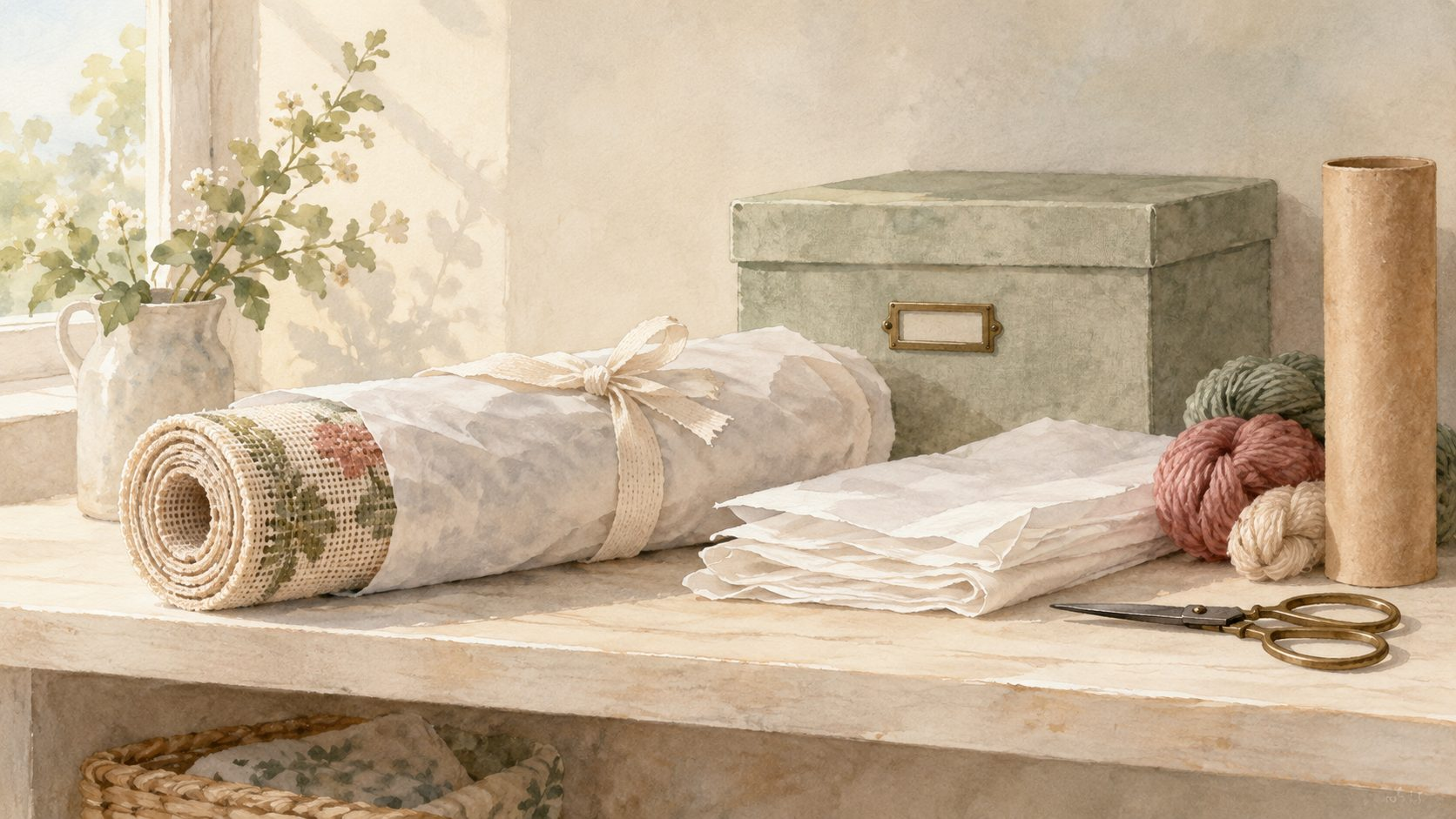
Needlepoint is a textile, so the same rules museums use apply at home: keep it clean, away from light and damp, wrapped in acid-free material, and not folded. Where the sources split is on rolling versus flat storage and on plastic containers.
Never fold a canvas. Roll it loosely around a tube, or lay it flat, and wrap it in acid-free tissue or clean cotton. Keep it out of sunlight, attics, and basements. Put the threads for the piece in the same place so the project can be restarted later.
Unfinished canvas
The Stitch Ladi sums it up as roll, do not fold. A fold develops creases along the mesh that are hard to remove, and on a painted canvas the fold can crack the paint. Its method: lay the canvas flat, put an acid-free tube at one end, and roll with even tension, painted side facing out, not so tight that it stresses the stitches and not so loose that it slides. Add a layer of acid-free tissue, then clean cotton or muslin, store the roll horizontally supported along its length, and put nothing on top, since weight compresses stitches and flattens texture. A plain cardboard tube works in a pinch, but cardboard is acidic over time, so wrap it first if the piece will sit there for months.
The Canadian Conservation Institute gives the museum version for rolled textiles. Cover the tube with Mylar or polyethylene sheeting, then wrap the roll in unbuffered acid-free tissue or prewashed cotton sheeting. Do not fold the textile before rolling, and do not roll without an inner tube. Tie the roll loosely in several places with white cotton tape, and attach an identification tag. It also warns that some flat textiles should not be rolled at all, such as those in poor condition with weak or detached parts or long raveling threads. Before storing, remove pins and staples, which stress fabric and rust, and make sure the piece is clean, since soil invites infestation. Our cleaning guide covers that step.
If you prefer flat storage, XStitch Magazine says flat prevents creases and distortion that are hard to fix later. Use a clean dry surface, put acid-free tissue between pieces, and drape a breathable cover such as a white cotton sheet or tissue over the top, not pressed down or wrapped tightly. If a piece does come out warped, blocking can fix shape, though The Stitch Ladi warns it cannot fully undo flattened texture from weight left on top.
Finished pieces
For ornaments, stockings, and tree skirts, Nuts about Needlepoint describes the approach it copied from museum practice: wrap items in acid-free tissue, then put them in plastic boxes with tops and no holes. The tissue keeps the textile away from acids in wood and paper and the box keeps bugs out. It names light, acid, and bugs as the main enemies of textiles, and for years kept pieces in cotton pillowcases before moving them into plastic boxes. If you have not yet finished the piece, see our guides to finishing an ornament, finishing a pillow, and framing.
PieceWork adds that folding is the biggest mistake with antique textiles because it creates weakness at the folds and corners. It says small textiles should be stored flat, large ones gently rolled, tapestries and rugs always rolled, and painted textiles neither folded nor rolled because paint can flake. Folding modern contemporary textiles is perfectly safe, it says, but antique heirlooms should be rolled with archival tissue or muslin.
Materials that help and harm
- Acid-free tissue. Gaylord Archival says regular tissue, cardboard, and wood are acidic and speed up deterioration, so paper-based storage materials should be acid-free. It adds that buffered paper should touch only plant-based fibers such as undyed cotton or linen, and everything else, including dyed textiles, should use unbuffered materials. PieceWork says buffered tissue suits plant fibers and suggests replacing tissue after a period because it can lose its acid-free quality. If unsure, ask the supplier. Wool is an animal fiber, so unbuffered is the safer match.
- Undyed cotton. Gaylord and PieceWork both say undyed cotton can replace paper products. Gaylord says to wash it in neutral detergent and run it through a second cycle without detergent.
- Cardboard tubes and boxes. Acidic. Line or wrap them (Stitch Ladi, CCI, Gaylord).
- Pens and markers. Gaylord says to avoid them near textiles and to label containers in pencil.
Light, heat, humidity, and pests
XStitch Magazine says to avoid attics and basements, where temperature and humidity swing, and to keep pieces away from direct sunlight, with UV-filtering blinds if the room has windows. Gaylord lists insects, mold, handling, light, heat, and humidity as the main hazards. The Stitch Ladi says a few weeks of direct sun is enough to start fading threads. Check stored pieces periodically for dust or moisture (XStitch Magazine), and keep the storage area clear of smoke and cooking fumes. A pest or mold problem should be isolated, per CCI, in a sealed polyethylene bag away from other pieces.
The project you are stitching now
The Stitch Ladi says a project in rotation needs something you will reach for daily: a bag with a closure that keeps out dust, pet hair, and lint, holding the canvas flat with threads and tools. It also says to keep the threads assigned to a piece with the canvas, because a project missing two colors months later tends not to get restarted. If you keep several projects, avoid stacking canvases, which crease each other. Our floss organization guide covers the thread side, and stretcher bars keep a canvas taut during stitching.
When the stitching is done, Final Curtain Finishing gives the same rule for waiting before finishing: roll the canvas loosely, never fold, wrapped loosely in acid-free tissue. Its shipping advice is a rigid tube or a well-padded flat box, never a padded envelope, because canvases bend and crease in transit. Do not trim the unstitched border before sending it to a finisher.
A simple storage checklist
- Finish or secure loose threads and remove pins (CCI).
- Make sure the piece is clean and dry before it goes away (CCI, Gaylord).
- Roll loosely over a wrapped tube, or lay flat, with acid-free tissue or clean cotton around it.
- Label the outside in pencil or with a tag, so you do not unwrap it to find out what it is (Gaylord, CCI).
- Choose a stable, dark, dry place and look inside now and then (XStitch Magazine, PieceWork).
Where sources disagree
Rolled or flat. The Stitch Ladi, CCI, PieceWork, and Final Curtain Finishing all favor rolling for canvas and larger textiles. XStitch Magazine favors flat storage for finished pieces waiting to be framed. PieceWork says small textiles should be flat and large ones rolled. Either beats folding. Choose by size and shelf space.
Which side faces out. The Stitch Ladi says roll with the painted side facing out. Final Curtain Finishing says the stitched side facing out. CCI rolls pile textiles with the pile outside. Sources do not agree on needlepoint, so choose one and avoid rolling so tightly that the stitches are crushed.
Plastic containers. Nuts about Needlepoint and PieceWork use lidded plastic boxes or tubs with tissue as a buffer, and PieceWork says to air the textiles regularly. Gaylord says wrapping or containing textiles in plastic film or containers can cause moisture condensation and mold and is not recommended, and CCI covers a tube with plastic film only as a partial acid barrier under tissue. If you use a plastic box, keep it dry, wrap the contents in tissue or cotton, and open it from time to time.
A cardboard tube. The Stitch Ladi says plain cardboard works in a pinch if wrapped for longer storage. CCI and Gaylord call cardboard acidic and recommend barriers.
Questions
Can I fold a needlepoint canvas for a trip?
Sources say not to. Folding creases the mesh and can crack paint on a painted canvas. A rigid tube or a flat box is safer, per Final Curtain Finishing.
Where should I keep finished needlepoint?
In a stable, dry, dark place in your living space, not an attic or basement, wrapped in acid-free tissue or clean cotton (XStitch Magazine, Nuts about Needlepoint).
Do I need special tissue?
Acid-free, and unbuffered for wool and dyed fibers, per Gaylord. Regular tissue is acidic.
Does Threaded store my physical canvas?
No. Threaded makes patterns and charts, so storage is up to you. Start a new one with the needlepoint chart maker.
Sources
- The Stitch Ladi: The best way to store needlepoint works in progress
- Nuts about Needlepoint: Storing needlepoint
- Canadian Conservation Institute: Rolled storage for textiles
- Gaylord Archival: Archival storage of textiles
- PieceWork: Safe storage, protecting historic needlework at home
- XStitch Magazine: Storing cross stitch and needlepoint
- Final Curtain Finishing: Prepare your needlepoint canvas for finishing