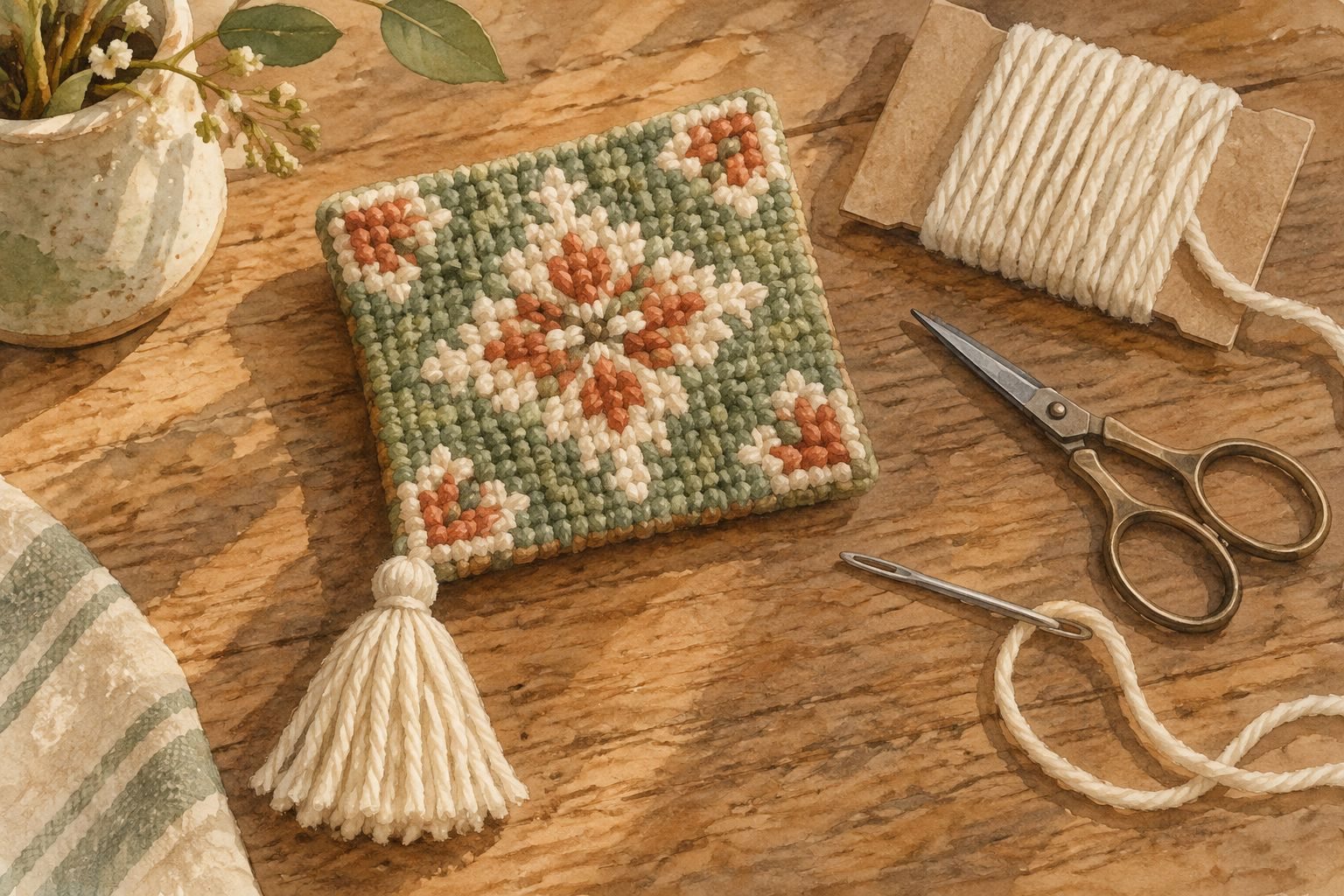
A tassel is a small finish that makes a stitched piece look done: on the corner of a pillow, the end of a bookmark, an ornament hanger. Every source describes the same core idea, which is to wrap thread round something, tie the top, and wrap a head. They differ on size, on how to tie the head, and on when to attach it. This guide covers the common ways to make one and to fix it to needlepoint. Last updated October 26, 2026.
Start here: wrap thread round a piece of card, slip a tie thread under the top and knot it, cut the bottom loops, then wrap a second thread about an inch below the top to form the head. NeedlepointTeacher.com and Sewing.org both describe this method. Decide before you finish the piece whether the tassel goes into a seam or is added afterward.
What you need
NeedlepointTeacher.com, a needlepoint instruction site, lists thread or yarn, cardboard, a needle and scissors. It says any thread can be adapted, including cotton, wool, acrylic, metallic and novelty threads, and suggests silver or gold metallic for a formal look and cotton or wool for a casual one. It also suggests combining two or more colors from the project, or tying the head in a different shade from the body. For matching wool, see our guide to separating Persian yarn.
The card-wrapped tassel
This is the method most sources use. In the version from Sewing.org, a sewing guide:
- Cut a piece of cardboard the length you want the finished tassel, and 4 inches wide.
- Wrap yarn snugly round the card until the tassel is as full as you want.
- Slip a 6 inch strand of yarn under the loops at the top edge and tie it. For a bead on top, make this strand longer so it can be threaded through the bead.
- Cut the loops at the bottom and remove the card. Leave them uncut and slide the bundle off if you want a looped tassel.
- Wrap yarn round the bundle where you want the head, and tie it off.
NeedlepointTeacher.com ends the same way. It wraps a thread about an inch from the tied end, threads it on a needle and runs it under the wraps and down the tassel. Then it trims the ends square, and with embroidery floss or other multi-strand thread, it separates the strands below the head. Tiny Modernist, a cross stitch shop, uses a card about 2 inches wide, wraps about 20 times, and ties the top with a 14 inch thread folded in half and pulled through its own loop. It wraps a second 14 inch thread round the tassel, passes the end through a loop and closes it to make the head.
The skein shortcut
Two sources skip the card and use the skein itself. SewCanShe, a sewing blog, pulls about 14 inches of floss and cuts it, then cuts a second piece about 28 inches long. It ties the shorter piece round the middle of the skein, removes the paper bands, folds the skein in half, and wraps the long piece round the top about half an inch from the fold. It stops with about 4 inches left, ties both ends in a tight knot that hides under the wraps, and cuts all the loops at the bottom.
Olive Jude, a home decor blog, does it with two 10 inch lengths. One is tied at the fold of the skein, and the other is wrapped near the top and knotted. It then wraps the extra length round the neck to make a thicker band, trims the ends, cuts the bottom loops and fluffs it. It says you can add a wood bead on top and make one in under 5 minutes.
Size and proportion
NeedlepointTeacher.com gives two rules of thumb: a 4 inch tassel should have a head about 1 inch across, and a 6 inch tassel a head of about 2 inches. A thinner tassel gets a smaller head and a thicker one a larger head, and the length and thickness of the thread should be in proportion. King Cole, a yarn maker, wraps 50 g of yarn round a coaster 30 times for a medium tassel, and says to wrap fewer times for a thinner one and more for a thicker one. Tiny Modernist says a wider card and more wraps make a bigger tassel.
Attach it to your needlepoint
Into a seam. The University of Kentucky site, in its needlepoint pillow instructions, makes tassels from yarn wrapped round 4 by 2 inch cardboard, tied at the top with a 6 inch strand. It places one in each corner of the pillow, pointing toward the center, before sewing the front and backing together. The Sewing.org describes the same tuck-in: tassel ends point toward the project, the hanger loop extends into the seam allowance, and you stitch close to the tassel with the head against the corner. It cuts the loop and knots it, with glue for security, so the tassel does not pull out. See our guides to finishing a needlepoint pillow and finishing an ornament.
After the piece is finished. Sewing.org says a tassel can be stitched on afterward by threading the loop into a large-eye needle, pulling it into the project and securing it with hand stitches. Tiny Modernist threads the top threads on a needle and attaches the tassel to the project. King Cole starts with the attachment instead: it doubles a 10 inch yarn through the corner of the project and ties it, builds the tassel, places the bundle between the tied yarn, and double knots it. Then it wraps the head with a 20 inch piece using a loop. King Cole writes for knit, crochet and sewn pieces, so test the corner method on spare canvas first.
Glued, for miniatures. Anna-Carin Betzen, on a miniatures site, makes a tassel from an overhand knot with extra threads inserted so the head stays small. She trims the top threads to a few millimetres, glues them to the back of a piece of needlepoint with tacky glue and covers the glued part with silk ribbon for a neater back. She also describes a stitched-on version, where half the strands run through the piece and an overhand knot ties them. It suits small pieces such as a bookmark or a keychain, and the back of a finished piece is covered in our guide to keeping the back neat. For the wider picture, see needlepoint finishing basics.
Where sources disagree
Card size. Sewing.org uses a card 4 inches wide. The University of Kentucky site uses 4 by 2 inches. Tiny Modernist uses about 2 inches wide, and King Cole uses a coaster. The card length sets the tassel length in every version, and the width mainly affects how many wraps you need.
Where the head goes. NeedlepointTeacher.com wraps about an inch from the tied end. SewCanShe wraps about half an inch from the top, and King Cole wraps about 1 cm below the top. Pick by the size you want, using the head proportions above.
How the head is tied. NeedlepointTeacher.com and the Sewing.org wrap and tie. King Cole and Tiny Modernist wrap through a loop and pull it tight. SewCanShe and Olive Jude knot the ends of a wrapped band. All end in a wrapped neck, and the loop methods leave no knot to show.
Before or after finishing. The University of Kentucky site and Sewing.org tuck tassels into a seam. King Cole builds on a tie at the corner, and Tiny Modernist and Sewing.org also describe attaching later with a needle. If you have already closed the seam, the stitched-on routes are the ones left.
Soft or hard. Sewing.org separates soft tassels, made only of yarn or fiber, from hard ones combined with beads or wooden shapes. Olive Jude adds a wood bead on top. The other sources make soft tassels only.
Common mistakes
- Missing loops. SewCanShe says to cut all the loops at the bottom, since there are lots of them.
- A loose top tie. In each method the tie at the top holds the tassel together, so knot it tightly. Sewing.org knots the hanger loop and adds glue for a tuck-in tassel.
- A head that is out of proportion. NeedlepointTeacher.com ties the head size to the tassel length and thickness.
- Leaving the loose ends ragged. NeedlepointTeacher.com and Tiny Modernist both trim the tassel ends evenly at the end.
- Adding it too late for a seam. The two seam methods need the tassel before the front and back are sewn together.
FAQ
What can I use to wrap a tassel?
Cardboard in NeedlepointTeacher.com, Sewing.org and the University of Kentucky site, a ruler or card in Tiny Modernist, a coaster in King Cole, or the skein itself in SewCanShe and Olive Jude.
How long does a tassel take?
King Cole says its method takes under 3 minutes, and Olive Jude says its floss tassel takes less than 5 minutes.
Can I add a bead?
Yes. Sewing.org says to make the top loop longer so it threads through the bead hole, and Olive Jude adds a wood bead.
Should the tassel be the same color as the design?
NeedlepointTeacher.com suggests combining two or more colors from the project, or tying the head in a different shade.
Can I make a tassel for a miniature?
Yes. Anna-Carin Betzen scales the strand counts down and glues the tassel to the back of the work.
Sources
- NeedlepointTeacher.com - How to Make Tassels (a needlepoint instruction site; cardboard method, head proportions)
- Sewing.org - Tassels (PDF) (a sewing guide; soft and hard tassels, tuck-ins, attaching)
- University of Kentucky (fcs.mgcafe.uky.edu) - Needlepoint (PDF) (a university guide; tassels in pillow corners)
- King Cole - How to Make and Attach the EASIEST Tassel (a yarn maker; written for knit, crochet and sewn projects)
- Anna-Carin Betzen - Easy-to-make tassels (btz.se) (a miniatures project; knot-head tassels glued to needlepoint)
- Olive Jude - The Easiest Embroidery Floss Tassels (a home decor blog; floss skein tassel)
- SewCanShe - How to Turn Embroidery Thread into Tassels (a sewing blog; skein tassel with a long wrap)
- Tiny Modernist - How to Make an Embroidery Thread Tassel (a cross stitch shop; card-wrapped tassel with a needle tail)