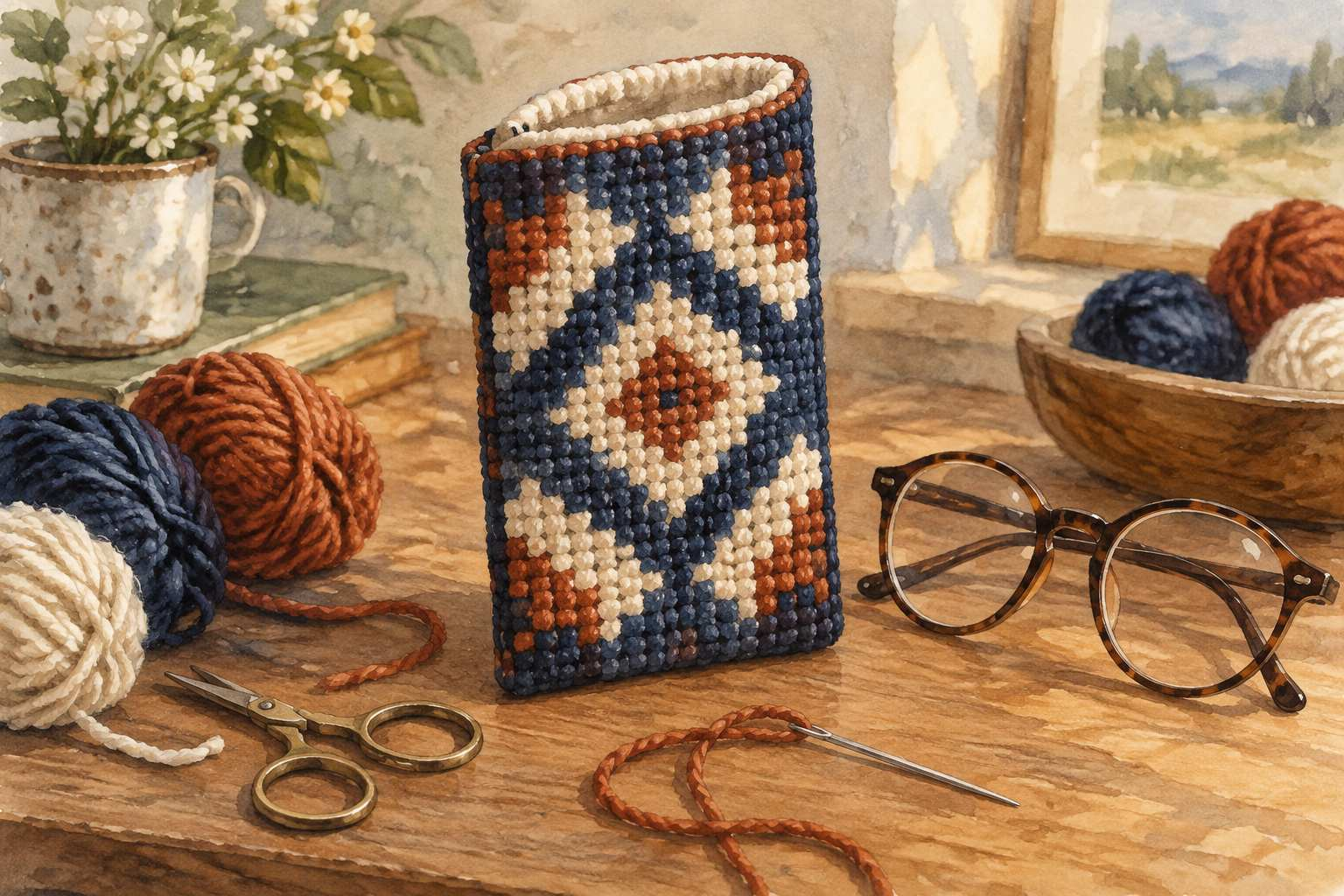
An eyeglass or sunglasses case is a practical finish, and it is also one that goes wrong in a specific way: the inside touches your lenses. The sources agree on that point. They differ on almost everything else, from how to close the edge to whether you need a sewing machine. This guide sorts the methods by the kind of canvas you have and says what each source actually described. Last updated October 27, 2026.
Start here: check whether your canvas is a double-sided piece, which folds in half, or a single front panel that needs a back. Block it, work a binding stitch round the edge, line it with something soft, and sew the sides. Unwind Studio describes this route with self-adhesive velvet for the lining and no cording. The rest of the sources are variations.
Which kind of canvas you have
Unwind Studio, a needlepoint designer and shop, separates the two types in its FAQ. In a double-sided canvas the piece is usually square, so the stitching shows on both sides of the case and you fold it in half. A one-sided canvas is only the front, so you attach it to a backing fabric. Its video tutorial covers only the double-sided type. If you started from a loose canvas of your own, you are in the second group. See needlepoint finishing basics for the wider set of finishes.
Prep: block and leave room
Unwind Studio says not to skip blocking if the canvas is not straight, since continental tent stitch is likely to distort the design. Needlepoint Finishing Fairy, a finishing newsletter, lists blocking as the first prep step for both its scissor and eyeglass case tutorials. Our guide to blocking covers how.
A commenter on r/Needlepoint, a forum thread, suggests stitching two extra rows of background as a seam allowance. The thread is three stitchers answering one question, so treat it as a tip rather than a standard. For how much bare canvas to leave, see how much extra canvas. A VirtuoSew Adventures post, from a stitcher who finished a canvaswork case, notes a worry about whether the panel would be big enough to fit around sunglasses. Measure the glasses before you stitch the size, not after.
Method 1: fold and sew
This is Unwind Studio's method for a double-sided canvas. It uses a binding stitch on the edges instead of cording and self-adhesive velvet instead of a sewn lining. Its steps:
- Work the binding stitch round the whole perimeter in a matching thread. Unwind says the same type of thread as the design is fine (DMC soft cotton in its example), and stranded cotton is common and a little more resistant.
- Cut the lining to the size of the design and stick it to the back of the canvas, smoothing out wrinkles and air bubbles. With regular fabric, sew it in instead.
- Fold the canvas in half with the lining inside. Sew all the edges except the one the glasses go in and out of.
- Sew along the line between the binding stitch and the design. Unwind used invisible thread to hide the stitches.
For the binding stitch itself, see our bookmark finishing guide, which compares sources on it. The Unwind materials list also includes a sharp sewing needle and scissors.
VirtuoSew Adventures finished a canvaswork case differently. It went round three sides with herringbone stitch, which also attached padding fabric to the back, and used a herringbone edging on the fourth. It folded the piece in half and joined the edges with satin stitch, and did not herringbone that seam because it became very difficult to stitch. It then stitched a drawstring pouch, the flimsy kind that comes with sunglasses, into the top edge so the glasses stay in. It says a bright strong case is not protective if the glasses fall out.
Lining that will not scratch
Unwind Studio says to use a soft, smooth fabric and to avoid rough or textured ones that could scratch lenses. It uses self-adhesive velvet, which is soft and needs no sewing. Needlepoint Finishing Fairy uses two fabrics in its scissor case: a velveteen for the back and a separate lining fabric for both sides. Its Finish Along class recommends silk, satin or lightweight cotton for the lining and cotton velvet, duck canvas or heavier cotton for the backing, with batting for front and back. The Charming Needle, a sewing blog, lines a fabric case with flannel or another soft fabric. Its case is not needlepoint, so use it as a lining idea only.
Method 2: a front panel and a back
This is the harder case. The r/Needlepoint poster who started the thread had a 6 by 3 inch stitched panel, no sewing machine, and said flipping a turned case is difficult. The plan was to bind stitch the panel, cover the back of the needlepoint with velvet, and sew a backing fabric on. One commenter said an awl helps because pushing a needle through stiff layers by hand is hard. Another named an Instagram tutorial for a case with backing and no cording that is machine sewn but could be hand sewn, and said it is a turn-out method, and said they push the corners out with a chopstick.
Needlepoint Finishing Fairy covers a fuller version. Its Finish Along class, taught by a guest instructor, uses a sewing machine and premade cording or self-welt cording, with a zipper foot, interfacing and batting. It describes a no-turn method meant to keep the canvas blocked. It also gives a cording length formula: height times 2, plus width times 3, plus a little extra to tuck in the ends. Most of both tutorials is paid, so this guide uses only what the public pages say. The scissor and eyeglass tutorial lists 9 strands of DMC floss made into cording with a cording maker, a small flat magnet, interfacing for a magnet pocket, and invisible thread or fishing line to attach the cording. It rates the difficulty 3 out of 5 and says to have finished a round ornament and to have hand or machine sewing experience first. See our ornament finishing guide.
Nuts about Needlepoint, an information site, takes a shortcut: buy a Stitch and Zip glasses case with a blank front, stitch the front, whipstitch the backing and zip it up. It suggests tracing a glasses outline onto the canvas with a Pigma Micron pen. This suits someone who does not want to sew a case from scratch.
Method 3: plastic canvas
Two sources use plastic canvas, which needs no blocking. Benzie Design, a design shop, makes a retro sunglasses case from 10 count canvas. Its pattern is two rectangles of 70 by 36 squares. It recommends cutting the canvas larger than the finished size and trimming after stitching. It joins the two sides with whip stitch round the perimeter in a border color, then continues along the top edge. It says the case is a slow project of 10 or more hours.
jennyhenrydesigns, a designer's blog from 2012, uses 7 count plastic canvas and adhesive-backed felt. It cuts a front and back of 20 by 40 holes, two sides of 8 by 35 and a bottom of 8 by 20, for a finished case of 3 by 6 by 1.5 inches. It cuts felt slightly smaller than each piece and joins the pieces with an overcast or whip stitch. It stitches with Sugar n Cream cotton yarn and notes one sheet makes two cases. For more on the material, see our plastic canvas guide.
Closures
An open top is the simplest, and Unwind Studio leaves one side open. VirtuoSew uses a drawstring pouch. For a magnet, Needlepoint Finishing Fairy puts a small flat magnet in a pocket made from two small pieces of interfacing. The Charming Needle uses a hidden magnetic snap, and says it moved to that after realizing that pressing a snap with glasses inside is not a good idea. It positions the magnets and pins the tabs first to check how the case closes, and checks that the magnets attract. Nuts about Needlepoint uses a zip. A tassel or cord edge is a decorative option; see how to make a tassel.
Where sources disagree
Edge finish. Unwind Studio uses a binding stitch and no cording. Needlepoint Finishing Fairy uses cording, either made from floss or premade. VirtuoSew uses herringbone and satin stitch. The plastic canvas sources use whip or overcast stitch. Cording needs more supplies and sewing skill, and the Finishing Fairy tutorials are rated 3 out of 5 for difficulty.
Sewing machine. Unwind Studio hand sews, with optional adhesive lining. The Finish Along class uses a machine. The r/Needlepoint thread says a machine is not required but that hand sewing through layers is hard, hence the awl.
Lining. Self-adhesive velvet (Unwind Studio), a velveteen back plus a separate lining (Needlepoint Finishing Fairy), silk, satin or lightweight cotton (its Finish Along class), flannel (The Charming Needle, not needlepoint) or adhesive felt (jennyhenry designs, on plastic canvas). All the fabric sources pick something soft.
Turn out or no turn. The Finish Along class describes a no-turn method meant to keep the canvas blocked, while a commenter in the forum thread describes a turn-out method and uses a chopstick to push it out. The original poster found turning difficult.
Eyeglass or scissors. Needlepoint Finishing Fairy says its scissor case process can be followed for an eyeglass case, including the magnet. Size is the main change, so measure your own glasses.
Common mistakes
- Skipping blocking. Unwind Studio says tent stitch can distort the canvas and that it matters for a straight case.
- A rough lining. Unwind Studio says to avoid rough or textured fabrics because they can scratch lenses.
- Stitching the panel too small. The VirtuoSew post worried about fit after the work was done.
- Hand pushing a needle through stiff layers. A forum commenter suggests an awl.
- A snap that presses on the glasses. The Charming Needle moved to a hidden magnet for that reason.
FAQ
Can I finish a case without a sewing machine?
Yes. Unwind Studio's method is hand sewn with adhesive velvet, and the plastic canvas methods are whip stitched.
What lining is safe for lenses?
Unwind Studio recommends soft, smooth fabric such as self-adhesive velvet and warns against rough or textured fabric.
Do I need cording?
No. Unwind Studio uses a binding stitch instead. Needlepoint Finishing Fairy uses cording, and its Finish Along class gives a length formula.
Can I use plastic canvas?
Yes. Benzie Design and jennyhenrydesigns both made cases that way, and neither needs blocking.
Is a scissor case the same process?
Needlepoint Finishing Fairy says its scissor case tutorial can be followed for an eyeglass case, including the magnetic closure.
Sources
- Unwind Studio - How to Finish a Needlepoint Sunglasses/Eyeglasses Case (a needlepoint designer and shop; binding stitch, adhesive velvet lining, sewn edges)
- Unwind Studio - Your Top Needlepoint Finishing FAQs (the same shop; lining fabric, one-sided and double-sided canvases)
- Needlepoint Finishing Fairy - How to: Finish Scissor or Eyeglass Case (a finishing newsletter; the paid tutorial's public materials list)
- Needlepoint Finishing Fairy - Finish Along: Eyeglass Case (the same newsletter; the paid class's public prep and materials list)
- Benzie Design - Needlepoint Tutorial (a design shop; plastic canvas sunglasses case, whip stitched)
- jennyhenrydesigns - DIY Needlepoint Eyeglass Case (a designer's blog, 2012; seven count plastic canvas with felt)
- VirtuoSew Adventures - Finishing my canvaswork sunglasses case (a stitcher's blog; folded canvaswork with herringbone edges)
- Nuts about Needlepoint - Make An Adler-Inspired Sunglass Case (a needlepoint information site; zip case with a blank front)
- r/Needlepoint - Finishing tutorial help - glasses case (a forum thread; three stitchers' tips, not expert advice)
- The Charming Needle - Eyeglass Case Tutorial (a sewing blog, 2012; a fabric case with a hidden magnet, not needlepoint)
- KC Needlepoint - Virtual Class: Bright Self Finishing Eyeglass Case (a shop; video class for a self-finishing kit)