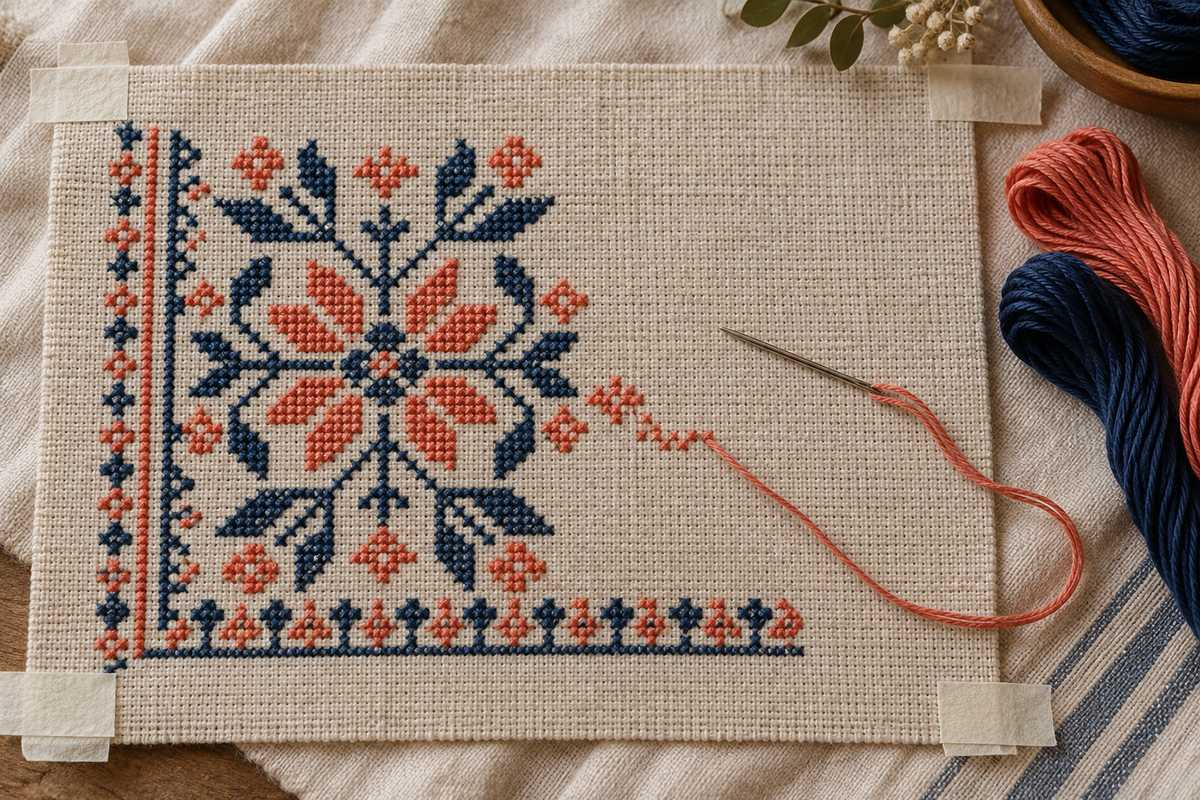
Linen cross stitch is not a different stitch. It is the same X worked on a plain weave fabric instead of Aida blocks. The change is in the counting: most linen is stitched over two threads, so 28-count linen gives the same finished size as 14-count Aida. Linen gives a softer drape and a more refined surface, but it asks for better light, careful counting and a tidy first stitch. Last updated November 5, 2026.
Start here: For a first linen project, choose 28-count linen, two strands of floss and a size 24 tapestry needle. Stitch over two threads. Find the center, start beside a vertical thread that lies on top at the crossing above, and use a hoop or frame without stretching the weave out of square.
Why linen feels different
Aida groups its threads into visible blocks, so each block reads as one stitch square. Linen is a plain weave of single warp and weft threads. Floss Field describes evenweave and linen as cloth with the same number of threads per inch in both directions; linen is woven from flax and its threads are usually less uniform than a smooth evenweave blend.
That structure changes the finished look. Stitched Modern says linen's higher thread count gives cross stitch a finer, more refined surface than Aida. It is also softer and has more drape. The Cross Stitch Guild cautions that linen is not automatically finer or harder to see: it comes in several thread counts, so choose one you can count comfortably.
Linen is a good step after Aida when you want a less obvious background grid. It is not a requirement for advanced stitching. Our evenweave vs Aida guide covers the broader fabric choice; this guide is about working on linen once you have chosen it.
Count linen the right way
Fabric count means threads per inch. Stitched Modern lists common linen counts from about 22 through 40 or more, with 28-count and 32-count the most common. Because one cross normally covers two linen threads in each direction, divide the linen count by two to get the finished stitches per inch.
- 25-count linen over two gives 12.5 stitches per inch.
- 28-count linen over two gives 14 stitches per inch, the same size as 14-count Aida.
- 32-count linen over two gives 16 stitches per inch, the same size as 16-count Aida.
To substitute linen for Aida, double the Aida count. A pattern sized for 14-count Aida needs 28-count linen; a pattern sized for 16-count Aida needs 32-count linen. Peacock and Fig gives the same finished-size formula: divide the design's stitch count by the stitches per inch, then add your finishing margin. Our cross stitch size calculator guide walks through that math.
How to stitch over two
Over two means each leg of the cross passes over two threads across and two threads up. Floss Field suggests picturing a three-by-three square of holes. The cross uses the four corner holes; the center hole stays empty.
- Bring the needle up at the lower-left corner of the stitch.
- Count two threads right and two threads up, then go down.
- Come up two threads directly below that point.
- Go down two threads above the first hole to finish the X.
For a row, you can work the first legs across and return to complete the crosses, just as you might on Aida. Keep checking that the center hole of each stitch is empty. If it is filled, you have drifted into over one counting.
Place the first stitch
Linen's threads pass over and under one another. Stitched Modern recommends starting beside a vertical thread that passes over the horizontal thread just above your starting hole. Its memory phrase is that the first stitch should be "leaning against the post."
Floss Field explains why this works: the first leg rests against an upright thread, which holds it neatly in place. You only need to make this check once. Later stitches are whole numbers of two threads away, so they land in the same relationship to the weave.
Handling, light and edges
Linen is softer than Aida, so a hoop or frame can make the weave easier to see. Stitched Modern recommends pulling the linen taut without stretching it enough to distort the weave. Q-Snap frames are one option; the important point is even, gentle tension.
Use strong light, and consider magnification on 32-count or finer. Count threads rather than holes. For a large design, a gridded line every ten stitches reduces recounting; see our fabric gridding guide. Bind or tape the cut edges before you start, because linen and evenweave fray more readily than stiff Aida.
Finished linen can be gently hand washed in cold water with a light detergent, according to Stitched Modern. Test hand-dyed fabric and floss first, then follow our washing and care guide.
When to stitch over one
Over one means each cross covers one thread in each direction. On 28-count linen that produces 28 stitches per inch, so the design is half as wide and half as high as it would be over two. It is used for fine detail, small pieces and patterns designed specifically for over-one work.
Floss Field recommends fewer strands, often one, and completing each cross before starting the next. On a single-thread weave, half-stitch rows can slide under the fabric threads. Peacock and Fig notes the same sliding risk. If you are new to linen, learn over two first; over one is a separate skill, not a mandatory upgrade.
Where sources disagree
Is linen different from evenweave? Floss Field separates the terms by fiber: linen is flax, while evenweave is often a smoother cotton or rayon blend. Many shops use the words loosely. For counting, they behave the same; for color, texture and dye variation, check the actual fabric.
Do you need a hoop? Stitched Modern recommends a hoop or frame for a first linen project. Some experienced stitchers prefer working in hand. A hoop helps you see the weave, but it is not part of the stitch. Use the lightest tension that keeps the fabric readable.
How many strands should you use? Floss Field's table gives two strands for 25, 28 and 32 count over two, while noting that some published charts give three strands on 25 count. Coverage depends on thread brand and color as much as the count. Stitch a small sample before changing the pattern.
Is over one always better detail? It gives smaller stitches, but Peacock and Fig and Floss Field both warn that the stitches can slip under the weave. Detail improves only if the pattern was designed for that scale and you can keep the crosses aligned.
FAQ
Is linen harder than Aida? It is slower at first because the grid is less obvious. The stitch itself is the same. Start with 28-count linen and strong light.
What linen equals 14-count Aida? 28-count linen stitched over two gives 14 stitches per inch, the same finished size as 14-count Aida.
What needle should I use on linen? Floss Field lists a size 24 tapestry needle for 25 and 28 count over two and size 26 for 32 count over two, with two strands of floss.
Where should I start a linen project? The Cross Stitch Guild and Stitched Modern both recommend starting from the center of the fabric and chart. On linen, also place the first stitch beside the correct upright thread so it leans against the post.
Can I stitch a pattern over one on linen? Yes, if the pattern supports it. One strand is common, and completing each cross before moving on helps keep stitches from slipping under the weave.
Can I wash linen after stitching? Stitched Modern says finished cross stitch on linen can be gently hand washed in cold water with light detergent. Test dyed fabric and thread first.
Sources
- Stitched Modern - How to Cross Stitch on Linen Fabric (a cross-stitch shop and teaching site, September 2017; counts, first-stitch placement, handling and washing)
- Floss Field - How to Cross Stitch on Evenweave and Linen, Over Two Threads (a cross-stitch educational reference; over-two counting, count table, first stitch and over-one cautions)
- The Cross Stitch Guild - Stitching on Linen (a needlework teaching organization; center-start and strand-count example)
- Peacock and Fig - Stitching Over One Versus Over Two (a cross-stitch designer and tutorial site, June 2019; size formula and over-one sliding risk)
- DMC - Step by Step Cross Stitch Guide (a thread manufacturer reference; standard cross-stitch formation)