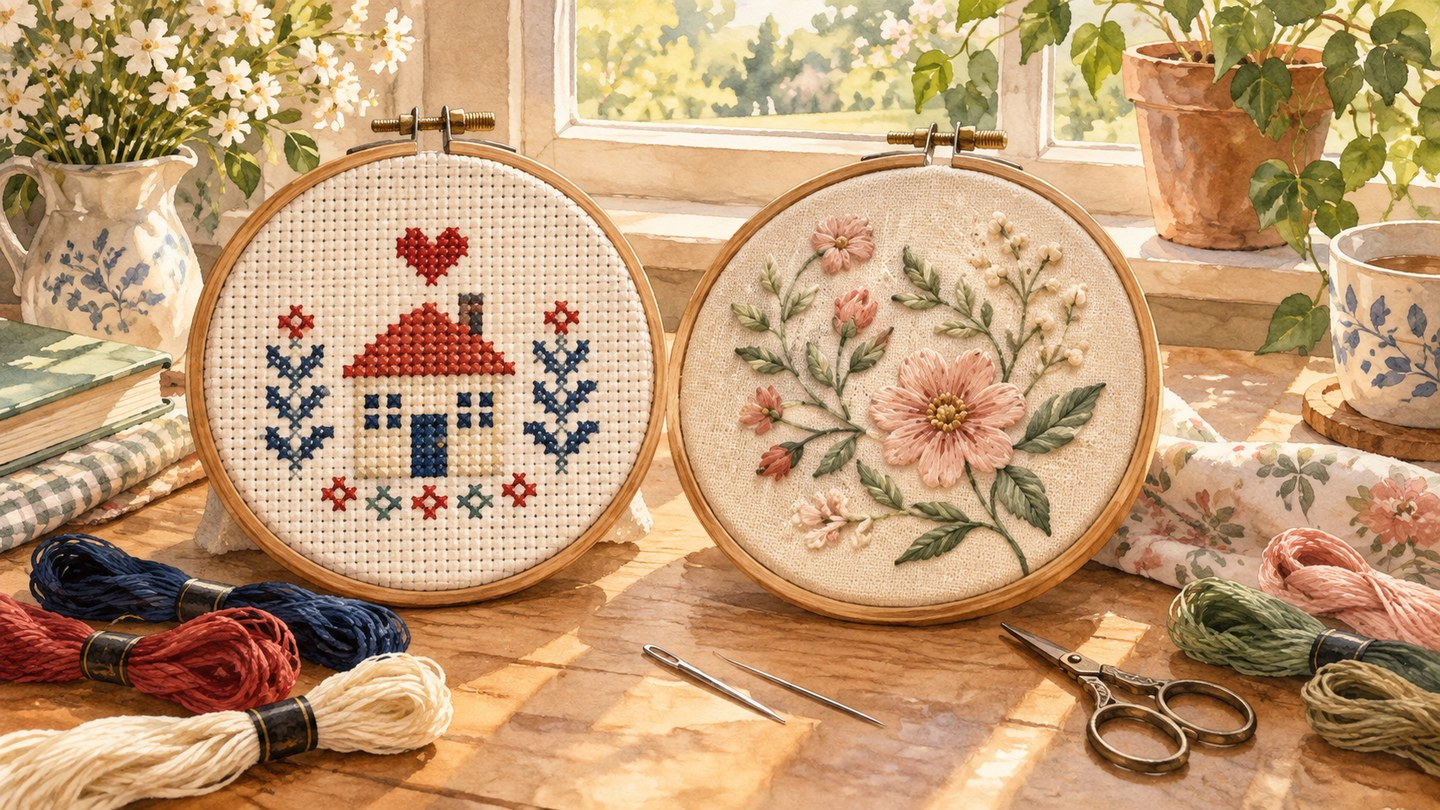
Cross stitch and hand embroidery share a needle, a hoop, and the same skeins of floss, which is exactly why they get confused. They are different crafts with different rules: one fills a grid of squares with x-shaped stitches to build an image like pixel art, the other draws freely on plain fabric with dozens of stitches like a painting. This guide breaks down how they differ in fabric, needles, thread, and patterns, what each one is good at, and which one to pick up first.
Cross stitch is counted and gridded: you follow a chart and place x-shaped stitches into the holes of evenweave fabric. Embroidery is freeform: you transfer or draw a design onto any fabric and stitch over it with whatever stitches suit the line or fill. Everything else, needles, thread, difficulty, and cost, follows from that one difference.
The core difference
Cross stitch is a form of counted needlework. Every design is a grid of colored squares, and each square becomes one x-shaped stitch on a fabric woven with evenly spaced holes, called aida, evenweave, or linen. You count squares on the chart, count holes on the fabric, and the image emerges like a mosaic. A full pattern uses surprisingly few stitch types: whole cross stitch, half cross stitch, fractional stitches, backstitch for outlines, and the occasional French knot. That is the entire vocabulary for most charts.
Hand embroidery is the broader art of decorating fabric with a needle and thread. There is no grid and no required fabric structure. You draw or transfer a design onto cotton, linen, denim, or nearly anything else, then fill and outline it with stitches chosen for effect: satin stitch for smooth fills, stem stitch for curves, lazy daisy for petals, seed stitch for texture, and dozens more. Where cross stitch gives you one shape repeated thousands of times, embroidery gives you a toolbox and asks you to improvise.
One sentence version: cross stitch builds pictures out of squares, embroidery draws pictures with thread.
How the finished pieces look
You can tell the two apart from across a room. Cross stitch has a distinct blocky, pixelated character because every mark is the same x snapped to the same grid. Fine curves become stair steps, and shading happens by swapping whole squares of color. That geometry is not a limitation so much as a style: it is why cross stitch suits samplers, lettering, folk motifs, and anything that benefits from crisp repetition.
Embroidery reads like an illustration. Stitches can be long or short, dense or sparse, raised or flat, so a stitched petal can have a smooth satin center, a lazy daisy edge, and a stem stitch outline in the same flower. Very small or highly detailed subjects that would turn to mush on a cross stitch grid, a bird's feathered cheek or a script signature, are exactly where embroidery shines. The tradeoff is that embroidery asks you to make those rendering decisions yourself, stitch by stitch.
Fabric: aida vs almost anything
Cross stitch requires fabric with an open, even weave: the holes are the grid. Aida is the standard, a stiff cotton woven in visible blocks, with evenweave and linen as finer alternatives. Fabric is sized by count, meaning stitches per inch: 14 count aida fits 14 stitches in an inch, 16 count fits 16, and 18 count fits 18. The lower the count, the larger the stitches and the larger the finished piece. The same 36 stitch wide motif measures about 2.6 inches on 14 count and exactly 2 inches on 18 count, which is why our size calculator divides stitch count by fabric count. Fourteen count is the forgiving beginner standard; Threaded builds its patterns around 14 count for the same reason.
Embroidery fabric is the opposite: dense and hole-free, usually a smooth cotton or linen that takes a transferred design well. Because the needle pierces the weave wherever you push it, the fabric just needs to be stable and opaque enough to hold stitches without distorting. This also means embroidery can live on finished objects, a shirt pocket, a tote bag, a denim jacket, where no aida could ever go.
The loophole worth knowing: waste canvas and soluble canvas add a temporary grid to any material. Tack it onto a sweatshirt, cross stitch through it, then pull or wash the canvas away. It is how cross stitchers put counted designs on clothing, and it is the closest the two crafts come to sharing a fabric.
Needles: blunt vs sharp
The fastest way to tell the crafts apart at the supply wall is the needle. Cross stitch uses a tapestry needle: a large eye with a blunt, rounded tip. The blunt point is a feature, not a compromise. It slides into the existing holes of aida instead of piercing threads, which keeps stitches uniform and stops the needle from splitting the fabric or previously stitched floss. Sizes 24 and 26 are the common workhorses and the right starting point for 14 and 18 count respectively. The one exception is fractional stitches, which end in the middle of a square rather than at a hole; many stitchers keep a sharp crewel needle on hand just for those.
Embroidery uses a crewel (embroidery) needle: sharp pointed, so it can enter the fabric anywhere along a drawn line. A sharp tip would be a liability on aida and a necessity on dense cotton, which neatly sums up the whole comparison.
Thread and floss
Here the crafts finally agree: both run on six strand stranded cotton, the same DMC or Anchor skeins sold everywhere. The difference is in how you use it. Cross stitch almost always works with one or two separated strands, matched to the fabric count, so the x lies flat and covers the square without bulging. Our floss calculator covers strand counts and skein math in detail. Embroidery varies the strand count for effect: one strand for fine detail, three for a bold outline, all six for chunky fills. One caution in the other direction: perle cotton and other non-divisible threads are embroidery threads only. They cannot be separated into strands and will not sit properly in a cross stitch grid.
Charts vs transfers
A cross stitch pattern is a chart: a grid of colored or symbol-marked squares with a key mapping each symbol to a floss number. In counted cross stitch, the most common kind, the fabric starts blank and you count from the chart, often gridding the fabric with a removable pen every 10 stitches to keep your place on large pieces. In stamped cross stitch, sometimes called no-count, the design is printed directly on the aida and you stitch over the printing, a friendlier start for kids and absolute beginners.
An embroidery pattern is a line drawing. You transfer it onto the fabric with a heat erasable pen, a light box, a water soluble stabilizer, or an iron-on transfer, then stitch over the lines however you like. Two stitchers can start from the same transfer and produce visibly different pieces, because the pattern specifies shapes, not stitches.
This is also where the digital tools differ. Embroidery digitizing converts artwork into machine stitch files, a different world entirely. Cross stitch software converts a photo or image into a counted chart with a thread list, which is exactly what Threaded's pattern maker does: upload a photo, get a stitchable grid matched to real floss colors.
Which should you start with?
Cross stitch is generally the easier entry point, and it is not close. The stitch vocabulary is tiny, the chart tells you exactly where every stitch goes, the fabric tells you exactly where to put the needle, and mistakes are easy to spot and unpick. A beginner can finish a satisfying first piece in a weekend having learned one stitch. The structure that makes cross stitch restrictive later is what makes it relaxing at the start.
Embroidery rewards the stitcher who wants freedom: drawing your own designs, stitching on clothing, mixing textures, and building a personal style. The learning curve is gentler than it looks if you start with five or six core stitches, but the craft never stops offering new ones, which is either the appeal or the overwhelm depending on your temperament.
Practical guidance:
- Choose cross stitch if you like following patterns, want meditative repetition, love the pixel look, or plan to stitch from charts, including photo conversions.
- Choose embroidery if you want to draw with thread, decorate clothes and objects, or chafe at the idea of counting squares.
- Choose both eventually. The floss, hoops, and habits transfer completely, and backstitch lettering, fractional stitches, and French knots already live in both worlds. Many stitchers cross stitch their pictures and embroider their clothes.
If the counted, charted side of this comparison sounds like your craft, Threaded's cross stitch pattern maker turns any photo into a stitchable chart with a matched DMC thread list, so your first project can be a subject you actually care about. Curious how cross stitch compares to its other close cousin? We have separate guides on needlepoint vs cross stitch and needlepoint vs embroidery.
Questions
Is cross stitch a type of embroidery?
Technically yes: cross stitch is one counted technique inside the broad family of embroidery. In everyday craft usage, though, "embroidery" means freeform surface embroidery, and the two are treated as separate crafts with separate supplies, patterns, and communities.
Is cross stitch easier than embroidery?
For most beginners, yes. Cross stitch has a handful of stitch types, a chart that dictates every placement, and gridded fabric that prevents wandering stitches. Embroidery asks for more decisions from the first stitch: which stitch, which direction, how many strands, how dense a fill.
Can I use the same thread for cross stitch and embroidery?
Yes. Six strand stranded cotton, the standard DMC or Anchor skein, serves both. Separate one or two strands for cross stitch, and vary the count for embroidery effects. Avoid non-divisible threads like perle cotton for cross stitch.
Can I cross stitch on normal fabric or clothing?
Yes, with waste canvas or soluble canvas: a temporary gridded layer you stitch through and then remove thread by thread or with water. It is the standard way to add counted designs to sweatshirts, tote bags, and baby clothes.
Do I need a hoop for cross stitch or embroidery?
A hoop or frame helps both crafts by keeping fabric taut, but stiff 14 count aida is workable in the hand without one, and many cross stitchers stitch large pieces in a scroll frame or with no frame at all. Embroidery on soft cotton benefits more from a hoop, since untensioned fabric puckers under dense fills.